
Digger fever has taken the nation by storm. Alejandro González Iñárritu’s latest has been a tornado of discourse, drawing spirited arguments between devout zealots and bitter haters. There are very few people who feel moderate or normal about Digger. My hypothesis is that because Digger circles the ways we use art to confront our own helplessness, it has become a stand-in for something much larger and more nebulous. I’ve started using Digger as shorthand for our growing uncertainty about how to live in a world that seems to be falling apart. At its core, Digger is a satire about how we engage with a world that seems to be getting worse by the day, and how little we seem to know about what to do with it. In that helplessness lies our own desperation to find answers through art, and that makes the film particularly topical. Although Digger currently carries the discourse crown, several other new releases this year have been grappling with that exact same conversation.
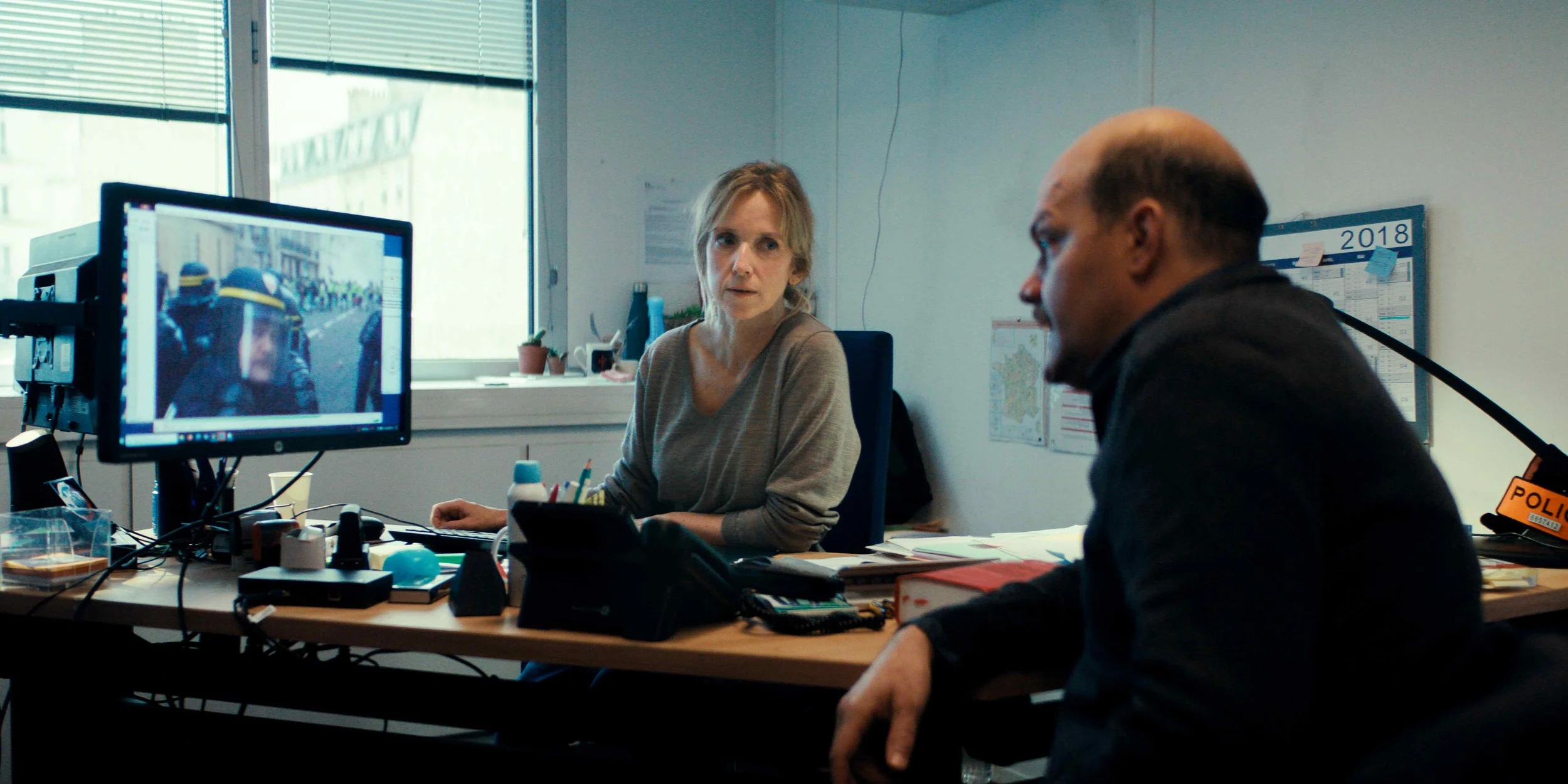
Dominik Moll’s latest film, Case 137, which competed at Cannes in 2025, belongs in that same conversation, although his approach is far more personal. His feature follows a police officer named Stéphanie (Léa Drucker), who is investigating a case of police violence during France’s Yellow Vest protests. Moll initially viewed the protests through media coverage that emphasized violence, but eventually came to recognize that there was more to the movement. “It took me some time to understand that behind it was a real need for those people to be seen,” Moll tells me about his changing understanding of the protests. Through Stéphanie’s investigation, Moll brings his own uncertainty to the screen. Case 137 is Moll’s approach to reckoning with protest and authority, using film to better understand the world around him.
It’s difficult to separate Case 137 from Moll’s own relationship to the events that inspired it. His initial uncertainty about the Yellow Vest movement and his frustration with the way those in power abuse their authority give the film a more personal dimension. Case 137 is a living example of Moll’s attempts to make sense of the world through art, reflecting the same desire for understanding that has made Digger so magnetic. To better understand Case 137, I chatted with Moll about his relationship with protest and authority, how his perspective has changed over the years, and what it means to make art as a way of understanding the world rather than simply passing judgment on it.
This interview has been edited for length and clarity.
Ali El-Sadany: Just to start, I’d love to know a little more about your relationship to the Yellow Vest movement and what was actually happening. I know that in previous interviews, you talked about how you felt like you passed by it, and that it took some time for you to reckon with the legitimacy of what people were trying to express.
I’ve grown up in the age of the internet, where I’m constantly seeing protests and atrocities happening across the world, and sometimes it’s really hard to stop and actually think about why we’re doing the things we do. I’d love to know more about your relationship with that and about the experience of making a movie, because I think making a film really forces you to sit with the motivations behind protests and the state of the world.
Dominik Moll: When the Yellow Vest movement started at the end of 2018, it took everybody by surprise. Not only the government, but the whole country. It started as a small thing based on gas prices getting more expensive, and suddenly it spread like wildfire all over France.
Nobody expected that because there was no political organization behind it, no union. It was many individuals who, partly through the internet, realized they had the same kinds of problems and questions. Then they had this idea of putting on the high-vis vests, which gave them a strong visual identity. At first, they occupied roundabouts, and there was something about recreating a sense of community. In an age of very strong individualism, suddenly there was a common goal and a common political movement.
It was mostly outside Paris, in small towns and rural areas. Then, every Saturday, they started demonstrating in Paris. The government didn’t really know how to handle it because they didn’t know whom to talk to. Many of the Yellow Vests had never participated in demonstrations before, so they didn’t necessarily know the usual way of doing it. They didn’t declare beforehand that they were going from here to there. They were all over the place, and many of them went to the Champs-Élysées.
A lot of people, myself included, didn’t really know what was behind it. Was it a populist movement? Was the far right behind it? On the news, you mostly saw images of burning cars, which did happen, but that was of course not the whole thing. Most of the protesters were peaceful. The way the news portrayed the movement was quite one-sided because it stressed the violence, so everybody was asking, “What is this? What is going on? What do these people really want?”
It took me some time to understand that behind it was a real need for those people to be seen. That’s why they put on the high-vis vests. They wanted to be seen and heard. They wanted to participate in a society and democracy from which they felt excluded. France is very centralized, and most political decisions are made in Paris, which is also why they converged there.
The government was in a kind of panic. It felt as though the 1789 Revolution was starting all over again, so they reacted with strong police repression. In France, the police are more heavily armed than in some other European countries, and as soon as there are arms in the hands of police officers, there will be people who are wounded, sometimes severely.
It took me some time to process all of this. Then, after this movement that really shook France and was something very historical, there was the pandemic, which was almost like a sponge erasing the whole movement.
When I started thinking about the film, I didn’t tell myself that I wanted to make a film about the Yellow Vest movement. I wanted to make a film about internal affairs. How can the police control the police? How is it possible to police the police? I also wanted to talk about police violence. When I started working on the film in 2023, there were many demonstrations around retirement laws and other things, and again the police reacted in a very repressive and violent way.
I felt that the way the police behave, or are used by political power, tells you something about how society works or doesn’t work. I wanted to find a story that could tackle those topics, and I realized it made sense to set it within the Yellow Vest movement. At that point, nobody was talking about it anymore, almost as if it had never happened and the problems expressed by the movement were no longer there, which of course wasn’t true.
I also had some distance from it. As a filmmaker, especially when you’re making fiction, it’s difficult to react right on the spot when something happens because making a film takes time. This had happened four years earlier, so there was time to process it and include it in a fiction film.
AE: One of the things you said that really resonated with me is that while this is about the Yellow Vest movement, it also feels like it’s about so many other things. It’s a reflection of power and how power becomes concentrated.
I’d love to hear more about your own relationship with protests. How did you view them before making the film, during the process, and afterward? Did your opinion shift at all?
DM: I think protests and demonstrations are part of our democracy and should be considered one way of expressing discontent.
Right now, for example, there’s a high school movement where students are blocking their schools because many of them, especially those living in the suburbs, don’t have enough teachers or proper facilities. They’re saying, “We want proper conditions to learn.” Again, the first reaction of the government is to send the police against kids who are 14, 15, or 16 years old. People have already been severely injured.
I really think there’s something wrong with a country where the only response to demonstrations is the use of force and violence rather than trying to understand what’s behind them, trying to have a dialogue, and trying to find solutions.
I myself only participate in demonstrations once in a while. I don’t feel very comfortable in crowds. But I strongly feel that demonstrations are necessary and that the response should not be the one the French government offers.
AE: I’ve also struggled with protests because there are so many of them, change happens so rarely, and it can be such a slow and arduous process. One of the things I really appreciate about your movie is that it doesn’t necessarily give us closure. The Night of the 12th is similar. Both are about people who do sincere and exhaustive work without receiving the gratification that normally comes at the end of films like these.
What draws you to people who have to keep going even after they’re given an unsatisfying answer? Do you find comfort or fear in that lack of resolution?
DM: Both, I would say. As long as there are people who try to take their jobs seriously and do them in the best possible way, while also seeing the complexity of things, I find some comfort in that.
We live in a time where everything has to be black and white. Everything is simplified, facts are being denied, and that’s a movement I find really frightening. It’s almost as if people can’t talk to each other anymore.
People have different opinions, and I think films can very modestly contribute by showing different points of view and the complexity of things, rather than simply pointing fingers and saying, “Those are the bad guys and those are the good guys.”
It’s about trying to have a more intelligent approach to these problems, which unfortunately is becoming less and less common, especially when you see how a lot of media handle these kinds of topics.
AE: Living in such a connected world is so weird because often it feels like we're constantly being asked to react to things before we've really had time to understand them. Your films seem interested in doing the opposite. When you're approaching something as politically complicated as this story, how do you make room for perspectives that might contradict your own understanding of what's happening?
DM: There’s a problem with nuance. With my films, especially the last two, the first thing I want to do is get a real understanding of what I’m talking about. For that, it’s important to document yourself, to talk to as many people as possible who have different points of view, and to put the nuances forward rather than simply pointing fingers.
For me, that’s more than important. Even if you make a film that has no political topic, it’s always more interesting if your characters are nuanced and complex rather than having only one color or one side to them.
The films I like are films where I see situations and characters that make me think, where they can suddenly surprise me by the way they act, rather than being on a one-way street that just goes straight forward.
AE: I've been thinking about this a lot in my own relationship with criticism. When I started FilmSlop, I was much more concerned with deciding whether a film was good or bad. Over time, I've become more interested in listening and understanding rather than passing judgment.
That makes me curious about your relationship with Gilles Marchand. You've worked together for decades, and your films are often about people who see the same thing in completely different ways. When one of you has an idea the other doesn't immediately understand or agree with, how do you work through that difference? Has that process changed the way you approach your own ideas?
DM: It’s certainly very important. I feel very lucky to have met Gilles when we were at film school, which was a really long time ago. We’ve always worked together.
We don’t always agree. Sometimes he might bring forward an idea and I’ll think, “What is this about?” But what we’ve learned, and part of why we appreciate each other, is to try to understand what’s behind an idea, even if at first we don’t seem to like it or agree with it.
Then we discuss it and see how strongly one of us feels about something. It’s mostly about trying to understand what’s behind it. We know each other so well and trust each other. We know that someone isn’t bringing up an idea just to take more space or grab power.
It really has to do with listening to the other person and trying to understand what’s behind what they’re saying. Maybe one of us has an idea the other doesn’t quite like or understand, and through discussing it, something else comes out of it. It’s about listening, exchanging, and trying to understand what the other person is suggesting.
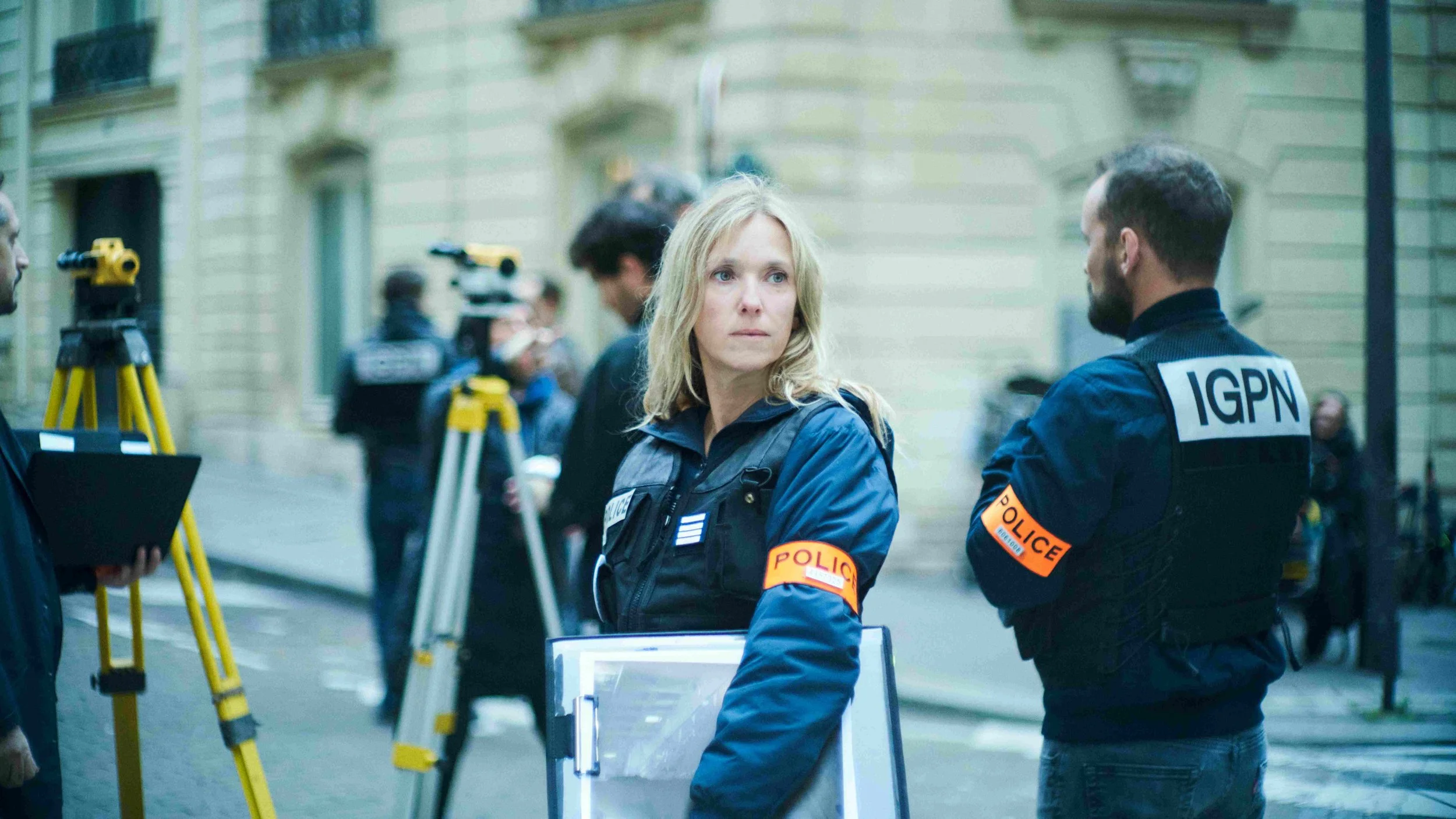
AE: You’re working with Léa, who gives a very muted emotional performance. The emotion is there even though it isn’t outward. In your filmmaking generally, I feel like there’s a lot of emotion, but it’s rarely loud or obvious. It sits beneath the surface. Can you tell me about that approach and how you worked with Léa on Stéphanie’s instinct to keep everything internal?
DM: The fact that things are hidden beneath the surface, whether they are emotions or impulses, is something I like a lot with characters. I feel film is really the best way of expressing that. You can show someone’s face and they’re smiling, but through the way you shoot it or the way the actor plays it, you sense that there’s something else behind that smile. They’re not simply being friendly. There’s something else there.
I find that more interesting than someone bluntly expressing their emotions or feelings, even if that can work depending on the scene.
After talking to a lot of people working in the police, I understood that they are taught to stick to the facts, which makes sense. If you’re facing someone you’re interrogating or questioning, you might find them very sympathetic, but that has nothing to do with the facts or what they have or haven’t done.
They have to keep their emotions down. If they show them, it can make them weaker, and they also can’t allow themselves to become overwhelmed by their emotions because that could influence their judgment of the facts. But of course, they are human beings, so they do have emotions and feelings.
We talked with Léa about that a lot. She had to keep the emotions inside, but the audience still had to sense and feel them in a very subtle way.
More generally, when talking about police work or politicians, emotions can sometimes be dangerous too. Even in the news, it can become less about facts and more about emotions, and emotions can start to replace facts. That’s something we should be aware of.
What I think a lot of politicians lack is empathy. They should perhaps replace emotion with empathy. A lot of politicians are unable to put themselves in someone else’s place and try to understand their point of view.
That’s what Léa’s character is doing in the film. There is empathy, and that is what her superior reproaches her for in a way. She’s becoming too close to the victims. For me, it has more to do with empathy than emotion, which can be tricky or dangerous.
AE: I’ve been thinking a lot about the role of art and satire at a time when the world is changing and, in many ways, getting worse. We’ve talked about losing the ability to have nuance while making art about terrible and horrifying things.
I’m curious where you stand as a filmmaker on what we should do with art, how we should engage with it, and how we can use it as a tool for nuance. I also think there can be a kind of self-importance when we say, “We’re making art about something terrible happening in the world.” We still have to be careful with the things we make.
It’s such an interesting balance. You’ve made films about difficult subjects for a long time. How do you navigate that?
DM: I think the important thing is that the subject should not be in front of everything. If you begin making a film by saying, “I’m going to make this or that statement,” whether it’s political or something else, I don’t think that’s the right way of doing it. Everything will end up being organized around the statement you want to make.
The important thing is to think about characters, situations, their dilemmas, and their contradictions. Then the subject should emerge from that rather than doing it the other way around.
For instance, with The Night of the 12th, Gilles and I didn’t tell ourselves, “We’re going to make a film about men’s violence toward women.” At the beginning, it was a film about a police investigator who cannot solve a case, how he becomes obsessed with it, and what that frustration does to him.
Because it was the murder of a young woman, little by little another question came into the film: Why is it mostly men who commit these acts of violence? Why is it mostly men who investigate that violence?
That wasn’t there from the beginning. It came from the way we worked on the character. That’s how I would describe it.