
The Return of the Repressed: On ‘Sirat’
During the summer of 2025, I came back home from New York. I hadn't seen my little sister, nor the rest of my family, in over a year. I played tag with my little sister under the hot California sun around the swimming pool. "Yallah!" she yelled — one of the few Arabic words she understood — before jumping on the table, laughing, and yelling "The floor is lava." To her, it was just another game. For me, it immediately brought back a repressed memory: a recurring nightmare I had growing up in Yemen.
These nightmares had started during the beginnings of the war. One day, after finding photos of men in Calvin Klein underwear and jockstraps saved on my fake iPhone that I had exchanged for a twenty dollar bill, my mother, in an attempt to scare me, sat me down and warned me about the Sirat. The Sirat, in Islamic teachings, is mentioned as a bridge stretched over hellfire that crosses toward heaven. It is said to be thinner than a strand of hair and sharper than a blade.
Throughout my childhood, I have become neurotically obsessed with the image in my brain. Night after night, I imagined people plunging and screaming into an endless sea of fire till they reached it, and all you can hear is the loud silence. I was about 8 years old, and I had started developing extreme night sweats, closing my room door to avoid anyone suspecting anything was wrong. It shook my core that being myself was an identifier to what my end would look like. I couldn't escape these images of falling people — especially of little kids just like me — and I could be next. To escape those fears, I would put on my headphones and listen to Mozart until I fell asleep. Music that felt hypnotizing freed me from those fears temporarily and it had become my refuge.
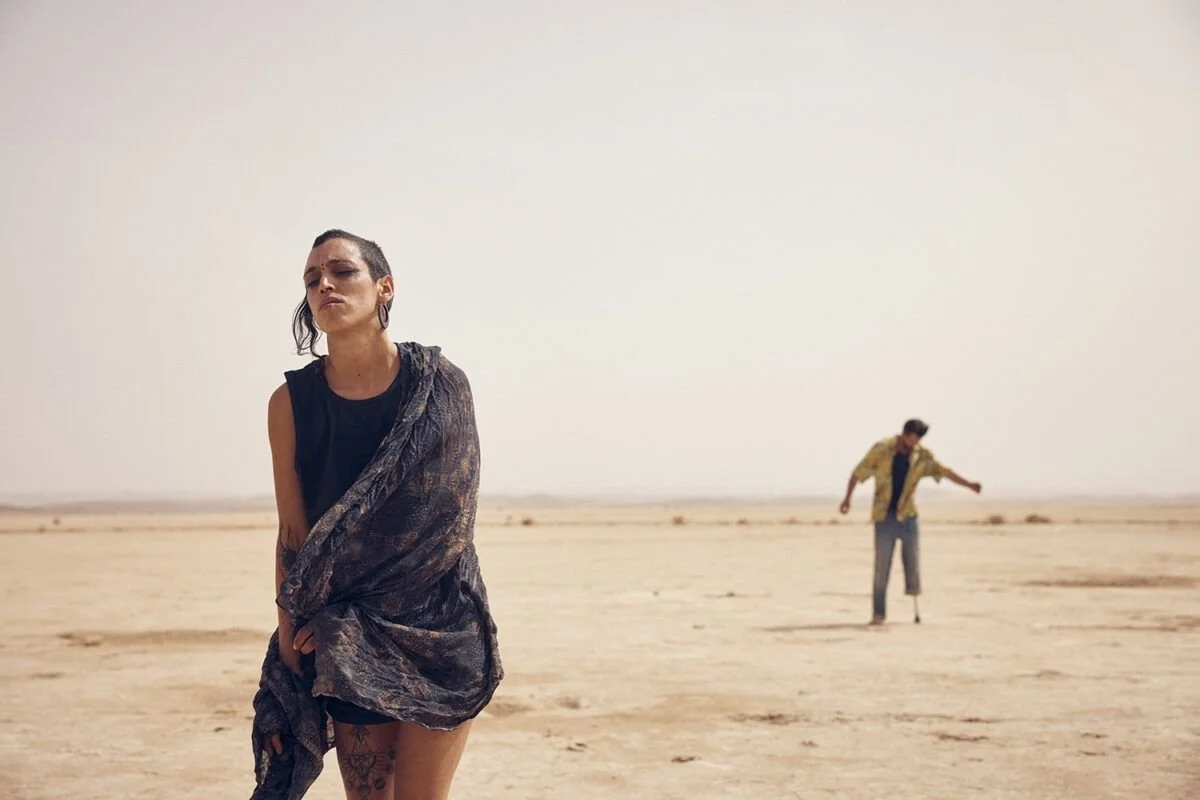
Watching Oliver Laxe's Sirat this year, I recognized that same impulse in its characters. On the surface, Sirat follows Luis (Sergi López), a father searching for his missing daughter after arriving at a rave deep within the Moroccan desert. When military authorities shut the first rave due to a warning of an escalation hinting at World War III, In which is very believable now a days that it can happen any second as it easily feels like the world could end before any ideology does. Luis joins a group of ravers traveling across increasingly hostile terrain, convinced that his daughter might be at the next rave. What begins as a search narrative slowly transforms into something uncanny, spiritual, and deeply unsettling. This ambiguous yet thrilling descent into uncertainty becomes a compelling metaphor for life itself — one that never wastes time trying to sound reasonable or believable.
In Sirat, the ravers seem to lose themselves in a search for transcendence and catharsis from repressed fears caused by loneliness, trauma, war and despair through dance and techno music. I was reminded of my own childhood habit of disappearing into Mozart. The ravers seek the same thing: a temporary escape. Luis, however, cannot escape. While the ravers surrender themselves to the present moment, dwelling in their unconscious and repressed desires, Luis remains consumed by the absence of his daughter, even when his little son dies inside the van that falls from a steep desert cliff.
This part did not just give me flashback images in my memory, but a complete flashback of a certain feeling, one that I can describe as "Weltschmerz," a German word translated at best as "world pain", but in a deeper meaning: a feeling of complete melancholy that overtakes your whole physical and processes, that arises from the gap of what one hopes the world to be and what it really objectively is.
Psychoanalyst Jacques Lacan had described desire as the pursuit of something permanently lost, an object that promises to fill or bring wholeness but can never fully be recovered. Luis follows that desire across the desert. The possibility of finding his daughter keeps him moving, even as the landscape becomes increasingly hostile. This is where Lacan's theory of the lost object can be observed in that of Luis search for his daughter is becoming less about finding her and more about the drive, in which he, by the film's latter half, circles in repetition, the absence continuing despite suffering staggering upon him and the ravers he met along the way. That drive could be, in a way, in relation to religion, hopes, and fears that one becomes stuck inside instead of bringing the repressed back to the present and understand where they had stemmed from. Director Oliver Laxe himself does not associate it with anything, as he explains that his spirituality is a private matter, and this meaning can be defined in many ways.
But in this ambiguity, I came to understand that the trials one has to take to realize that the fear of "the floor is lava" is in itself the trial, and it is not in being in the lava.
The Moroccan desert itself becomes the film's true protagonist. Shot in 16mm, on one of my favorite formats, it possesses a texture of grain that is not excessive, feeling both ancient yet modern and truly real. At times, I felt as though I were watching a forgotten film by Youssef Chahine in mix with that of Dennis Villeneuve's Dune, in the mountains and deserts, and how they appear beautiful enough, yet indifferent enough to inspire terror. The further the characters travel into the never ending desert and its terrains, the more the landscape resembles a place of judgment. How an empty space like a desert can be so quiet, yet so eerie and loud.
I was in complete fascination not in the dialogue, but instead what happens when language fails. It does not escape me how the protagonists rarely reveal much about themselves through conversation. They speak in fragments, jokes, and passing observations. Yet when catastrophe strikes, when hidden mines suddenly explode beneath them and witnessing the horror, words become irrelevant. What mattered is action. Loyalty. Presence. The film constantly suggests that we reveal ourselves the most clearly not through what we say but through what we do when we are confronted with mortality. This is where Sirat transcends its premise. It is not ultimately a film about raves, nor even about a missing daughter. It is a film about how people live with the knowledge that they will die.