
Femme Filth
The founder of LA's filthiest film festival on perversion, programming, and why nobody gets to correct her copy.
Early in FilmSlop's journey, we interviewed Annapurna Sriram for Fucktoys, her stunning debut feature about a sex worker scootering through a place called Trashtown trying to undo a curse by securing $1,000 and a baby lamb. Around the same time, Abby Wright was opening a night of Femme Filth Fest with the same film. Wright calls it one of the best nights of her life. That night is a snapshot of what she has managed to turn her festival into.
Femme Filth has become a home for films like Fucktoys, the ones the industry tries to silence by calling “too much.” Everyone who has seen Fucktoys is willing to die for Fucktoys, yet Sriram has spent over a year in distribution limbo hell despite making something spectacular. The film swept jury and audience prizes across the festival circuit, yet buyers still circled without committing long enough for IndieWire to run a headline asking why nobody had bought it. A movie can win everything, including our hearts, and still have nowhere to live because it is deemed too much, too bold, and too honest.

This is the exact gap that Wright is working tirelessly to bridge. While the industry deliberates and writes thinkpieces, she is making sure people can actually watch these films, loudly and together, in rooms designed to properly appreciate them.
I have spent the last few years fascinated by consumption as art: the idea that how we engage with movies is a means of expression in its own right. Critics develop styles of consuming similar to the way filmmakers develop styles of shooting. Some find their entry point through cinematography, dialogue, or structure. Others find it by latching onto their own lived experience and watching the movie through it. I belong to the second camp (if it wasn't already obvious from the posturing of this website), but that doesn’t stop me from being fascinated by all forms of the art.
Lately, I have been fixated on (or consumed by, if you want to get cute with it) the different outlets of consumption, exploring them everywhere I can. I interviewed the hosts of The Bechdel Cast, the podcast that shaped my taste; profiled David Ehrlich, a critic I deeply admire; and wrote a borderline incoherent manifesto trying to Pepe Silvia my way through the reception of Obsession, a film I despised. Wright has built one of the most exciting answers I have found anywhere. She is programming inside an industry that trains everyone to talk down to audiences like they're babies and keeps clearing space for AI and algorithmic nonsense. The result is that everything feels like Cocomelon.
"So blended," Wright says in response. "I hate that. We're in this space where we have to tell the audience everything verbatim, but we're also expected to have all the characters we put on screen, and all the choices they make, be morally good, and that people should agree with them, and that we shouldn't make a film about things that are bad, because then we're romanticizing or we're putting a positive spin on something bad.
“And it's like, no, it's just bad, and we can put that on screen, and we can each take from it what we will. It doesn't have to be this morally sanitized playground for people to be in."
Wright built Femme Filth Fest in direct opposition to that playground with one word in mind that she has spent years defining. She originally thought of “filth” as a horror term, but decided quickly that it belongs to every genre. "I think of filth as things that are eliciting a strong reaction," she says. "And that's what we set out to do in our screenings and our programming, get the audience to have that visible, audible reaction.
“Sometimes it's positive, sometimes it's negative, but something that's filthy gets under your skin. It makes you think, it makes you upset, it turns you on, it freaks you out. For us it's been blood and gore, it's been sex, it's been drugs, it's been betrayal, lies. Anything can be filthy."
In her framework, every film lands you somewhere on a spectrum of feeling, and the only true failure is the forgettable middle — the movie you shrug at on the way to the parking lot. Everything Wright programs pushes an audience out of that middle, toward love or toward disgust, and she is delighted no matter which way you fly. Her screenings have developed a reputation of creating rooms where people gasp and groan and laugh at things they would never admit to laughing at anywhere else.
Wright came to the concept of filth late herself. She didn’t get to see a lot of films when she was younger and as she puts it, "my exposure to film was only really on the most basic blockbuster level." She grew up queer, feeling "outcast and very different," reaching for something she had no name for. "As a kid I was always searching for this thing that I didn't know what it was. I was drawn to this very macabre, very taboo style of filmmaking, because I didn't know what I was looking for, but I knew it was out there somewhere."
The word arrived in her twenties, in Los Angeles, with the films that finally ended her search. Cronenberg's Crash hit her hardest. "I just remember watching that movie and being like, who hid this movie from me? Who kept me from watching this?" After that came The Piano Teacher, Possession, and Fat Girl — films about repression that she found late and that worked on her like mirrors. "Those are all films I only saw within the last few years, but they made me feel like, oh my gosh, I understand myself because of those movies,” Wright reflects. “They show you how to confront the scariest parts of yourself and not use them for evil."
Wright sees femininity and filth as deeply interconnected. "Filth and femininity have so much in common that people don't realize. So much of femininity is tied in with what filth is. So many things that we think of as being feminine, the world doesn't want to know about, because it's too grotesque and too filthy for them." Growing up queer and a woman, she says, you are made to feel perverse for the things you feel, as if they are simply wrong. "And it's like, no. Being who you are is not wrong, and you don't need to be punished for it. It just is, and you can just be that."
Plenty of people hold that conviction. Wright had the vision and ability to turn hers into a working institution, starting with building a strong community of filmmakers. "Filmmakers whose work has been made to feel like it's perverse, like it can't be shown to an audience, like people won't connect with it. Those are the filmmakers I'm trying to bring in and be like, no, your audience is here. We have the people that want to see what you're making."
The number one piece of feedback Wright gets, from filmmakers and audiences alike, is that people have found a community where they feel seen, visible, understood, and where they don't have to explain themselves to anyone. She hasbeen deliberate about making sure the festival never treats representation and inclusion like a checkbox. Trans, non-binary, and gender-expansive filmmakers "are a core pillar of this belief system and what we are, and they have been from day one. It's not just, ‘you can come in because I guess you count.’ No, you are a core pillar of what we believe."
I found Femme Filth the way most people do, through social media, and was pulled in by how genuine her copy sounded. The captions read like an actual person wrote them, which in the current landscape is enough to pause your scroll. "So much of the festival landscape is so corporatized," Wright says. "It's so sanitary, it's so bland, it's so boring.
“You go to some festivals and there's no personality. I don't know who's behind this, because there's no personality. I don't feel anything from you guys. When I went to festivals like that, I was leaving thinking, I can do this better. I can do this differently."
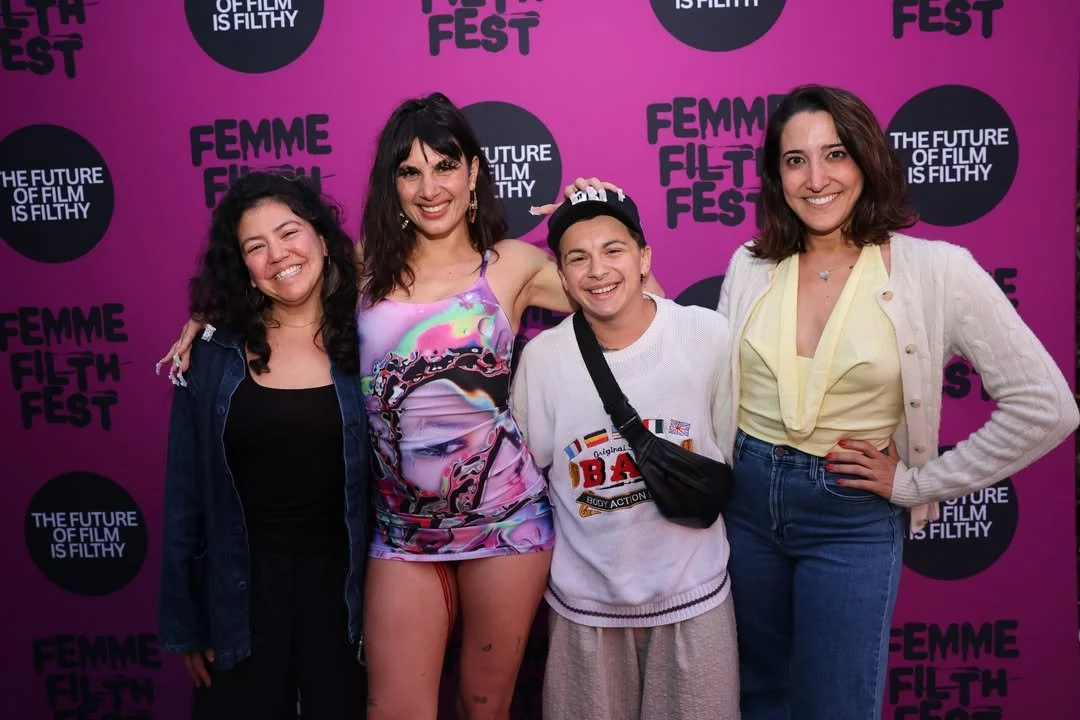
Wright has done it differently from the first day. "I started the festival just like me, in my room," she says. "So naturally a lot of the voice of the festival is coming out of me. The festival, to me, is a character. I'm puppeteering the strings of the character. I want it to feel human, I want it to feel living, breathing. Bloody, stinky, filthy thing."
The character survives because of how she runs the operation underneath it. "The really good thing about running Femme Filth Fest myself is that nobody can tell me no,” Wright relishes. “Nobody is correcting my copy, nobody is in charge of me. I'm the boss, so I can write whatever I want, post whatever I want, use as many curse words as I want, do whatever programming I want. And that will never change about the festival."
Femme Filth has no corporate sponsors. Everything the festival generates from ticket sales and submissions cycles go straight back into the operation, supplemented by friends who donate spaces and design work. Out of essentially nothing, Wright has built a festival that sustains itself on its own community, and that independence flows directly into what ends up on screen.
"Challenging your audience is the most exciting thing that you can do, whether you're a filmmaker or a programmer," she says. "Creating something that is divisive, that's polarizing. The worst thing, in my opinion, that you can feel about a film is, it was whatever, it was fine, I'm forgetting about it. If someone hates your work, you've done something good. We want to be on either end. We don't want to be in here in the middle. We want to be out here. Whether you hate it or love it, I'm happy if someone leaves and says never again. I did my job."
Wright’s sharpest industry take is structural, and she is one of the few people willing to say it on the record. "There's this weird quota right now where film festivals are like, we're gonna program 25 percent this demographic and 10 percent this demographic. Do you see how that's no longer natural to your vision?
“It doesn't work because it doesn't feel authentic to anyone,” Wright observes. “A lot of these programming teams behind these festivals are not made up of the same groups they are trying to put on screen, so it is never going to feel natural when they do it.”
Wright’s intention in programming went beyond quotas to actual representation. “I was extremely intentional about who I put on our programming team,” she says. “People of color, queer people, trans people. The only way you can get authentic stories put to screen is if you're putting those people behind the screen too. And I don't think the industry is as ready to talk about the voices behind the programming as they are about what's actually on screen. And that's the first step."
When I asked Wright what the right way of consuming looks like, she answered as a programmer and ends up describing everything I have been chasing as a critic. "It doesn't matter what you feel about something. Hate, love, it doesn't matter, as long as you are hating and loving thoughtfully and with intention, and because that's genuinely how you feel.
“A lot of our consumption right now as a society is based on what we think other people will think of us for thinking it,” Wright reflects. “We need to be thoughtful. When you consume something, think about it in your own brain, separate, devoid of what anyone else around you is saying or thinking, before handing it off to other people's opinions."
Wright has no patience for the fear that drives the opposite. "We're so worried about people tearing us apart in the Instagram comments on IndieWire, and it's like, can we just grow up and think what we want to think? When you leave the theater, what did you actually think, and what did you actually feel? Not what you're worried people are gonna cancel you for."
Fear is only half of what corrupts a watch, though. The other half is ego: the urge to have the best take instead of an honest one. On this count, we both plead guilty. Wright and I are Letterboxd patrons who have chambered the funniest possible review before the credits finished rolling. "I'm not gonna act like I haven't done this," she says. "It feels great. But you are formulating your thought so that other people laugh at your thought and think you're funny for your thought. It's no longer actually what you would think. You've lost the plot."
If I had to boil everything Wright is doing down to one thing, it comes down to comfort with discomfort. Filth trains you to be okay with things that are uncomfortable, and a culture that loses that training ends up back at Cocomelon. She has built a place where the training still happens, down to the hypothetical concessions.
When I ask what the Femme Filth snack bar serves in a perfect world, any food on earth, she takes the question more seriously than anything else I ask her, which is correct behavior. "The most calorically dense, sweet, salty, intense shit that leaves your hands orange, your fingers sticky,” Wright says. “Your worst movie snack, the one where you go, I shouldn't get it, but I want it so bad, but I need it, I'm craving it. I would reject any nutrition labels. There's gonna be no calorie counting at Femme Filth Fest."

Her dreams for the festival are very specific, and given what she has already accomplished, I'm willing to bet she'll get there soon. The first is establishing feature film grant, because she sees a gap between championing filthy films and getting them made at all. "As much as I love putting films to screen, there's a missing piece. How do we get filthy films made? How do we actually enable filmmakers that are on the fringe, that would not usually get money, to make their films and put them in front of an audience?"
The second is a building. "I want to own a theater,” Wright explains. “I have always wanted to own a theater. There are so many sad, dilapidated, boarded-up theaters in Los Angeles that depress me every time I drive by them." She has one picked out already, an old porn theater on Santa Monica Boulevard in West Hollywood, but has done enough homework to know exactly how out of reach it is. "If I had $5 million for Femme Filth to buy a movie theater, I know exactly which one I would buy." Were that to happen, Wright would use the theater for indie, queer, trans, and femme programming, free screenings for students and teenagers, and building a community arts pillar people are actually tapped into. "Not just playing Dory at the public library for children. No shade, I love the public library."
Wright understands representation in a tangible way, because she lived the version where it was missing. When she speaks about it, representation has nothing to do with quotas or optics. She talks about the space to discover who you are without being boxed into someone else's idea of you, the same space Crash and Possession gave her in her twenties, the same space her screenings hand to a room full of strangers.
Ultimately, what does Wright hope people carry out of her festival? "It's okay to be completely yourself,” she answers gently. “It's okay to be silly, it's okay to be gross, it's okay to be whatever you want to be.
“You should think freely. You should not be worried about what other people think or say about you. You should love yourself entirely, and at every stage. And you should be kind to people."
I came to Wright through copy that read deeply human, and I left understanding her festival the same way: as a bloody, stinky, filthy thing built to reach the people who need to hear that it’s ok to be human.