
Art Takes Time: Anna Fitch and Banker White on ‘YO (Love is a Rebellious Bird)’ and the Friction of Grief
Anna Fitch was sanding the floorboards of a one-third scale replica of her closest friend Yo's house when she finally started crying. It was 2017, four years after Yo had passed away, and it was the first time the grief caught up with Fitch.
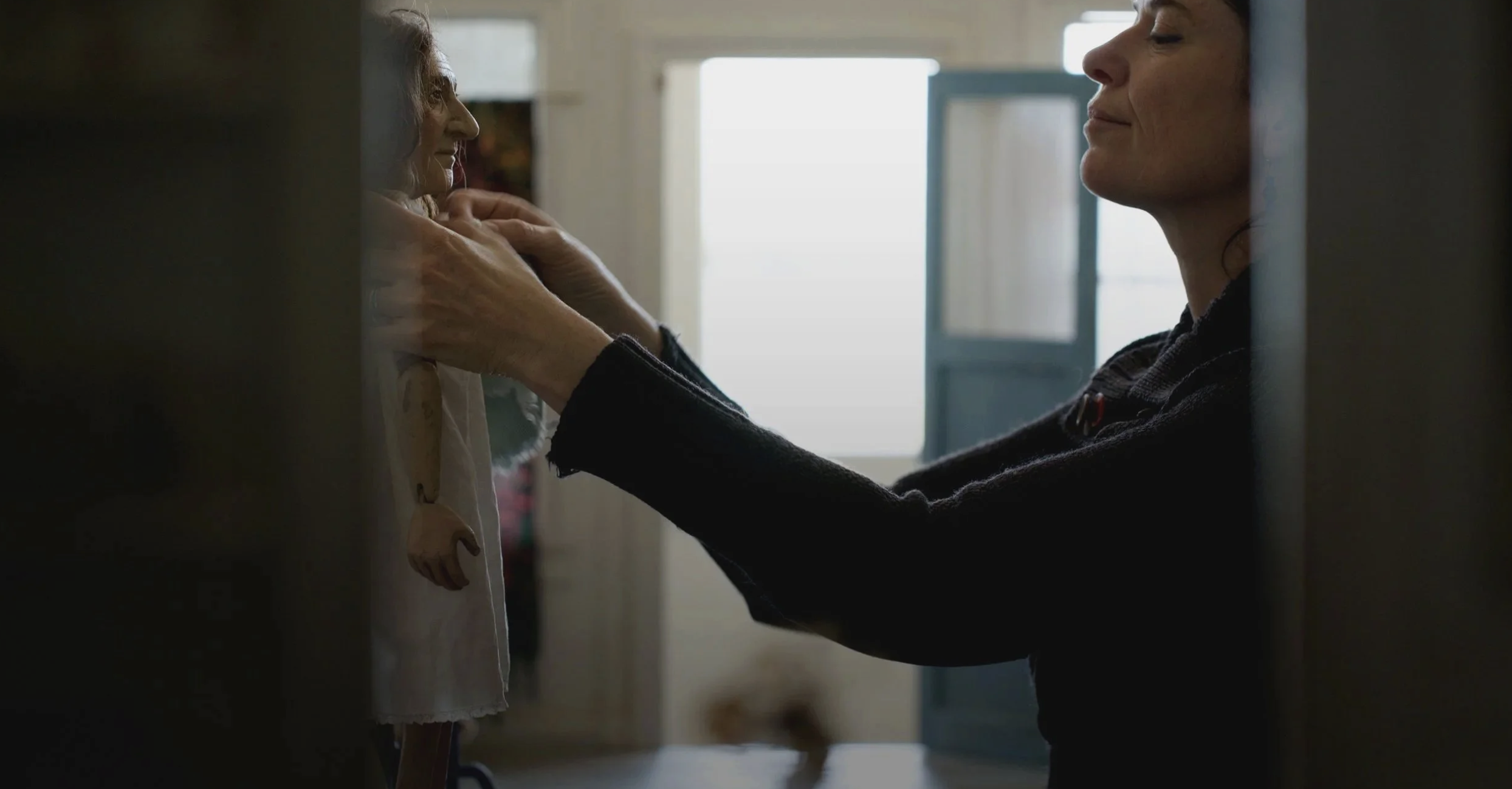
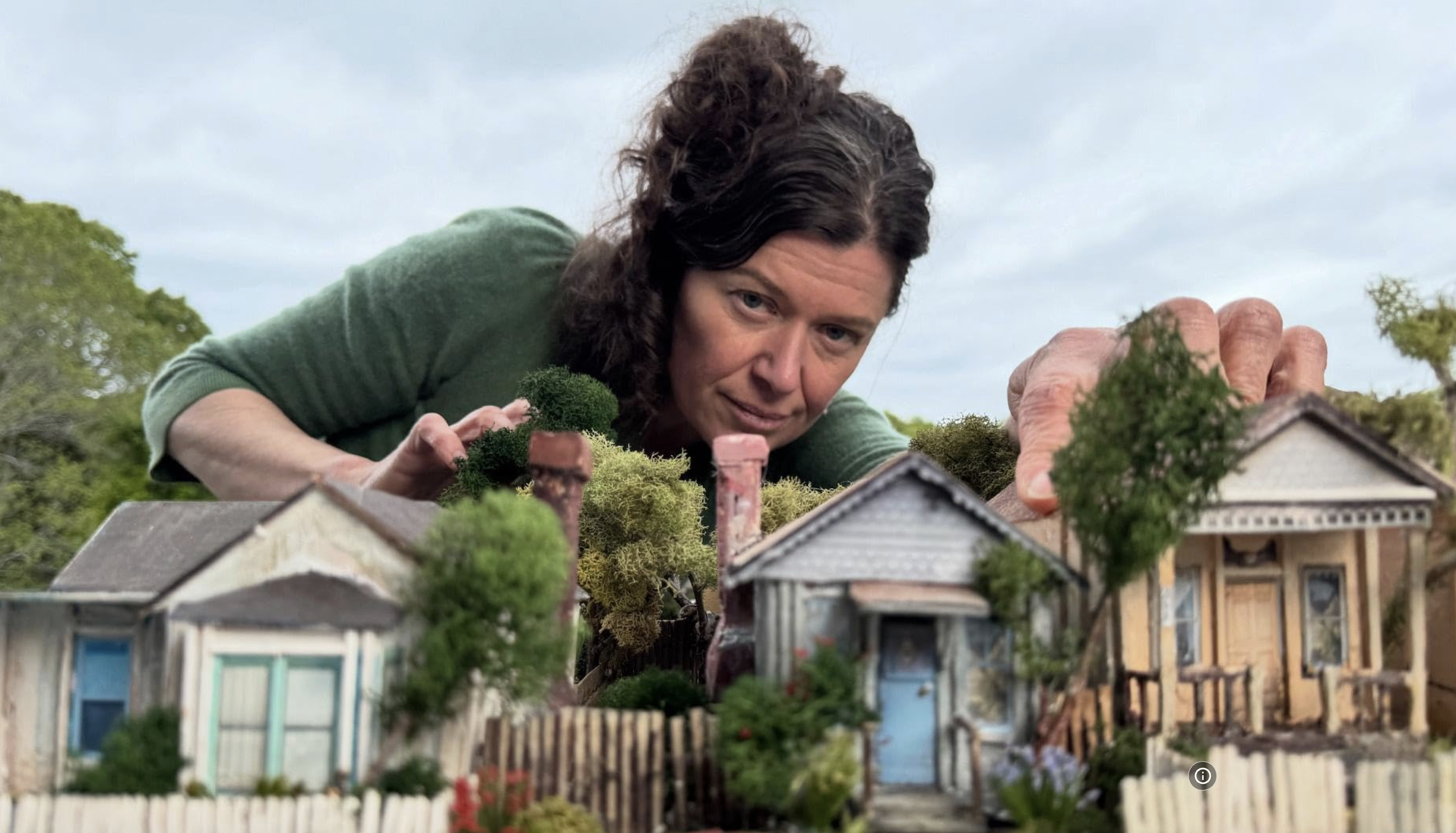
YO (Love Is a Rebellious Bird), which Fitch made with her partner and co-director Banker White over the course of sixteen years, won the Silver Bear for Outstanding Artistic Contribution at this year's Berlinale. Yo Shea was born in Switzerland in 1924. She was 73 when she met Fitch, who was 24, and the two stayed close for almost twenty years. Yo would hold court in her bedroom while Fitch recorded the stories she felt most connected to. Those recordings are the film's spine, intercut with puppet sequences staged inside the miniature model of Yo’s house. Yo’s puppet itself is twenty inches tall and dressed in clothes Fitch sewed and hair she cut from her own head.
Fitch and White work together as partners in life and in filmmaking, and YO (Love Is a Rebellious Bird) joins a deeply personal body of work they’ve built around honoring the people they have lost. Their film is a handcrafted labor of devotion and a tangible space where Yo still gets to hold court. We sat down to talk about acid trips, the physical weight of mourning, and parenthood.
This conversation has been lightly edited for clarity.
AE: I want to start with the physical act of making this film. In previous interviews, you talked about how building the miniature sets led to the first time you'd cried in years. Where exactly were you in that building process when the grief finally caught up with you?
Anna: That was in 2017. Yo died in 2013, and it had been a difficult couple of years for me. It surprised me how much grief impacted me. I was not enjoying looking at the footage or working on the film. But when we made the puppet and started to build Yo's house, I found that made me feel better in a way that watching the footage didn't.
I was sanding the floors of her one-third scale house, really studying the photos of where her feet had left marks in her real house. It just made me cry. I hadn't cried in years, and it felt really good to finally let it out. I realized that the process of building these physical things was a way for me to move through feeling stuck in some sort of purgatory between the relationship I had with Yo when she was alive, and what our relationship was going to be now that she was gone.
AE: Banker, you came into this as Anna's partner first, and Yo was already a fixture in her life. Taking on a story you're this close to carries its own pressure. What were you holding when you stepped into it?
Banker: We started filming Yo not that long after Anna and I met. We'd probably only been a couple for a few months when Anna told me, "I need to bring you down to meet someone really special." I felt like it was a vetting process, because Yo wasn't the type of person who would fake anything. She was never going to put on anything but some realness.
At the same time, I was slowly losing my own mom, who was much younger than Yo but had Alzheimer's. She was starting to become nonverbal. Yo died before my mom did, but watching Yo, who was an incredible matriarch with so much chosen family around her, prepare her friends and family for her passing was profound. She was so clear about what she wanted and what she didn't want. We have that scene in the film about the DNR. She never left a bedroom that was only heated with a fireplace, pretty much to the end. She knew. So for me, I was getting ready to try and figure out how to care for my own mom, who was losing the ability to advocate for herself. Having Yo in my life during that time was incredibly special.
AE: Anna, you've said you didn't initially see yourself as part of this film. What shifted, and how did Banker's role behind the camera reshape that?
Anna: Banker's participation in the building and the filming, and then his decision to start filming me, was a turn I probably wouldn't have taken on my own. There's a shot of me arranging furniture in the miniature house, this long zoom, and that was the first time I ever really saw myself in the film.
Banker had taken it as pre-roll, put it to music, and showed it to me. I was like, absolutely not. That is ridiculous. I'm doing totally weird stuff with my face that I don't actually do in real life. And everyone in the room was like, you do that all the time. It was a really slow process, but I give Banker a lot of credit for widening the field of vision beyond just Yo and her stories, to include our process of creating the things we needed to tell those stories.
AE: In the production notes, I read that Yo was involved with the making of this film. Did she ever push back on how she was being framed?
Anna: She was incredibly open to how this would be seen publicly. The only pushback came if I pressed her to talk about things that were emotionally difficult before she was ready, and that only happened once. I was very careful to let her lead. We asked her at one point if there was anything she wanted included that we hadn't filmed yet. She said, "You should film me taking my bath." So the bath scene was entirely Yo's idea.
Banker: She enjoyed being a provocateur. Some people might try and steer you away from the difficult parts of their lives, but there was something in her that wanted to lean into it. We thought so much about what she would want. One of the clues for us was, what are the stories she keeps coming back to? What does she want to tell us multiple times? We almost never interviewed Yo. We'd just come down, set up a camera on a tripod, mic on the table, sometimes audio-only recordings, and she would hold court the way she would if friends were over.
Anna: Any scene where someone's buying weed was just someone who came over and we said, hey, we're recording, do you mind. They'd say yes or no.
Banker: She had stories she told multiple times, almost like a confessional for loving friends. She kept coming back to some of the hardest parts of her life. Losing her kids. The difficult relationship with her parents. You could feel her processing it, knowing that after her heart attacks, every time we left there was some sense that it could be the last goodbye. So she was choosing which stories she wanted us to hear. That was the best indication we had, without being able to actually ask her what she thought of a cut.
AE: I want to talk about the acid trip, because the way the film holds it feels so balanced. Candidly, I've known people whose experiences with acid led somewhere very dark. The way Yo moves through it, and the way you two render it, is very unique. How did she tell you the story, and how did you decide to handle it?
Anna: It felt like the absolute turning point of her life. If you look at all the stories she told, there's life before that moment and life after it. It was so dramatic, and it was one of the first stories she told me that I desperately wanted to share with other people. I'd find that if I tried to tell people the story myself, I could never quite do it right, so I'd have to bring them to Yo so they could hear it from her. It took us a lot of experimenting to figure out how to recreate the moment she tells so dramatically.
Without saying it directly, she was either going to die and be crushed by all of the things that weren't working in her life, or she was going to face them and change her life completely. And it manifested in the scariest way.
Banker: She would use phrases like, "I would have committed suicide if." There are things she said that felt like too much in the context of how a film unfolds. We didn't want the idea that she was suicidal to be the thing that lands, because people have such strong reactions to it. So we let what she's sharing build up to the acid story rather than sit inside it. Not being seen by her parents. Being forced into marriage. All the things that would lead to some kind of mental breakdown. She says all of that, not directly inside the acid story but coming up to it, so you get a sense of the weight, and what it was like to be born as an outsider woman in 1924.
Anna: It was risky. You can go to that place and not come back. I said to her once, "It's a miracle you survived." And she agreed. That's part of why I wanted to share her story. It's rare that someone can go through those things and survive, and it's even rarer that they're confident enough to share their mistakes openly, without judging themselves or fearing the judgment of others.
Banker: She lived a really full almost-ninety years. She says these incredibly relatable things about how complicated it is to take on the responsibility of being a parent. She lost her kids, but she was close with all of her adult children. We don't really explain that in the film, but you see them there. You see them come. You see them sitting with her in that tiny little room. You see them at the hospital. You see them after she's passed. I think people get that. She told us the acid story as it related to the complication with her kids and the pressure of being a mother six times.
Anna: She went to Tassajara afterward. The Roshi there told her she could stay and work it out, because she'd gone to heaven through the back door, and that can make life really difficult. He told her next time she should try to go through the front.
Banker: For a long time, Through the Back Door was actually the working title of the film.
AE: Seeing Yo’s relationship to motherhood shift so starkly over the years is moving. As parents, what did witnessing all of that teach you? What did you want to bring home to your kids?
Anna: Yo's unconventional path through motherhood was riddled with mistakes, but in the end, it turned out really beautiful. Being able to witness that was a big part of me deciding to have children. I hadn't planned on having them. Seeing her life proved that mothering can look a whole bunch of different ways, and mistakes are going to be made. But that's not the end. Life is long. I'm friends with her children now, so I have both perspectives on what it was like to grow up in that family.
Banker: We have a daughter who does not like kids right now. If anyone asks her if she wants to hold a baby, she says, "No, I don't." But there's a scene in the film where Yo and Anna are holding our daughter, Dylan, and Yo puts her nose down and takes this massive deep breath of that new baby smell.
I was sitting next to Tinny, Yo's middle daughter, who Yo herself would say really struggled with the late-60s lifestyle she grew up in. When Yo took that breath on screen, Tinny grabbed my thigh and squeezed it. She didn't have an easy childhood. But in their adult lives, those kids chose Yo again. They were a very tight family. They were all very present at the end of her life. To see that same person who didn't have kids of her own breathing in the smell of a baby, so visibly full of love, was incredibly special.
Anna: They were close for decades as adults. By the time I met them, they were a beautifully tight family.
AE: The project is over now, and you’ve immortalized Yo to exist in a whole new environment where so many others have access to her. How does it feel?
Anna: Yo was such a special person, and I was so lucky to have that relationship with her. As an artist and a filmmaker, it's almost my duty to share her beyond just my own friend group who got to meet her when she was alive. Now that we've started sharing the film, I'll meet someone who saw it a week ago, a month ago, and they'll tell me they think about Yo every day. The idea that other people get to experience her and learn from her, and that it's lasting and meaningful in a world where there's so much information coming at you so fast that it's hard to retain anything, just makes me really happy. People get different things from the film. What it is for them is totally different from what it was for me and for Banker and for our family as we made it. Distribution has changed, but it feels like the film will find its people, and the people will find the film.
AE: I wanted to close on the credits note about no AI being used. For a story this grounded in human grief and tactility, that decision feels load-bearing rather than incidental. Talk to me about how that came together.
Anna: A friend of ours who runs arts for SFUSD saw a rough cut and mentioned that if we didn't explicitly say otherwise, people were going to assume a lot of this was made with AI. She asked us if we'd used it, and we hadn't. Of course it wasn't even available for the vast majority of our sixteen-year process, but we could have technically used it toward the very end. It was a conscious decision not to. The time it took is part of what makes this film what it is. If things take time, and if things aren't perfect but they're real, that's what's most important.
Banker: It took a long time, and the process was inherently social. The puppeteering and the production shoots were almost like art parties where our creative friends came together to collaborate. To create with other human beings takes time, and that friction is what makes the art special. There are some things that simply aren't replicable.
Anna: I feel the exact same way about distribution at this point. Maybe finding our audience is going to take time too. We're not used to that in today's industry. But that's fine.