
Cheri Gaulke on ‘Acting Like Women,’ the Woman’s Building and Revisiting Los Angeles Performance Art
As I sit down to chat with Cheri Gaulke, her debut feature film Acting Like Women is only weeks away from its world premiere. It’ll first be shown at the Bentonville Film Festival, followed closely by a screening at Frameline Film Festival, to kick off its festival run.
When I ask Gaulke how it feels to finally arrive at this moment, she describes a mix of excitement and nerves. And reasonably so — the screening of her film marks the culmination of seven years of production.“I've made a lot of shorts that have been in film festivals, but this is my first feature,” Gaulke shares. “The story itself is very personal. It's about a time in my life that was very profound and changed me in deep ways.”
The film revisits feminist performance art in 1970s and 1980s Los Angeles, largely centering on Gaulke’s time as an artist at the Woman’s Building. This influential arts centre — first founded as the Feminist Studio Workshop in 1973 — became a hub for experimental performance and feminist theory at a time when women and queer artists were still largely excluded from mainstream institutions.
Much of the work that came out of the Woman’s Building, Gaulke explains to me, was performance-based. Pieces staged in public spaces, where artists often used their own bodies as the primary material, turning lived experience into form, and speaking directly about sexuality, queerness, labour, gender-based violence, and everyday life. That sense of ephemerality is partly what Acting Like Women is trying to hold on to. Not essentially by recreating the performances, but instead by gathering the people who were there and letting them speak through their shared histories.
When the artists first arrived at the Woman’s Building, it wasn’t polished, or even simply ready-to-use. Instead, the women were presented with a rundown, industrial space — and thus, were prompted to construct walls, create studios, and shape the physical environment. Many of the women who came through the Feminist Studio Workshop weren’t trained in maintenance or carpentry, but they learned by necessity, turning maintenance into collective labour and collective labour into a kind of shared authorship.
That physical work blurred the boundary between making art and making room for art to exist at all. The building became — as Acting Like Women depicts — a space for community, shaped by joy and healing. Gaulke describes it as a place where people weren’t simply making work, but sharing deep, intimate parts of their lives in a collective space. That emphasis on being in the same room — on art formed through intimate presence — carries through into Acting Like Women itself. In the film, Gaulke conducts more than 50 in-person interviews in her own colourful, vibrant living room.
“It was a little mini reunion of sorts, in that there were women coming together and passing by each other as they were coming and going, who knew each other at the Woman's Building, or knew of each other. It was a special experience.”
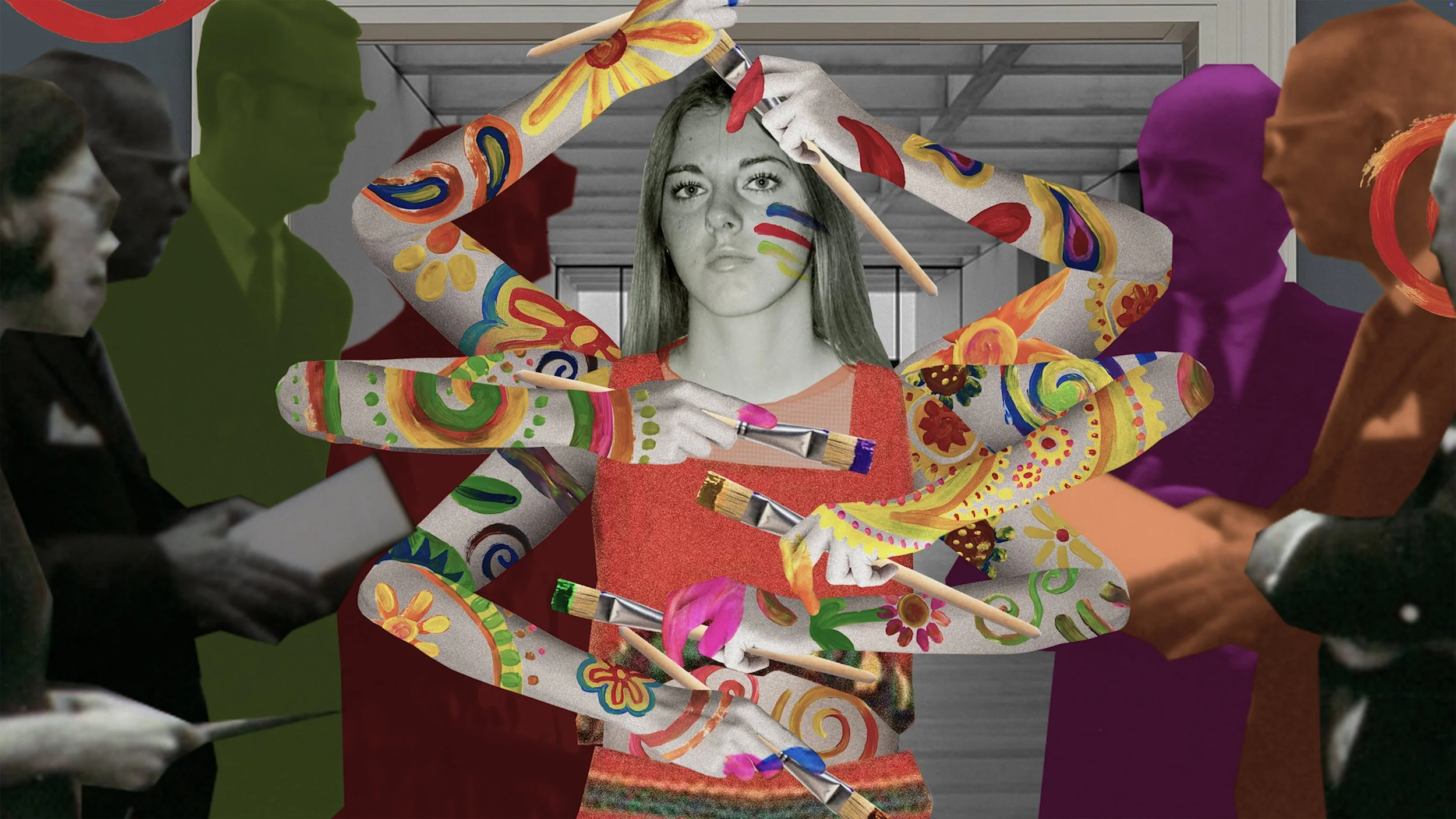
Speaking with Gaulke, even about the most complex parts of her story, is remarkably easy. In other words, chatting with her is an interviewer’s dream. She listens with care and responds with exacting precision, often finding the small detail that guides the conversation into sharp focus. So, when Gaulke tells me she never planned to put herself as a central onscreen figure in Acting Like Women, I can’t help but be surprised.
Gaulke originally saw Acting Like Women as a collective portrait — a story about a movement and the many artists who shaped it, rather than her own personal journey. But early in development, a producer challenged her to reconsider her role in the film.
“The audience needs a person to identify with to take them on a journey,” Gaulke was advised. “And that person should be you.”
In the film, Gaulke re-enters her own history, sitting face-to-face with former collaborators, students, fellow artists, and even her wife and twin daughters. Conversations unfold in close, lived-in spaces, often over the same kind of tables and communal spaces where those relationships were first formed. Gaulke’s stylistic choices bring these shared histories to the surface less like formal interviews and more like old friends picking up a conversation mid-sentence, decades later. And as a viewer, you can’t help but feel lucky, being granted the chance to sit in on these rich, intimate conversations.
As Acting Like Women prepares to launch into the world, Gaulke is thinking about what comes next — another feature project, this time focused on a single artist, built largely through archival material. For now, though, the focus is primarily on Acting Like Women. After years of revisiting the past, the film is now about to enter a new phase — as something experienced again in real time, in theatres and shared physical spaces where audiences can gather together.