
A Conversation with Meag Cherry of Tri Harder Film Festival
Let’s be honest: rejection is tough.
Whether it’s being turned down by a romantic interest or passed over for a job, rejection is never an easy thing to deal with. You probably heard the phrase “rejection is redirection” after facing a setback. Well, a New York filmmaker took that phrase literally and formed a film festival showcasing rejected short films. Meet Meag Cherry, a 26-year-old filmmaker originally from Saratoga, New York, who began the idea of Tri Harder Film Festival after being unable to screen Darkroom, a short film she co-directed with her longtime creative collaborator, Paul McGreevy.
The pair were motivated to get their short film a screening at a film festival. Despite doing the “right things” such as getting Darkroom professionally sound mixed, consulting film industry veterans for film festival strategies, and submitting to everywhere Cherry and McGreevy “stood a chance”, the duo kept on running into rejection.“...Over the course of a year, we struck out with every single one [festival],” said Cherry. “In our case, because we're working-class filmmakers, there was no more money to throw at the wall. That was the end of the line for our film that we came to love so much.”
She continues, “I think we've tried to find a way to process what has happened to us, and it became very clear that it's not an individual problem. It happens to the majority of filmmakers who seek the path to film festival premieres.”
While Cherry has received many rejections from film festivals over the years, she’s grateful and fortunate to have received “a lot of yesses” in mentorship, collaborations, and from the people around her. However, she acknowledges that the “yes” for breaking into the film industry is something that doesn’t come easily. Cherry says, “Breaking in, there's not an eager yes to give me a chance, yes to give me a multi-million dollar budget, yes to give me a theatrical release. That's something that I've settled with myself, that that yes does not come easy, and it does not come in a few short years to most.”
Suddenly, Cherry came to the realization. If she had trouble breaking into the film industry and getting her short film shown, why not make her own film festival and help other rejected filmmakers get their spotlight? Thus, Tri Harder Film Festival was born. Originally called “Sore Loser Film Festival”, a title that didn’t sit well with Cherry, she came up with the final title “Tri Harder Fest” with McGreevy in her kitchen, a playful jab at the Tribeca Film Festival, to which she had previously submitted short films to.
With 50 submissions, it was difficult for Cherry to narrow down a selection of six short films.
The six previously rejected short films that screened on June 13th, 2026, were as follows, along with their official loglines:
Cherry and McGreevy’s “Darkroom”, which follows an amateur photographer who finds himself stuck in his job’s photo lab overnight.
Emily Dhue’s “Family Life Education”, a sex comedy where a man loses his virginity in his mid 20s and has to teach a sex ed class the next day.
Sam Keshishian’s “Thin Places”, the festival’s only animated short, which takes place “on the night of Samhain, when the veil between the living and the dead is thin, three siblings defy their father's wishes and venture into the Irish countryside to find their mother's spirit”.
Jack Kelly’s “Chickensh*t Water-Boy” - a raunchy coming-of-age short which follows “an unstable high school quarterback who takes the team’s young water-boy under his wing for a night”.
Xander Favazza’s “First Car” - a romantic drama where "a mechanical problem with his car prompts a young man to reflect on the problems of a past romance”.
Lex Burger’s “Something Something 7th Street” - “After moving back to the city, Brooke buys a table off Facebook Marketplace and runs into an old flame” in this slice-of-life short.
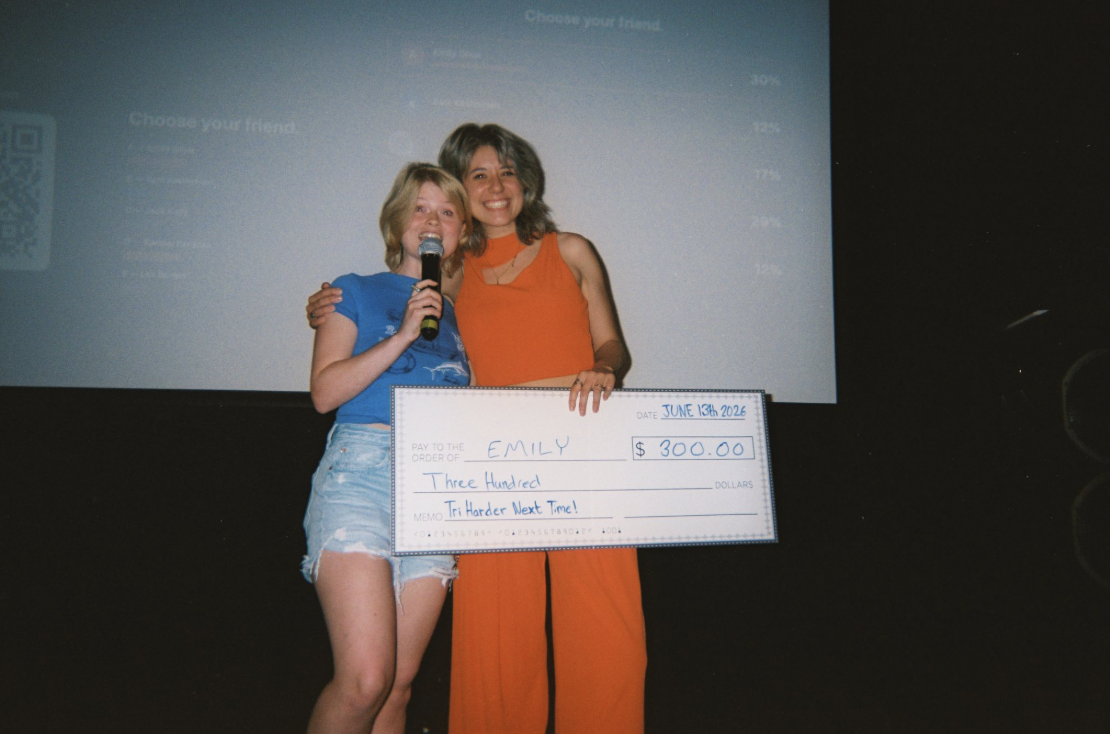
Meag Cherry presenting the “Favoritism Award” to Emily Dhue, Director of “Family Life Education”
For Cherry, her goal with the festival was to bring an encouraging sense of community to filmmakers who might have felt rejected by other film festivals. “I think a huge part of what Tri Harder does is, it's a wave of encouragement for people that have had the door shut in their faces over and over,” said Cherry. “...it's identifying people and saying that ‘rejection isn't you, it's not your film.’ There's an audience that is asking for you specifically.”
The phrase “rejection is redirection” is one that Cherry has quoted a lot to herself following a job shift, and rejection shows up in a certain way in each of the short films and the festival itself.
Cherry said, “I think sometimes things aren't meant for you, and you can be bitter about it, which we've certainly had phases of ourselves going through this film festival circuit. Or you can dig in and try and find something productive to do, and apply yourself differently. And if what you want doesn't exist, then make it yourself.”
Cherry continues, ”I'm just one person, and I work a full-time job, so I can't pretend to have the backing that institutions like Tribeca or Sundance would have. But I can put these films out there, and I can make a lot of noise, and I can scream from the rooftops that these filmmakers are good, these filmmakers have value, they have something to say.”
With over 80+ attendees and presenting a $300 "Favoritism Award” in the form of a comically large check, which goes to funding a filmmaker’s next film (it was awarded to “Family Life Education”s Emily Dhue), Tri Harder’s 1st year was a success for Cherry.
As for the future of Tri Harder Fest, Cherry is open to keeping the festival going, as a space for new filmmakers to find encouragement and motivation to keep on trying, and hopes that someone will eventually take over to host the event.
However, Cherry jokes that its pending Tribeca Film Festival doesn’t send a cease-and-desist for the name. “If the people want it and they take away a lot from it, regardless of where I am in my career, I think I would come back to it and open the space for new filmmakers to have a space and get the encouragement they need to keep going (and) make their next film,” said Cherry. Before the end of Cherry’s conversation with FilmSlop, she gives some advice to filmmakers who are struggling to break into the film industry and feel alone in their rejection. Cherry said, “As much as rejection is factually a part of this lifestyle, what you do with it means everything.”