
Interview with Suzannah Mirghani, Director of ‘Cotton Queen’
With her debut feature Cotton Queen, Suzannah Mirghani becomes the first Sudanese woman to write and direct a full-length film for the silver screen. The story follows fifteen-year old Nafisa, a young girl in a cotton-farming village in Sudan, as she navigates an impending arranged marriage, the incoming threat of genetically-engineered cotton that might wipe away her community’s entire way of life, her relationship with her grandmother, the village’s matriarch, and her own identity. The film had its world premiere as part of International Critic’s Week at the 2025 Venice International Film Festival.
Based on her 2021 proof-of-concept short film Al-Sit, which shot on location in Sudan, the 2023 Sudanese civil war flipped the production of Cotton Queen onto its axis. Not only was it no longer viable to shoot in the country, but all the actors fled to Egypt as refugees. It was by facing these obstacles that the film managed to get made: new locations in Egypt were scouted, and a replica set of a Sudanese village was built entirely from scratch. We spoke with Mirghani about the production of Cotton Queen, the origins of the script, her research process, and capturing the spirit of Sudan.
This conversation has been edited for length and clarity.
————
Eman Ibrahim: I originally saw your short film Al-Sit when it came out in 2021. I thought it had such a unique vibe that I hadn't seen on film before, so when I learned that you were turning it into a full-length feature, I couldn’t wait to see it. Lo and behold, it’s an incredible expansion upon the original short. There's so many layers to it that I didn’t even notice until I listened to some of your interviews. So I'm excited to be able to pick your brain about it today.
Suzannah Mirghani: I'm happy to hear that. And I'm happy to hear that you watched Al-Sit because it's an important part of the story. You can watch them both independently, of course, but those who have seen the short, I think this will make a lot more sense to them as well.
Ibrahim: What was the process of expanding that short film into a full length feature?
Mirghani: It was five years of just, oh my God, I actually thought it would be easier than how it turned out. I thought, you know, I'll just expand on this, and get the same actors and the same locations. But of course, the war in Sudan derailed everything. We already had the locations, we already had the actors, most of them, not all, of course. It was like a trial run: Al-Sit stands on its own, it's its own story, but it can also be a foothold into the feature. So it should have been a more straightforward process.
But of course, because of the war, we had to move to Egypt, and the actors are now refugees. So not only is it a lot of problems in production and finding your way around from scratch, from zero, from pre-zero, because you're going to a whole new environment, a whole new country, a place that I don't know at all. I'd only been to Egypt a couple of times and not even to the places that I needed to be. And then, of course, dealing with the actors' trauma, and refugee status. And so it was quite daunting to make the feature under these circumstances, it was a struggle.
Ibrahim: One thing I really adored about the film is, when watching it, you feel a lot of love and warmth infused into the scenes of everyday life in Sudan. Watching the girls sing together in the cotton fields or play in the river, it evokes this authentic, communal feeling. But also in terms of the scenery and the drone shots, the viewer can tell that this filmmaker really loves this setting. All of that, and you weren't even able to film in the setting itself.
Mirghani: I'm so glad you picked up on that, because it is through the community, through getting together, that they really created their Sudan. It's like, forget about what's beyond the camera, forget about the periphery, forget about Cairo. That was really the joy, even though it was a very difficult transition and a very difficult shoot, the joy they brought to each other on the set, that little community they created brought a lot of relief to them out of their daily, new lives. And they kind of remembered what it was like to be together, to be in a Sudan environment. We all suspended disbelief, we were on set pretending it was Sudan, to the utmost.
The sets that we built were so — they tricked all of us, you know? We really thought it was Sudan. We spent hours and hours and hours on the set, that once you get off at the end of the day, I kid you not, I was always shocked that this was a set, right? Just the momentary, millisecond of like, “Oh!” My heart just broke a little bit. So I think we willingly suspended our disbelief. And that kind of brought everyone together. So I'm really happy you picked up on that.
Ibrahim: I'm happy that they had that experience, honestly. But then, within the filmmaking and photography itself, what were the ways that you tried to evoke the visual landscape of Sudan?
Mirghani: I worked with Frida Marzouk, she's a Tunisian-French cinematographer. And she really helped me bring in the idea of the natural, as in there was a lot of handheld, I would say maybe there were one or two shots that weren't, but mostly handheld shots, mostly being with the girls all the time, running with them or swimming with them. She was part of their little girl group, you know, you just don't see her.
So, yes, even though it wasn't shot in Sudan, we tried to bring an idea of the natural, which is the cotton fields. The cotton fields you can't fake. It's in Egypt, it's in Sudan. One of the reasons why we chose Egypt, of course, apart from the fact that the actors were all there as refugees, was the similar landscapes, right? The Nile is the Nile, it's a continuation of the same waters, the cotton is the cotton, of course; people argue about which cotton is best and so on, but from a distance, it actually looks like Sudan, or Sudanese cotton. So I think through the use of the natural, it didn't ultimately matter whether it was Sudan or Egypt, because it is the unity of those spaces, those topographies, those waters that brought the two countries together physically.
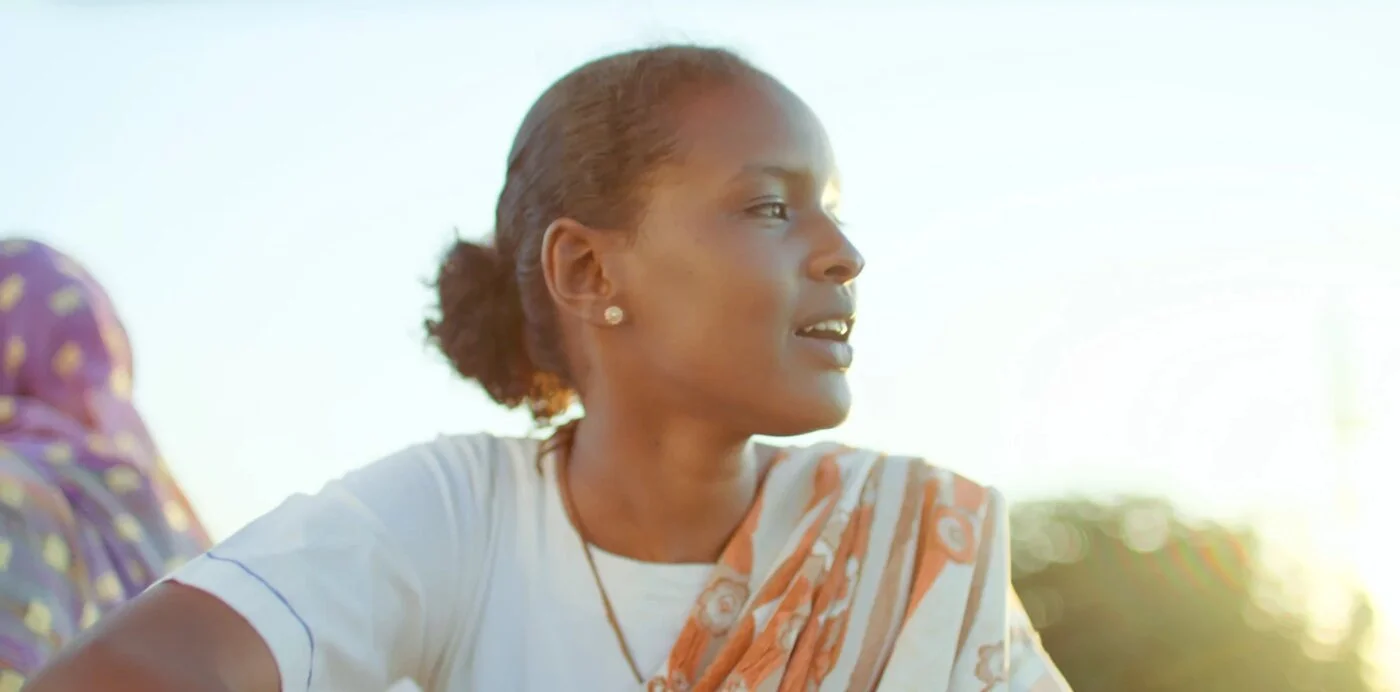
And other than that, of course, it's all in the art direction. And it's in the costume. All the costumes that you see are Sudanese Dammur cotton. We made sure to bring Nafisa's clothes from Sudan, the grandmother's thobe. These are Sudanese cotton-woven Dammur clothing, material fabric. And so you never lose the Sudanese element, regardless of where you shoot, whether it was Egypt or anywhere else.
But of course, the fact that this is fiction gave us a lot of room to play as well. I feel for anyone who's making documentary these days. I don't know if you heard about Khartoum, the documentary that just came out. They had to be really creative about how they made that film, because they hadn't finished the documentary when the war happened and they had to leave. So it's like, what do you do? What do you do with a documentary that's supposed to be about Sudan? So at least we had a little bit of freedom to come up with creative solutions and ideas.
But yes, Sudan is always present. Whether it's in the landscape or it's in the clothing or it's in the language or the faces. I've shown it several times to small groups of Sudanese people in the European and American context, I've screened it in Venice and Hamburg and Chicago, and now it's going to screen at the Doha Film Festival with a majority Sudanese audience. So let's see what happens then. I'm curious to see their feedback.
Ibrahim: Oh, that’s amazing, that'll be fantastic! To touch a bit more on the cinematography — the film utilizes a lot of magical realism. So while a lot of scenes feel very true-to-life, other scenes, like Nafisa's dream sequences, have these beautiful fantasy elements. When crafting these scenes, did you have any visual inspirations?
Mirghani: Frida and I had lots of discussions about what the differences would be between the magical realist elements and the rest of the story. And we were very clear about not just the visual, but also the oral, like what you hear. There's so many layers to that audio in both contexts. So it happens twice, where [Nafisa] takes these herbs and goes into a herb-induced dream, dreamlike state. For the night time [scene], the one that happens towards the end of the film, our mood board was — I don't know if you've ever seen The Night of the Hunter.
Ibrahim: It's one of my favorite movies actually!
Mirghani: I love this movie beyond. I love it so much. And just the two kids in the boat, you know, it's something that I have been dreaming to emulate for many, many years. And I'm so glad I got the opportunity now to say, OK, we have a river, we have a boat, we have a child. Let's put them all together. We had it up on the wall all the time, it was one of our key visuals.
Then, with the angel [character], because it was during the day, we wanted it to be kind of real, kind of not, like you're not entirely sure. I think the drone shot takes you out of the rest of the film, like the rest of the film is very natural, very handheld, and then you get this drone shot. So I think it's through that use of the floating camera that you're like, OK, something is different here. Not a crazy new world, but there are elements of it, and you hear a lot of very weird insects during that scene. And of course, you get this figure that is very real, but also not, this angel figure who we encounter later at the theater.
Ibrahim: To pivot towards the storytelling itself, this movie truly has so many layers. Every fact that I learn about it only endears me to it more. Like, I didn't know the Cotton Queen pageant was a real thing. Things like that kind of blew my mind. I'm aware that you have a very extensive background in academic research, and it's clear that the script is informed and grounded in a lot of that research, whether it's about the British empire, or the cotton industry, Sudanese women, tradition, even esotericism. Could you divulge to me what that research process was like?
Mirghani: I work for a research center here in Qatar. I work for the Center for International and Regional Studies at Georgetown University’s branch campus here. So research is kind of ingrained in my day to day, it’s part of my job. And I'm someone who really loves — for example, say we're doing a research project on, I don't know, environmental catastrophes in Southeast Asia. Sometimes there'll be a footnote that is a footnote to this story, but is in and of itself a complete story in a different context.
And so that's something that happened to me, actually, as I was reading about GCC land investments in East Africa. There was this tiny little footnote at the bottom that said something about the Cotton Queen. And I was just like, the what? So I started researching this footnote, and I read about the competition and its history, and it blew my mind as well. And I was just like, OK, there's a much larger story here that needs to be told. And then to take research out of the academic context and put it into an artistic context is a whole other kind of translation.
But I think there's something so necessary to bring up these, I wouldn't say hidden histories, because they're not really hidden, but they're kind of an embarrassment, now, to people. They're an embarrassment to the cotton industry, an embarrassment to the entirety of Britain, because it's something they really put front and center, these young, beautiful women, to parade as the face of your horrible industry, of your very patriarchal, very violent, very colonial industry would be this beautiful girl at the center of it all. And I just thought that is a ready-made film for me, because all those horrible elements will surface if you just talk about this one beauty pageant.
I do like in my films to layer a lot, as you've mentioned, to have connecting threads, but yet to maintain a simplicity. So to always keep it at a simple level, because it doesn't matter what story you're telling. If you are telling a story about industry, if you are telling a story about women, there are going to be all of these very difficult situations and very difficult questions that you have to address, but always maintaining a simplicity, I would say, a false simplicity.
Ibrahim: Were there any things that you came across in your research that you wanted to include but couldn't?
Mirghani: Oh, lots, lots. There's more films to come.
Ibrahim: You spent a good chunk of your childhood and adolescence in Sudan. How much of the film was inspired by your personal life, and how did you infuse those memories with the research that you conducted?
Mirghani: It's always a mix of the two. Inspiration for stories about Sudan always comes from personal experience of your childhood. For me, it was visiting cotton fields, seeing cotton fields for the first time. It's a very, very surprising thing to see cotton for the first time on the stalk. We know [cotton] in cotton balls, we know it differently. So when you see it in its natural environment, you're always curious. I remember seeing almonds recently and thinking, huh! We don't think of things in their natural environment, we think of things in packaging. So it's always nice to be surprised by something that is so common. I carried that into my filmmaking as well, just this idea of taking something very simple and common and elevating it a little bit more. Giving it some value, you know, beyond the monetary, beyond its cash value.
My family, extended family had cotton fields in Sudan. That was an inspiration. My grandmother is always an inspiration. She was always this very, very powerful woman and yet physically weak and demure. Just those kinds of contradictions. So those are the emotional memory basis of the film. But then to add to that the research and learning as an adult, which is about the genetically modified seeds, the industry, the British colonialists and so on. It's a good mix of both, wide-eyed wonder and historical research on top of that.
Ibrahim: The film is very much a love letter to Sudanese women, from Nafisa, to her mother, grandmother, to all the rest of the women in the village. There is a deep-rooted, gender-related, generational trauma that they all experience, from the cotton picking under the British Empire, to FGM. And this is the first time that I, or the world for that matter, has seen these women represented this way on screen. Were you aware of that when crafting the film? Did you feel any pressure to represent them wholly?
Mirghani: Good question. I haven't thought about that, which already answers your question. No, I didn't, I didn't purposefully. I mean, it's where the story takes you, right? So what I was doing in the film is mirroring the grandmother and Nafisa, like mirroring their struggles, like, what is it that the women in Sudan struggle [with], shared struggles and separate struggles, right? The shared struggle is definitely [female] circumcision. This is a shared trauma across generations, and even though it's not the centre of the story — and I was very careful not to make it the centre of the story or the main issue, because it's something that happens to most girls. Even though it's a very traumatic event that happens in childhood, it is part of most girls' lives. They take it in stride. It is sublimated, it is traumatic, but it's normalised. It's something that is very normalised within the culture, and not only normalised, celebrated.
So these are very difficult conversations to have. For me, it was normal and natural to put it in the story, because if I'm talking about a girl's upbringing, this is going to come up, regardless. But just, how to represent it. I’m talking about hidden trauma, hidden trauma in the circumcision, and hidden trauma in the grandmother’s story, [where] we don't fully realise what actually happened, you know? It’s hinted at. There is something very serious and dark that has happened to her. But what is it? We don't know because it has been sublimated.
Ibrahim: Yes, and that actually leads me to my next question. Could you talk about the parallels between Nafisa and her grandmother, that specific relationship?
Mirghani: Apart from the hidden traumas, I would say it is just the fact that they have to face— each one, generationally—has to face a kind of invasion of Sudan, a colonial invasion or a neocolonial invasion. Something that is going to upend their lives entirely, whether it is British rule or capital rule, something that's just going to change everything. We all understand that change happens, and that it happens gradually. But when it is an all-encompassing change like that, not overnight, but very quickly and for profit. These are the two overt traumas. So like, we have a covert trauma, and now we have an overt trauma for both. And I think for both of them, the real parallel they face is both these issues, hidden trauma and visible trauma.
Ibrahim: One of the elements in the film that I found to be the strongest is the character writing, particularly that of Nafisa. She's such a lived-in and realized character — and of course, I'll give credit to the actress, she did an incredible job — but yeah, she's smart, she's romantic, she's funny, she struggles with understanding her place as a woman, or a girl becoming a woman. What did you have in mind when you were writing that character?
Mirghani: You know, I'm so glad that you watched Al-Sit because you can see very clearly now what I had in mind, which is: ‘I want you to speak, I want you to speak a lot,’ because, you know, in Al-Sit [Nafisa] doesn't say anything. So basically this script was kind of in between Al-Sit and Cotton Queen, because I had a script that was too long for a short and too short for a feature. So when I started giving her voice, like literally giving her dialogue, I was just like: this girl is going to be a poet, this girl is going to speak her mind, I want her to tell you or tell the audience or her friends or her parents or her mother what she wants. I love the poetry element probably a lot more than dialogue, because I think it tells you a lot more than what she can say. The poetry could be funny, it could be romantic, and it could be very risque, it could be very daring, as we find out later on in the film. So I really just wanted her to be talkative, and to sing, also.
Mihad Murtada brings something completely, completely natural with her own teenage self. We collaborated a lot on the dialogue. I gave her a lot of freedom. I said, listen, if this is not the way that you want to say it, how would you say it? I'm the writer, but you're the embodiment of this character. And she'd be like, “I would never say that! In my age group, we would say this,” so it was a very collaborative process. I gave her a lot of leeway, you know, as long as you follow these plot points, then just be as natural as you like. And this happened a lot, actually, in the field scenes and in the swimming scenes where there was no script. It was like, you’re girls, you talk amongst yourselves! So they brought a lot, and that loosened them up a bit because they were talking about real stuff, you know, like “I know what you did last Friday!” and laugh, and it was a joy. It was a joy to see.
Ibrahim: Cotton Queen is coming out at a time where like the brutal war and genocide in Sudan only continues to rage on. What do you hope that people can take away from your film when coupled with the unfortunate context it exists in right now?
Mirghani: It's such a shame, because these girls should be celebrating. They should be out there, they should be celebrating, they should be happy. But the context in which it is now premiering in different places, is really just, I mean…the slight silver lining is that it gives them a way to highlight Sudan, right? Otherwise, if there was no other way of talking about Sudan, this gives them the platform to do so.
And I'm trying to be positive, you know, I'm really, I'm trying to be positive, but it's a difficult time. The girls are aware that they also have a responsibility to speak for Sudan, to highlight Sudan. Everyone knows it's not a matter of awareness, we're beyond that point. We're beyond speaking about Sudan because people don't know. Now it's like, what do we do? How can we do anything about it? And, you know, as an artist, I do what I can, and what I can is highlight Sudan, highlight different aspects of Sudan. It's not all just what you see on the news. There are other elements of it, and I think just highlighting Sudan and keeping Sudan alive is all I can do.