
Kent Jones on Escaping the Ego Trap and the Content Machine
Kent Jones physically recoils at the word "content." The longtime critic and former director of the New York Film Festival has spent his life around the parts of the film world that flatten art into product, and he has no patience for them. When he turns to filmmaking, the rejection of all that gives way to something more personal, grounded in his own life.
His latest film, Late Fame, which premiered at the opening night of the 69th SFFILM Festival, is the clearest evidence of it. Adapted by Sam Lipsyte from Arthur Schnitzler's 1895 novella, the film stars Willem Dafoe as Ed Saxberger, a man who trades the 1970s New York poetry scene for forty years at the post office before a younger generation of writers revitalizes his career. Jones wrote the poem Saxberger reads at his rediscovery. He cast his wife, his sons, his ex-wife, and his daughter in small roles. He dedicated the film to Peter Gizzi, his closest friend of fifty years, who sits in the background of a climatic scene.
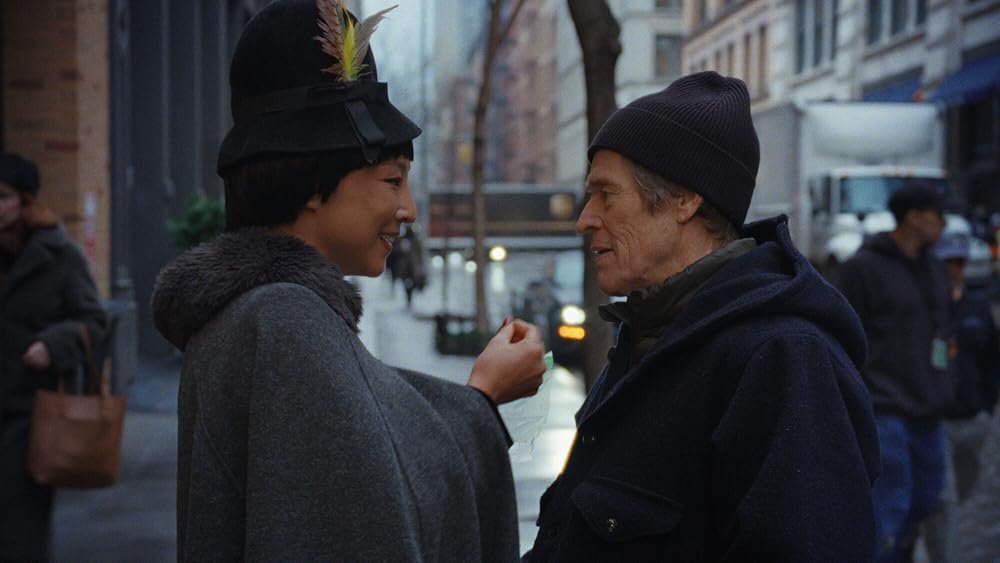
I spoke with Jones about the role of poetry inside cinema, the self-importance that comes with institutional power, and why a shared love of art is the baseline for his closest friendships.
This conversation has been edited and condensed for length and clarity.
Ali El-Sadany: I want to start with Ed. I see him as someone who made something a long time ago, and he's spent the years since convincing himself he's made peace with it. Where do you find yourself in that balance, not as a filmmaker, but as a person?
Kent Jones: It’s different. Willem and I discussed this before we started shooting. He asked, “How do you think he came to give up poetry and just work at the post office?” And I said, things happen. Poetry is so ephemeral. It's not like saying, "I want to be really famous, I think I'll be a poet." That happens by accident—sometimes to great people like John Ashbery, sometimes to people who aren’t that great and don't need to be named. It's more like: Okay, there's a job at the post office. I'll take the civil service exam. The benefits are good, I'm here in New York, I can deal with that. He winds up forty years later in an apartment with books lining the walls. Poetry is part of his life. It's not that it's stashed away and forgotten; life just goes on.
With me, I've never been outside of it. I've done a lot of different things, but I've always aimed toward making films. I just took a different, longer path. To write about films is one thing; to make them is something else. You never really understand them until you're making them. When I was making Diane, I had a moment very early on—the second day of the shoot—where I was in the middle of planning some elaborate thing, and I just sat down and felt, Wow, am I really up for this? I don't know. And then I thought, Ah, but it doesn't matter how I feel. I just have to do it. It was the same with this. I just did it.
AE: The poem in the film is something you wrote. I'm curious how you arrived at it, and what you think poetry should actually be doing inside a movie. It has to carry a massive amount of weight while looking like it's carrying nothing.
KJ: It’s a long answer. I'll start with Samy [Burch]’s script, which I preferred to Schnitzler's harsher novella. The reference points were different for Ed's past. In the original script, he came to New York in the ’60s rather than the ’70s—the coffee houses, Washington Square, folk singers, the Weather Underground bomb going off on 13th Street. But that would have made the character eighty-five or eighty-six years old. It’s possible for someone working in the post office at that age, but not probable. And how many actors could possibly play that part? Well, one.
Because Willem's character was coming to New York around the same time I did—and the time Willem did, roughly—it was important to think about what kind of poetry he'd write. We focused on a particular kind of New York School: a little bit of Kerouac, Ashbery, Allen Ginsberg, Frank O'Hara. The voices he's listening to in his apartment are the poets he and I listened to when we were young: Ezra Pound, Lorine Niedecker, William Carlos Williams, H.D., James Schuyler.
In the original draft, the poetry was very approximate. I turned to my closest friend, Peter Gizzi, to whom the film is dedicated. We’ve known each other for fifty years. I brought cinema to him; he brought poetry to me. I asked if he could write something, or if we could use one of the poems he had already written. Willem and I discussed it, but neither of us felt like it was quite right. I finally realized it had to be specific to the character. If it's not, it doesn't work. So I sat down and wrote it myself. I'm happy with it. It adds another layer to his past, his relationship to this woman, and the lure of coming to New York. Plus, it’s got a couple of movie references in it.
It's one thing to have poetry in a movie; it's another thing to figure out what it’s actually doing in the movie. When I was making Hitchcock/Truffaut, I felt you couldn't make a documentary with a lot of clips and just have them be clips. They have to turn into something else through the elements of your own film. With the poetry here, the question was: what is every voice doing? It's not just hearing a bunch of poets. It all has a bearing on Ed and who he is.
AE: I want to go back to Peter. It's beautiful that you dedicated this to one of your closest friends, someone whose relationship with you has gravitated around making and consuming art. My closest friends are the ones I've watched movies with. The reason this website exists is because my love language has always been, "this movie reminds me of you." Talk to me about your relationship with him, and the other people this movie is for.
KJ: It reflects most of the relationships in my life, really. With Pete, it goes back the furthest. The grounding of mutual love and respect for art—all different forms of it—is vitally present and vitally important. That also goes for my relationship with my wife. She's the costume designer, and what we've learned from each other over the years is unbelievable.
Experiencing movies with my sons, and now my younger daughter, is huge. They're all in the movie. My sons are congratulating Willem after the reading; my daughter appears with my wife walking into a bodega; my ex-wife Maria is there. Pete is there at the end of the movie, sitting down and reading while Myers is having his meltdown. He's not doing a fucking thing because he'll never be an actor.
If I'm being brutally honest, a lot of my closest friends are filmmakers. My friendship with Brian De Palma, with James Gray, with Marty [Scorsese]. It's there at the core with Olivier Assayas. I reflect on my relationship with Olivier, starting with me watching his films and responding to them. I felt like nobody else in America was thinking about his movies, and they spoke directly to my experience. I wrote to him, we started corresponding, and when he came to New York with Cold Water, we became friends. It was born out of mutual love and respect. He always encouraged me to make films. It's hard for me to imagine close relationships with people who don't have that kind of shared ground.
AE: You said earlier that poetry happens by accident. A lot of what people fear about AI is that it threatens accident, that it optimizes toward the deliberate. Do you buy that fear?
KJ: The thing about AI is, it's a tool. If people would calm down and understand it as a tool, that would be great. They posit it as either a threat or as something that's going to solve all their problems and take care of everything. Get real. It reminds me of the whole Y2K extravaganza, which was ridiculous.
I'm not saying I'm going to walk into a room and if you don't want to talk about the films of Jean-Marie Straub, I don't want anything to do with you. It's more that you have to appreciate art. You have to know how to engage. There are people who aren't artists, who don't go near art, but who nonetheless have a recognition of something beyond everyday life. But it's also a recognition of how easily you can be swept up in the opposite. For instance, the word "content"—I find it really horrifying. At the same time, I understand why people get swept up in things that are so commonly used.
AE: I love that thread, because the reason my site, FilmSlop, exists is to resist that exact idea of "content." I used to write for places that gave me access to glamorous spaces, but the content machine washed over me. It was intoxicating, and it pulled me away from why I was writing. In the film, Ed has this rediscovery late in life, and the attention is similarly intoxicating and corrupting. You ran an institution that depends on the same attention economy you're calling horrifying. The festival needs press, needs hype, needs the apparatus to function. How did you sit with that contradiction while you were inside it?
KJ: It might not have been actively in my head when I was creating it, but your experiences are your experiences, and they go with you. And you're right about that dynamic. The thing about the film festival is, there's a kind of self-importance that creeps into that role. If I had been younger, I'm sure I would have fallen for it and exercised it.
But at that point in my life, people would ask me, "What are your themes this year for the curation?" And I was just like, "I don't have any. The theme is: what are the best movies that we saw?" That's about it. The point is getting it in front of people and having them respond. It’s not about me pronouncing judgment so that everyone else will now "see the light."