
Meriem Sakrouhi on ‘Mon Taxi’ and the Tax of Distance
Leaving your home behind to chase a better future comes with profound sacrifice. As I've gotten older, I've realized that one of the most defining sacrifices for my parents has been watching their relationships with their family back home stretch across an ocean. As a first-generation kid, I've been fortunate enough to grow up with my immediate family in the same country; I never had to leave everyone I knew to build a life somewhere else. The distance in my house has mostly been internalized through my parents’ distance, and I've watched entire relationships confined to the screen of a phone.
I use the word "confined," but I don't think I'd describe the phone as a prison. I grew up watching my parents access a different version of themselves when calling their family back home. They become more animated, entirely in their element, using a language that seems to pull a vibrancy out of them that English never quite does. The phone can make the distance painfully obvious, but it is also the physical place where those relationships live.
When Meriem Sakrouhi left Morocco at seventeen (first for Spain, then Chicago, and then to New York), her relationship with her father came alive through the phone in much the same way. For more than ten years, she took him with her on her commute. She called on her way to various places, and he stayed with her until she arrived at her destination. Sometimes she complained and sometimes he walked her through the morning news he had already sifted through for her. He always picked up, even during meetings when he’d answer on video, turn the camera around to show her everyone sitting there, and whisper that he'd call her back. The phone may have started as a bridge across the distance between them, but it quickly became the very architecture of their relationship.
When her father passed away, Sakrouhi kept calling him. Those messages eventually became Mon Taxi, an eight-minute film assembled from the voicemails she continued recording while walking the streets of New York. In the film, she speaks to him in Darija, French, Spanish, and Tarifit, moving fluidly between them without explanation, because each language accesses a different mode of expression. She refers to him across these languages as Papa, Baba, Papito, and Babainou, each invoking a different side of him. Tarifit belongs most specifically to her father's side of the family, a language she does not speak fluently and has few others to speak with, making it a distinct inheritance from her dad. In that unique combination of languages, they forged a shared language. Through this small collection of words belonging solely to their relationship, she finds a way to keep a piece of him in motion. Entirely self-directed, edited, and produced, Mon Taxi is the first Moroccan short film to premiere at Tribeca in twenty years.
I'm no stranger to what a phone can mean when someone you care about is far away. I've watched my parents rely on it to stay close to the people they left behind, and I've relied on it myself to keep various connections and through stretches when I've been far from my own family. There is comfort in knowing the person is accessible to you through your phone. There is a comfort in knowing that you have something tangible to represent your relationship with someone important to you, that however much distance has opened between you, the relationship will never disappear into it. Sakrouhi's film takes that feeling somewhere I had never really considered: what happens when the person is no longer there to answer, but the relationship still feels present enough to call?
We talked about distance, shared languages that exist between two people, what it means to continue a relationship after death, and what it means to share a bubble so personal with a room full of strangers.
This conversation has been edited for clarity.
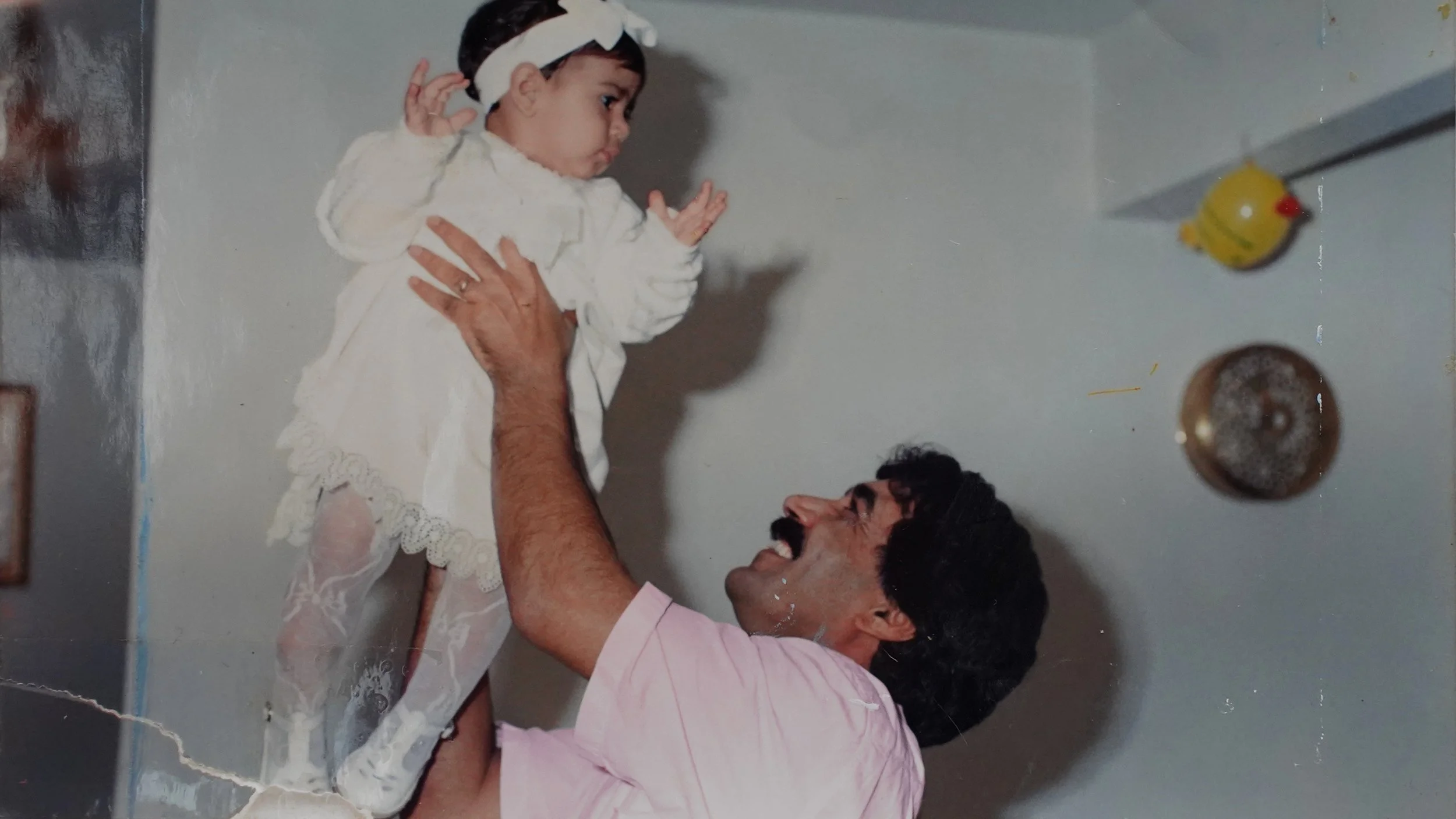
Ali El-Sadany: Your film struck a chord with me. My parents are both immigrants from Egypt, and what you did in eight minutes moved me. I want to start with the daily ritual of calling your father. He was the invisible driver on your commutes and a sounding board for your wildest ideas. Why did that one call carry so much weight?
Meriem Sakrouhi: I was born and raised in Morocco, and I moved abroad pretty early, first to Spain and then to the US. I was 17 when I left. My relationship with my parents changed when I did, in a positive way, or a different way. I almost feel like I started talking to my dad more than I used to when I was at home, because at home you take it for granted. You're sharing the space, you talk, but when I moved it became more intentional. It happened naturally, because I was living in very walkable cities. I've been in New York for over ten years now. I'd call him whenever I left my home and was walking somewhere. Meeting a friend for coffee, going to a day job, going to the theater, walking by myself, I'd pick up the phone and call him, and it was almost like he was driving me to the place. We'd talk and catch up. Sometimes it was mundane things. Other times he'd give me a briefing on what was happening in the world. He was my news source, which was great, because it was almost like a filter. He filtered what was true, because he'd already done the research, and then he'd tell me. Other times it was me complaining to him. It depended on the day. Sometimes it felt like monologues, sometimes he was the one talking more.
It was a gesture that became a ritual, and I didn't realize how important it was in my life until I lost him. When I lost him, I started realizing the hardest part of the grief was not having those mundane moments. The calls became the thing I missed the most about my relationship with him.
AE: How has the bond with your father changed since? Do you still leave him voice notes? Does the relationship still feel like it's evolving, or has it settled into something more fixed?
MS: I didn't realize this until it happened, but I feel like I'm continuing the relationship with my dad. It's a different relationship, but it still exists, and knowing that's possible has given me a lot of peace. I feel grounded. I still leave him voicemails. When I got the call from the head programmer, Ben Thompson at Tribeca, I called my dad right after. I was crying, I was excited, and he was the person I wanted to call. So I called him and left him the voicemail. I posted a little snippet of that on my Instagram, and a lot of people related to it. It had over 25,000 views immediately. I got messages from strangers telling me they couldn't wait to see the film, that they really related to the story and the way I was talking to my dad. It validated that it's good to share these kinds of stories, to be personal with your work, because there are people out there who want to receive it. My relationship with my dad is still strong and still going.
AE: Your relationship lived across an ocean even when he was alive. I've found that when I'm far from my parents, I sometimes feel closer, because I'm making more of an effort. For years you were calling your dad from another country. How did that distance shape the closeness when he was alive?
MS: Definitely for [the] better. I felt closer, I felt more part of his daily life living abroad and calling him than I was when I lived in Morocco. My dad worked a lot. He worked all the time, and when he retired he was a writer. But one thing he always did was answer my calls, even when he was in meetings, which was awkward, because he'd answer and a lot of times it was a video call and he'd show me everyone and say, I'm eating, I'll call you later. He always answered. If he didn't answer a call, I'd be so worried, because I knew he stopped everything. My mom would joke that I called him around 10 a.m., during a time when I had a full-time job, and he'd just be around the home waiting for my call, making sure he never missed it. It became a ritual, and it made our bond very strong. I already had a special relationship with my dad, but moving made it even stronger.
AE: Listening to the calls, you move between Darija, French, Spanish, Tarifit. When I think about my parents, I always think in Arabic, and it's black and white for me. Yours is so fluid. Which one do you reach for when you feel close to him? Do you complain in one, dream in another?
MS: In Morocco, you probably already know this, we mix a lot of languages, mostly Arabic, or Darija, which is the dialect, and French. In the north, because of the proximity to Spain, we mix in a little Spanish too. And there's another language, Amazigh, or Tarifit, from the Rif area of Morocco. My dad is indigenous from North Africa, from the Rif, and he speaks Tarifit. That's the language I'd only use with my dad and my grandmother and grandfather on his side, because they're the only ones I speak it to. I don't speak it very well, but I have a few sentences and phrases I only say in Tarifit. Some are in the film, the little ones. Even the way I call him changes. Sometimes I call him Papito, from Spanish. Sometimes Papa, from French. Sometimes Baba, from Arabic. And sometimes Babinu, which is dad or daddy in Tarifit.
I wanted the film to be authentic, so all my voicemails were true calls I made to my dad after he passed. I was talking to him the way I usually do, very fluid, mixing all these languages. The only language he didn't speak, of the ones I speak, is English. So the film combines all the languages I do speak to him. As for dreams, it depends on the subject and who I'm dreaming about. If there are people involved, I tend to switch languages depending on who I'm talking with. With my family it's mostly Arabic and French, and then a few words I'd only say in Spanish, or only in Tarifit.
AE: He once saw a screening of your film without knowing the language, reading the room around him, getting it through the audience's reactions. Your film does the inverse. A lot of people won't understand the language, but they can read his tone. What would you most want an audience to understand about who your dad was?
MS: I loved my dad. I had an amazing relationship with him, and he was very soft. In Morocco, in a lot of ways, Moroccan men are perceived as machismo, as patriarchal. My dad was so tender, so soft and encouraging. I'd love for people to get the sense that there are different types of relationships in every country, that it's not always the stereotypical things you hear. That's one thing. Otherwise, I'm hoping the audience understands that it's okay to be vulnerable and authentic, that there's strength and beauty in it, in sharing your emotions. I hope that by sharing mine, it invites other people to share theirs.
AE: The relationship uniquely belongs to you, but now that the film is premiering and getting reception, it belongs to something beyond you. What's that like?
MS: I'm excited about the relationship part. My relationship with my dad was amazing, and I hope people will love my dad a little, just from watching the film, and that it might inspire them in their own relationships, with whoever that person is who helped them or took them places in their life, whether it's a parent or someone else. But part of me is also nervous, because I'm being emotionally naked in front of a full audience. A lot of the things in the film I haven't shared with even my closest friends. There's one quote where I say, "Hey, Dad, I feel like I can't breathe." That was really hard to put in the edit. I cried while I was doing it, because I felt so uncomfortable, but at the same time I wanted to be true to how I was feeling. It felt more comfortable telling my dad that than telling anyone else. I don't want to put people in an awkward position. Sometimes people struggle with how to answer grief. It was easier to put in the film.