
Homeward Bound: Myrsini Aristidou’s Return to Cyprus in Her Debut Feature ‘Hold Onto Me’
A note on exonyms: major cities in Cyprus were given exonyms — anglicized names coined by the British who colonized the island in the early 20th century. The most common of these exonyms, Nicosia and Limassol, are used by natives and immigrants alike, as well as their original endonyms, Lefkosia and Lemesos. The names will be used interchangeably in the following interview.
There is an ever-ticking clock which counts down the remaining days of summer in Cyprus. It begins steadily in June, creeping louder as the days turn hotter. By August, it is so woven into the fabric of your consciousness, you can forget it’s even there. In the fig trees, on the pines, hidden in the juniper shrubs, the sound rings against the stillness of the summer air. It is the song of the cicadas, and their chorus of cacophony serves as the soundtrack of summer for many Cypriots. For Myrsini Aristidou, writer and director of the film Hold Onto Me (‘Κράτα Με’), their song was a fundamental - if not inescapable - element of her film. When I ask how she went about depicting Cyprus on-screen, she pauses, looking out towards the coastline. “I think the sound was more important for me. Like these cicadas, you know? The incessant sound of cicadas that just never stop in the summer, I use them a lot in the film… I guess it’s very much the sound of Cyprus in many ways,” she tells me, reflecting on the film’s sonic identity.
We are in her hometown of Lemesos, seated across from one another in a shaded corner on the terrace of the Four Seasons. Beads of condensation streak the glasses of our freddo cappuccinos as Myrsini rolls her cigarettes so deftly, you might blink and miss it. She carries elements of her travels on her person, adorning them like a map of her life: the Louis Vuitton tote she rummages inside as she tells me of her time in Paris, the floral silk blouse she got from her recent trip to China, and her unmistakable confidence, worn with the ease of someone who met the NYC grind and hit the ground running.
Her film, Hold Onto Me, is a story about Iris, a young girl who is as curious as she is headstrong, and Aris, her cunning father who has been absent most of her life. When Aris returns to town for his father’s funeral, Iris embarks alongside him on a journey of introspection and petty crime. The film is the first Cypriot feature to premiere at the Sundance Film Festival, and was announced as the official submission from Cyprus to the 99th Academy Awards for Best International Feature Film. However, Myrsini maintains that she did not set out to make a film about Cyprus. In our interview, we discuss the nature of vulnerability, making a movie in a heat wave, and the value in returning home.
This conversation has been adjusted for length and clarity.
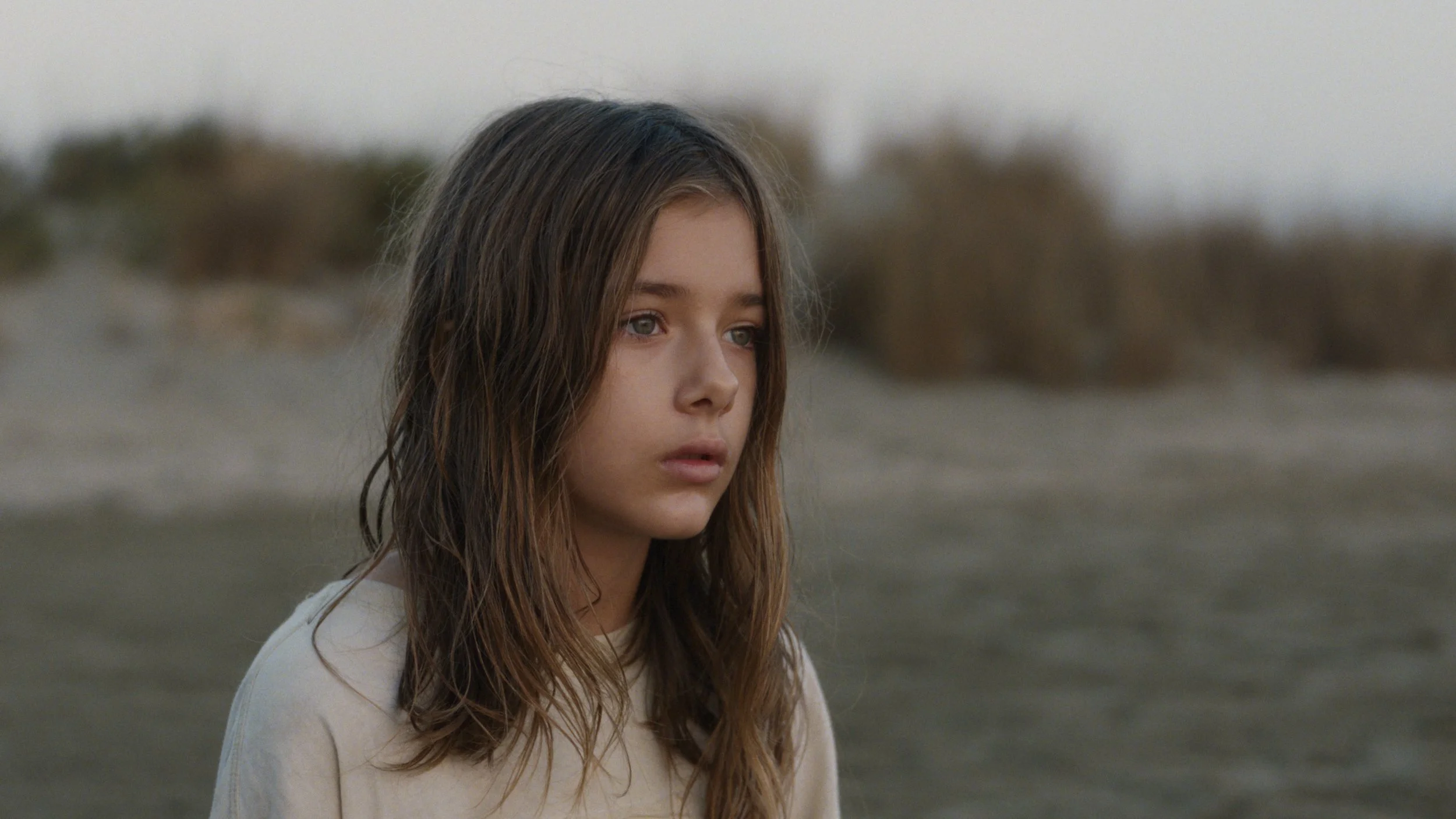
Alexia Angelides: For most audiences, Cyprus is not a country they are familiar with, culturally speaking. When you were depicting the story between Iris and Aris, how did you approach capturing Lemesos on film?
Myrsini Aristidou: I guess I chose not to show the developing parts of Limassol, which has changed a lot since I was growing up here. I wanted to show more of the natural areas. We actually also shot in Nicosia, so it’s not all Limassol, but I wanted to show a bit more of the marginalized neighborhoods of the island. I did shoot in the Cypriot refugee neighborhoods, so it doesn’t exactly represent Cyprus or Limassol as it is today, but in a way it does, because there are people that live in those areas, and the nature is the same… the sea is the same.
AA: The film features two stunning performances from the leads, Maria Petrova and Christos Passalis. You’ve spoken about your desire to allow for a natural dynamic to develop between the two of them during filming. Was there any particular moment on- or off-screen where you felt they had locked into this vision you had for their characters?
MA: It was interesting, because I didn’t have time to rehearse with them at all before the shoot, so we just did a reading the day before, and then we started shooting. I think Christos was kind of trying to be nice to her and funny, and she was being really shy and reserved and not really giving into his jokes or anything, so I don’t think she really liked him in the beginning, which actually worked for me. Even though we were not shooting the film in order, it was okay to have this kind of off-beat relationship between them at times, because I did want them to be awkward with each other, being that [the characters] don’t know each other. But during the shoot—and I mean, we were shooting for two months, so during that timeline they got to know each other more and hung out more behind the scenes, and it did bring them together. It happened gradually, as it happens in the story, and so it was a very nice evolution of that dynamic, and I tried to use it as much as possible.
AA: I think that sort of honesty shows up in the film.
MA: Yeah, like in the moment that she first sees him at the shipyard, it was early on in the film, and she still didn’t like him, so many of her facial expressions were very honest.
AA: I was really surprised to hear that this was her first on-screen performance. How did you go about casting her?
MA: Well, I was worried that she didn’t have experience, but then when I first saw [Christos and Maria] together in casting, I felt like they looked very much alike and kind of looked like family. And I liked that their dynamic was a bit off-beat or strange. It wasn’t easy in the beginning because she didn’t know exactly how to say things or do things. But on the other hand, children have this natural thing that, because they’re not self-conscious, they don’t care about the cameras, they don’t care about many things that adults start thinking about. So yeah, it was a combination of things. I think she was very natural in front of the lens in many ways, and she’s a very mature kid for her age, so she would listen. But performance-wise, if she couldn’t get there in a scene interacting with other actors, I would navigate the other actors to navigate her in the scene. It’s a combination of many things to get a good performance — or what turns out to be a good performance in the final version of the film.
AA: I found it incredibly cohesive, and she brought a sort of childlike stoicism to it.
MA: Yeah, exactly.
AA: Was that a surprising shift to see, in its final form, how her performance came together?
MA: I think it’s a combination of her character, of the script, of the way I chose to shoot it, and the way it was edited, ultimately, based on what I got. They always say there’s three films you make: the one you write, the one you shoot, and the one you edit, because at the end of the day, you can only use what you have.
AA: Speaking of the actors, Christos Passalis, who is best known for his work with Yorgos Lanthimos in the 2009 film Κυνόδοντας (Dogtooth) — did you have him in mind for the role initially?
MA: I did, actually. It was very interesting, because I first saw him at the Thessaloniki Film Festival in 2019. I saw him at a bar and I was like, “Ah, that’s an interesting face.” I found out he’s an actor, and I had already written the first draft of the script at that point, and I thought he could be very interesting, at least physically, for the character I’m looking for this role. So I did have him in mind. I did a casting of a few actors in Greece and in Cyprus, trying to find who could do the part better, but he’s an excellent actor, Christos. He works very hard, he’s very intelligent, he has a great personality as a human being, and I think that matters a lot when you choose your actors. And he also doesn’t agree easily. He hadn’t acted in many films at that point and was doing more theater, so he had just started to consider going back. In the past couple of years he’s done more movies, but at that point, he was more involved in theater. He really liked the script, because it connected with him, and I really liked that he was connected to the story. I think that he also felt like it could have been a challenge for him to play the role, which is always something actors like, because he’s not a father himself. But it felt like the right dynamic.
AA: Since the Cypriot dialect is so distinct from that of mainland Greece, which maybe not a lot of audience members would be aware of, did you take that into consideration during casting?
MA: Yeah, of course. In the beginning I felt like it would be inauthentic if I didn’t shoot it in Cypriot, but on the other hand, the film is a little placeless. It’s not like you know you’re in Cyprus, it’s not like they ever say “We are in Cyprus” or “We are in Limassol” or anything. I think it got marked as that because I’m from here and because I shot it here. In a way, this could be any coastal town in Greece, and so I felt like it didn’t matter to me, to know that we’re in Cyprus, but also I knew I was going to have a mix of cast between Greece and Cyprus, and it felt like it’s better to have a cohesive language where everyone speaks in Greek, so there’s no mixture of dialect. And it’s easier for Cypriots to speak Greek because we learn it in school, so that’s how the decision came, after the casting was locked. I wanted to have the liberty to choose the cast that I wanted for the film. Also, Cyprus is a smaller industry, so you don’t have so many options to choose from, so ultimately you have to do this mix, usually.
AA: You brought up an interesting point, that in other publications and interviews, it was discussed as a film about Cyprus, with a large emphasis placed on the fact that this was shot on location and with Cypriot crew and cast members. However, you’ve talked a bit about searching for liminal spaces and maintaining a sense of anonymity. Do you feel like that’s something you want to continue exploring in your future work, or do you have interest in Cyprus as a subject?
MA: I think each film has its own direction, and this was supposed to be a personal film for me, returning back to my country after living abroad for many years to make a film. I wanted to capture the days of summer in Cyprus, and how they can be very quiet and kind of desolate and hot. At the same time, the locations I chose are meant to reflect both characters. I think that every decision when you’re making a movie should be cohesive. That’s how you actually make a movie, you know? It has nothing to do with your ego or what you want to do sometimes. I love action films, those are the movies I’d want to make, but this story needed that thing — it needed that aesthetic, that kind of movement, that emotional art. Also the budget it had: it’s an indie film, it’s not like I could do a great action film with the budget I had in Cyprus. So you do what you can with what you have, and at the end of the day the intention is always to follow through with the story and the characters.
AA: Even if it wasn’t your intention to make it explicitly known that this was Cyprus on film, I feel like there were a lot of moments that felt like an inside secret, little nuggets you were giving to your Cypriot audience members. One scene in particular stands out, when Iris is walking down the road and you can see the φαρμακείο (pharmacy) lights behind her. Little moments like that, and details which you included, very much lent to the visual identity of Cyprus. Were there any others that you incorporated, maybe not to distinctly identify Cyprus, but to construct the feeling of home and the visual language of the film?
MA: A lot of the dirt roads and the places that [Iris] walked kind of remind me of my childhood and the places we would go on motorcycles and explore, and things we would do as kids, like going and finding these desolate, disgusting, dusty places to hang out and light fires and just hang around. They’re very personal memories, and I guess they could happen anywhere else in the world amongst kids. This could be happening in Louisiana as well, or Texas, even. I think the sound was more important for me. Like these cicadas, you know? The incessant sound of cicadas that just never stop in the summer, I use them a lot in the film.
AA: As for the soundscape, that was absolutely one of my favorite parts of the film.
MA: Yeah, I guess it’s very much the sound of Cyprus in many ways. It’s hard to capture the sound of stillness.
AA: And you were filming in August?
MA: In July and August, and some days in September.
AA: Those are like, the hottest months of the year!
MA: Yeah, it was terrible! It was very, very hot… There was a heat wave that lasted for weeks on end. It was a difficult shoot. I don’t think people were happy that we had a lot of exterior scenes. Ideally, we had wanted to start a bit earlier, maybe in June and July which is a bit milder, usually, but it didn’t happen, so we shot in the hottest months of the year. It made things complicated, really, but I guess it worked out in the end. And I don’t know if you can even feel it in the film, that it’s so hot!
AA: You can hear it more than you can see it.
MA: Yeah, exactly.

AA: So, following your short films Semele and Aria, you’ve described Hold Onto Me as the final installment of a triptych exploring father-daughter dynamics. With this film, what do you hope the audience leaves with from the story?
MA: The intention was mostly this idea of being young and vulnerable and looking up to someone who is supposed to represent so many things: the father figure. I guess, for me, the last shot of the film says it all, but I don’t want to give it away. There are a lot of themes in there, starting from the fact that they reconnect, and there’s a generational aspect. He returns because his own father, her grandfather, has passed away, and I think when that happens to someone, regardless of age, there’s a strong identity crisis going on where you maybe start realizing, “Okay, now I don’t have this figure in my life, how do I assume this role or become this person for myself?” And if you haven’t gotten there yet… I think it is a shock to the system, even though death is just part of the cycle of life. So I wanted to create that dynamic, where it’s his loss that also forces him to return, and her showing up with an expectation, without directly telling him that, but showing it. And he opens up to that vulnerability so slowly, through his own grief, so there’s that reconnection through the loss. There always has to be a death for there to be a birth or a rebirth, and so that was an important part of the realization of the story.
MA: At the same time, there are a lot of themes of forgiveness. I’m not saying we should forgive everyone for shitty behavior, but I think in this case, they both take actions towards arriving there, to a tighter relationship. It doesn’t happen only from one person, which I think is very important; it always takes two. In their own ways, they both move towards each other. They’re dancing towards each other throughout the entire film in order to arrive at some sort of acceptance and coexistence, if you can call it that. I guess ultimately what I feel about this is that it’s important for us, whether as children or adults, to come to an understanding and acceptance of who our parents are. Psychologically, it’s important.
AA: Seeing them as individuals?
MA: Yeah, because it also defines a lot of our relationships in our adult life. Coming to an acceptance and understanding of that relationship really helps you have better relationships as an adult. I think that was the intention, to shine light on that relationship, and how we grow from it, and hopefully make people reconsider it.
AA: It’s a harder dynamic to break through, the one between father and daughter. Across cultures, there is a bit of emotional distance that comes with expectations for the two roles, traditionally speaking. There is a scene where Iris, who is something of a tomboy, is filming a TikTok dance with her friend who is a bit older and girlier than her, and is not interested in it at all. How did you take gender roles into consideration with her character?
MA: There are a lot of gender dynamics in the film. Her friend is older and more in touch with her feminine side, while Iris is still in this age in which she’s more a child. You can’t call her a woman, she’s still becoming a woman. And I feel like many times, the absence of the father is what makes a girl more of a tomboy, because when you grow up that way, you have a sort of independence. There were no real boundaries growing up in that specific household, because it was a single mother raising them alone and working, so I think it formed a stronger personality. Maybe I’m wrong, but when your father is around as a young girl, if you have a good relationship with your father, and they’re present and they’re a provider and they’re there to set boundaries in a household, it does allow for a girl to be more in touch with her feminine side. But when that role is missing, then you can go through that exploratory territory, where you’re kind of everything. I feel like the presence of her father does soften her, and turns her more into a girl.
AA: Especially towards the end, where she’s allowing herself…
MA: …To be protected. Yeah. I think that’s a very important dynamic that we should allow to exist, regardless of how strong we have become, as women, and independent and self-sufficient. I think it’s really natural that we find solace in that embrace.
AA: With that dynamic in mind, some fans on Letterboxd have drawn parallels between your film and Peter Bogdanovich’s Paper Moon. Were there any influences which you drew from when writing the story of Iris and Aris?
MA: It’s funny, because I watched the film after I had written the first draft. I actually think I wrote the first draft, and then someone told me, “Oh, you should watch that film because it’s very close to what you’re trying to do.” And then I watched the film and I was like, “Fuck, this film is so great.” I think the dynamic is similar. In that film, though, we never really know if he’s actually her father or not, and he is kind of a vagabond. And I like that she wants him to be her father, but he denies it, and it’s a tense relationship between them. So there is definitely that similarity, I’d say.
AA: But you weren’t familiar with it beforehand?
MA: Before I wrote the first draft, no. But then I saw it, and I guess after, I reworked the script and everything. But that film is a masterpiece for me, I don’t think my film gets close to what Bogdanovich did there. There’s a similar dynamic because of the oddness of the relationship and the things they do together, but that was always part of what I wanted to write, regardless, because of my own childhood experience and personal dynamic with my father.
AA: Getting back to you and your journey as an artist, you moved to New York City over ten years ago, and you’ve lived in other parts of Europe recently, as well. Many young Cypriots have aspirations of leaving and establishing themselves elsewhere in the world. Of those who do, they find it difficult to return to the culture and pace of the island. As a Cypriot and as an artist, how do you approach merging your lived experiences outside of Cyprus, and how do you bring them back home with you?
MA: I think it’s true that, when you live abroad for many years, it’s hard. Especially in a place like New York, which is completely different from Cyprus, where you’re plugged in 24/7. I feel like it’s not easy to come back to Cyprus, because things are slower here. But there is something that happens in Cyprus; I find myself being way more introspective here, and way more in touch with nature and my feelings and my soul, and I like that. I think in an ideal world, you need both. You need to be out there to explore and get inspired and energized, and then come here and introspect and figure out what’s actually happening, and then reflect and create. And I guess that’s how it worked for me, because when I lived in New York and then I would come back to Cyprus in the summers, I always felt this peace. I could go to the beach and things were quiet, my family is here, friends are here… It just feels like a safe space in many ways, and I like creating in places that I feel safe. And then growing up I realized, by living in many countries around the world and moving around a lot, that I am my safe space at this point. Doesn’t really matter where I am — I am my home. So I guess the trick is finding that peace wherever you are. Especially for the film industry, it wasn’t easy to return here, being that it’s a small industry and there’s not a lot going on, but I think it was important for me to do it for my own personal reasons.
AA: Did you always know that you wanted to explore outside of Cyprus?
MA: Yeah, I always wanted to leave, always, all the time. I mean I did travel a lot as a kid because of my mom’s work, so I was a traveler from a very young age, and I knew that I was going to live abroad. I kind of thought I would have never come back… But here I am now. I don’t know if I’m going to stay, but here I am now. I always knew I was going to leave. Like many kids in Cyprus, we all study abroad, many stay longer and work, and then at some point, everyone returns. They return when they want to have a family or have children. I guess a movie is a child in some type of way, so I returned to do that, to give birth here. For my journey and my soul, maybe that was my reason for wanting to come back, because it’s safe here. It’s easier to have a family here than anywhere else — when you’re from here, especially. It’s an island, so you do feel trapped growing up here. The sea is all around you so all you can see is this horizon and the distance of where you could go, and so the desire to leave, or the dream of crossing that horizon and going to faraway places and discovering new cultures and perspectives, and learning and growing and experiencing life, for me, was always a big thing. And it still fulfills me so much, so I don’t think that’s ever going to change.
AA: Like a constant yearning?
MA: Yes. It used to be that I felt that life is taking place elsewhere and I’m here, but now it’s less of that and more that life is everywhere. Allowing yourself to experience all aspects of it, wherever you are.

AA: Do you think that leaving was able to give you that shift in perspective that allows you to appreciate life here?
MA: Absolutely. When I moved to New York, I knew no one, I had no family there or anything, so I was 18 years old in this huge city. It was a big thing for me to be there at that age, and was definitely a growth experience. You have to learn to hustle and survive, and you’re far away from home, and there’s a time difference, so you can’t call anyone at any time of day. If something happens in the afternoon, you’re fucked! You have no one to call back home, really, so you have to figure it out, and I think that gives you a lot of strength and builds a lot of character. I can definitely say that, since my early adult years were all there, it built that character in me. It was a challenge, but I’m drawn to challenging situations if they’re going to bring growth. I take them as they come.
AA: Did you bring any pieces of home with you when you first moved to the States?
MA: I can’t remember if I had taken a stone with me from the beach, or sand in a little bottle. I think my mom gave me sand in a little bottle? But I was very ready to leave Cyprus, so I kind of wanted to start a new life and not carry things with me.
AA: A clean break?
MA: Yes, in a way. I feel more tied to the things I brought from New York back home. Whenever I go to New York, I feel like it’s also home. Even if it’s changing and different all the time, shops close and new ones open and everything just keeps shifting, it feels like a second home.
AA: And you said you moved when you were 18? That’s like entering a whole new stage of life
MA: Yeah, and for the first time, belonging to a community of artists and creatives which I didn’t have here in Cyprus. I was in a private school with people that wanted to be lawyers and accountants, so I was a misfit, I was an outsider, anyway. And growing up in a very unconventional family, for the first time in New York, I felt like I belonged. I was actually not a misfit at all. We’re all the same there. There’s a beautiful humanitarian thing going on in New York. Everyone arrives for different reasons but everyone can belong. I wonder if everyone in New York is either escaping something or working towards something. It might be both.
AA: Having come back now to Cyprus as an adult, do you still feel that you struggle to find an artistic community here?
MA: Yeah, I still don’t have it here. But I don’t mind that. I have it abroad now, so I can go and find it whenever I need it, and then when I come here, I’m here for other reasons: to be close to nature, to my family or maybe childhood friends. I’m here to be closer to the things that are familiar, closer to my roots. And then when I need inspiration and the artist community, the fact that I lived abroad created those kinds of communities for me, so I can always go back and find them, and now they’re all over the world. There’s a global dynamic going on which is why I don’t feel like I’m anywhere ever, on any given day I feel like I exist in many places because I’m in touch with people from all over the world.
AA: Do you ever wish there was more of an artistic haven for you here?
MA: Maybe. I mean, I’m very pragmatic about the place; it’s a small island, so it can only grow so much. It can only have that much of an expansion. I think we are doing better in recent years, and I think there are some wonderful artists here, so it’s great, but I guess it can never be a hub like New York or London or Paris, or any place where artists gather, and so there’s a lot of back-and-forth and inspiration and triggering points. I don’t expect Cyprus to be that, geographically and realistically, but nature is very inspiring, too, and so you don’t need to be in an artist community to be inspired, in that sense.
AA: As Cyprus begins to appear on more people’s radars internationally, your achievement with this film acts as a benchmark for the country. Within the film industry, it shows what is possible for Cypriots to achieve. Even though you did not intend to make this film a cultural statement, you introduced the beauty of Lemesos with honesty and sentimentality. How do you hope to see the country or the culture represented in visual media moving forward?
MA: I think it matters that we are from Cyprus. It matters because we grew up on an island that is divided, and that’s an important dichotomy of identity for us, because we are culturally and historically Greek.* I mean, half the island is occupied, which creates a feeling of unspoken nostalgia and pain, and that lessens in younger generations. But growing up in a country like this, you are always involved in politics — at least I was. We always listened to the news and we cared about the politics of the region, we cared about what was going on around us, how things can shift that maybe could shift our predicament. I think politics is naturally ingrained in our identities, being Cypriot, and I think there are many ways in which you can take that feeling and turn it into stories without necessarily having the stories be political, but that’s only if it matters to you personally as an artist, and it matters to me as an artist. Cyprus has become more multicultural in recent years, and I think it’s great. We’ve always been, actually, because we’ve always had people cross paths here — whether the Venetians or the French, or the Arab invasions or the Turks — they had a lot of influence. I actually think what’s beautiful is that we’ve maintained our Greek culture and language and traditions and origins, regardless of all these crusades that went over the island. It shows a lot of strength, because we are not many, so I guess I wish people stayed closer to that strong identity that we hold as Greeks, and culturally as Greek-Cypriots. I wish they thought higher of it.
AA: How so?
MA: Well, they’re worried. They’re so worried that with all these cultures and things that have happened and are happening, they’re diluting our identity and who we are, and I think it’s a global phenomenon. But I think it gives you a lot of strength of character to stay close to that root and the values which you carry generationally. If you are to use it in your art or not, I think it’s a very personal decision, but it matters to me that I come from a divided island. I grew up having politics resonating all around the society, and it’s part of who we are in many ways. We’re a small island surrounded by big powers, in the hands of bigger powers, relying a lot, trying to be Switzerland with everyone here because we don’t have a choice, and that creates a sort of identity as well, to be very submissive. But that’s where I think there’s a strength in keeping close to who you are, whatever you choose to be. And maybe the people of the diaspora feel it more; I think they stay closer to the roots. I felt that when I was in New York and I would meet second generation Cypriots and Greeks, they really, really love their culture and it’s a beautiful thing. I think it needs a balance, like everything — not to be too stuck in old ways, but also to feel rooted somewhere. I think that’s pretty important.
AA: My last question for you: what have you been watching or listening to lately?
MA: To be honest, I’ve been traveling so much, I haven’t been watching much.
AA: What about music?
MA: Music, definitely. A lot of it. I’ve been listening to Tai Chi music, because I just came back from China, so I was deeply inspired. I went to the Wudang Mountains, which is the place where Taoism originates from, and I guess I wanted to go deeper into the Tai Chi and Kung Fu practice and how you find the balance in your body. There’s a whole philosophy of being in flow in Taoism, which aligns very much with our own Stoicism here, but there is a certain series of movements that you do with your body to get yourself to be in that flow of energy, and yeah, I’m very much in that headspace now. I carry China with me now, it was a beautiful experience and very profound.
AA: I really appreciate your candor. You have a very strong sense of self and it comes through in how you communicate.
MA: I have arrived here. It took years to figure it out, and I think it’s important that we do that. It’s not easy to arrive to this point, to have a strong sense of self. It takes a lot of ups and downs and lefts and rights and challenges and things you don’t expect. I think that’s what helps you stay more focused to the core.
Myrsini Aristidou’s film, Hold Onto Me, will be screening in Cyprus on September 17th, 2026 at K-Cineplex theaters in Lefkosia and Lemesos.
*While Greek heritage has deep roots in Cyprus, the earliest known settlers of Cyprus are historically identified as Anatolian and Levantine