
Purgatory in a Motorhome: Mia Moore Marchant on Her Debut Feature, 'Again Again'
A few weeks ago I sat in the front row of a John Waters sermon. In his a-joke-a-minute speech he kept using the phrase “a trans” instead of "a trans person". The words sounded like a Thing. In many ways it was just a reminder that John Waters, one of my favorite queer filmmakers of all time, is very old. In other ways it was a cry for more trans-led indie films with real and tangled trans personhood at the center.
In our often bleak film landscape, it’s a joy to be in the hands of Again Again, Mia Moore Marchant’s debut feature, which she wrote, co-directed, produced, and stars in. The film follows Aggie, a trans lesbian who breaks free of a nightmarish Groundhog Day time loop, only to find herself staring down something suddenly much scarier: the unknown.
Personally, gender transition has been about presence and embodiment, but I had to first take many terrifying steps through the unknown to get here. In that void, it was easy to fill the space with impending catastrophe. I'd have recurring visions of a stranger noticing my anomalous gender expression, and sucker punching me in the back of the head for it. Watching Again Again, I couldn’t help but feel for Aggie’s habit to fill in the fate’s blind spots with mangled car crashes.
The situational horror that Aggie experiences in the time loop is a struggle invisible to most everyone around her. As a trans viewer, I reflexively related to that tortured unreality as a metaphor for dysphoria. On the outside everything is fine, but the meaningless days speed up, blend together, and push you deeper into a messy “stuckness”. With that said, one of my favorite things about Again Again is that the meaning of timeloop isn’t prescriptive. It welcomes audiences to reflect on what might make every day feel the same to them, and what changes are needed to escape it.
Again Again treats gender identity with a refreshing matter-of-factness, sharpened against the absurd backdrop of a time loop. Don't get me wrong: it's certainly a transgender story with a tortured transgender protagonist, but their torment doesn't come from being trans, the way the genre so often defaults to when in the wrong hands. When you’re stuck in an inexplicable time loop, there are obviously much bigger fish to fry, and thus better stories to tell.
Marchant and I spoke over Zoom, which she joined sporting a skeleton print outfit. We talked about demolition derbies, shitty people, boy drag, and the motorhome that shaped the film's most intimate scenes.
This conversation has been edited for clarity and length.
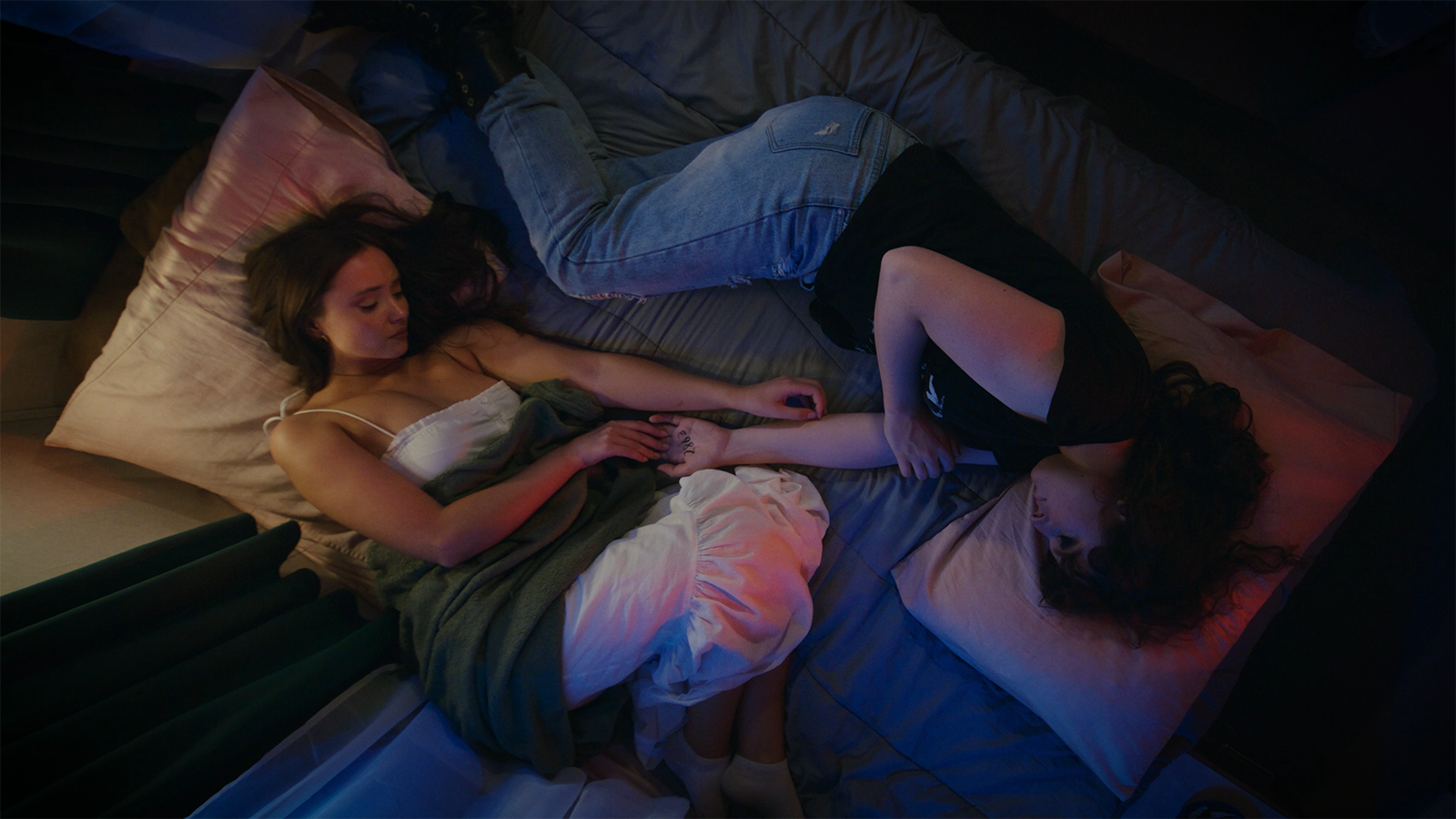
JAMIE SULLIVAN: Well, first of all, I want to say I love the film. I watched it twice: once last week to get a first gut feeling, and then again today to freshen up for this. I enjoyed it both times! Again, and again, truly.
MIA MOORE MARCHANT: So it hasn’t aged terribly in two weeks?
JS: It literally got better. As someone who is also trans, I related a lot to this film. Given you wrote, directed, and starred in it, as a viewer I assume there's a lot of Aggie you might relate to. Which parts of the character resonate with your experience most, and which feel divergent from your lived experience?
MM: I feel like both Aggie and Tess as characters are two parts of my own psyche in conversation with one another. A lot of what I pulled from my own life into Aggie was that feeling of helplessness and hopelessness — you know, worrying and catastrophizing about the future, feeling like you're about to explode, that everything is about to fall apart and nothing will ever be okay again. I wrote this movie as a way to work through those feelings.
I've never dated a straight girl, if that's what you're asking — never been in a relationship like Aggie and Tess's, that "does my girlfriend actually love me or does she just care about me as a person?" energy. And I've never been in a time loop, as far as I'm aware (though maybe). I'm grateful for both of those things, honestly, though dating a straight girl could be fun; I wouldn't know, maybe it's my time.
JS: Don’t do anything too crazy now.
As a viewer, watching how Aggie treats the people around her is something I rolled around in my head a lot. The first time I watched the film I couldn’t help but think, "wow she is sort of being a bitch," and I was slow to root for her. During the second watch I reflected more honestly with my own experience, and was really impressed with her. Before I made peace with myself, I could be messy and caustic with people I actually cared about. I thought “wow Aggie is really holding it together”, given her ability to be sort of normal during an out-of-body, time-loop nightmare. It can be hard to give ourselves credit.
There's a line where Tess says, to paraphrase, “you feel comfortable hurting everyone around you because they're not real”. My lived experience was closer to “nothing matters because I’m not real”. It was like if people didn’t like me in the first 20 years of my life they were just yelling at a shadow I put on the wall. I'm curious about your own experience with depersonalization and derealization, how that may have affected your relationship, or shaped the film.
MM: I've never been someone who depersonalizes, but before transitioning I was very dissociative. It was hard to stay in my body, or stay in a moment, without thinking about the past or future. There's something about dissociation, and about depression and anxiety, that — while people can't help it — is kind of selfish. You don't want to make the whole day about you, but it ends up going there anyway, because the people around you would have to be pretty callous not to engage with that.
It's also similar, I realize, to how people engage with each other online. I've never thought about it in terms of this movie before, but I'll be in a conversation with someone online who refuses to see me as a person, and I'll call them on it: "What would you do if you were in the room with me right now. Would you still say this? Would you still treat me this way?" People don't like that. Sometimes they do take the bait and realize, "you're a human being and I'm being an asshole."
JS: Admittedly, back before Twitter was a Nazi website, I followed you for a few years. I've literally seen this play out for you before.
MM: Someone will be publicly cruel and then thirty minutes later they're in my DMs apologizing.
JS: Brutal.
MM: Yes, brutal stuff. People will just project nonsense onto me, even back in pre-transition “boy-drag.” People love to do that to anybody online.
JS: I really loved the setting of the demolition derby. Is that popular in Aberdeen?
MM: There actually isn't a demolition derby in Aberdeen — that was shot out in Puyallup, Washington. The demolition derby was something I went to every single weekend as a kid, all summer long, as early as I can remember. My uncle was a demolition derby driver, and my brother was one too. I always felt like this is a very cinematic place, and I have to do something with it someday. Eventually I found my way to it, so I could film cars smashing into each other and catching fire.
JS: I loved that side character, Jeremy, who was mentioned early in the movie as a meat-on-a-stick vendor and then again later as a demolition driver. Stick meat was a beautiful through-line. I clocked it when the kid in the background stole a bite of Aggie’s corn dog.
MM: The kid who plays the corn-dog kid, the little psycho kid, is actually one of my brothers. The kid with the chainsaw is my stepbrother, Caleb. That was very much just me and my siblings in the basement, going "okay, be really scary" for eight or ten takes.
JS: That's so fun. I'm curious about the vibe at the derby. I live in New York City, and one of my favorite things about it is that being trans doesn’t automatically make you the wildest thing on the street. I'd imagine the derby has a similar energy. What's the crowd like — the people attending, the people driving the cars?
MM: Well, I don't think of the demolition derby as a particularly queer place. I go every summer, but I think I blend in, probably because I'm basically a redneck. Once trans people start transitioning, a lot of the time they move to the city, and I wanted to tell a story about people who transition but are still true trash, who still throw rocks at trains and spend all their time killing time in small-town Washington. A byproduct of telling such a queer story set there is that people watching ask, "are there really that many lesbians and trans people in Aberdeen, Washington?" I have to break the news — no. There are some out there, though. Mostly the people you'll meet are flannel-wearing loggers — a fun vibe.
JS: If you squint, they're all lesbians.
MM: [laughs]
JS: Aggie smokes a lot of weed in the movie. I also smoke regularly, and it can be a double edged sword. There's a line where Aggie says, "why do I have to be so fucking high all the time?" How would you answer that for her, and how does your experience with weed intersect with the story?
MM: I've never had a problem with weed — it's funny, because I'm an alcoholic, nine years sober. Alcohol was how I stayed in dissociation for so long, but with marijuana I can smoke once or twice a month and be fine — I've never had an issue with actually being too high. But Aggie definitely uses it as a tool of dissociation: if she can live outside her body, she can be an asshole to people and it's not her fault. It's the same way she engages with the time loop — "it's not my fault I'm in this dissociative state, so I can say and do whatever I want." I like to write characters who are pieces of shit, and I like that I'm not altogether like them.
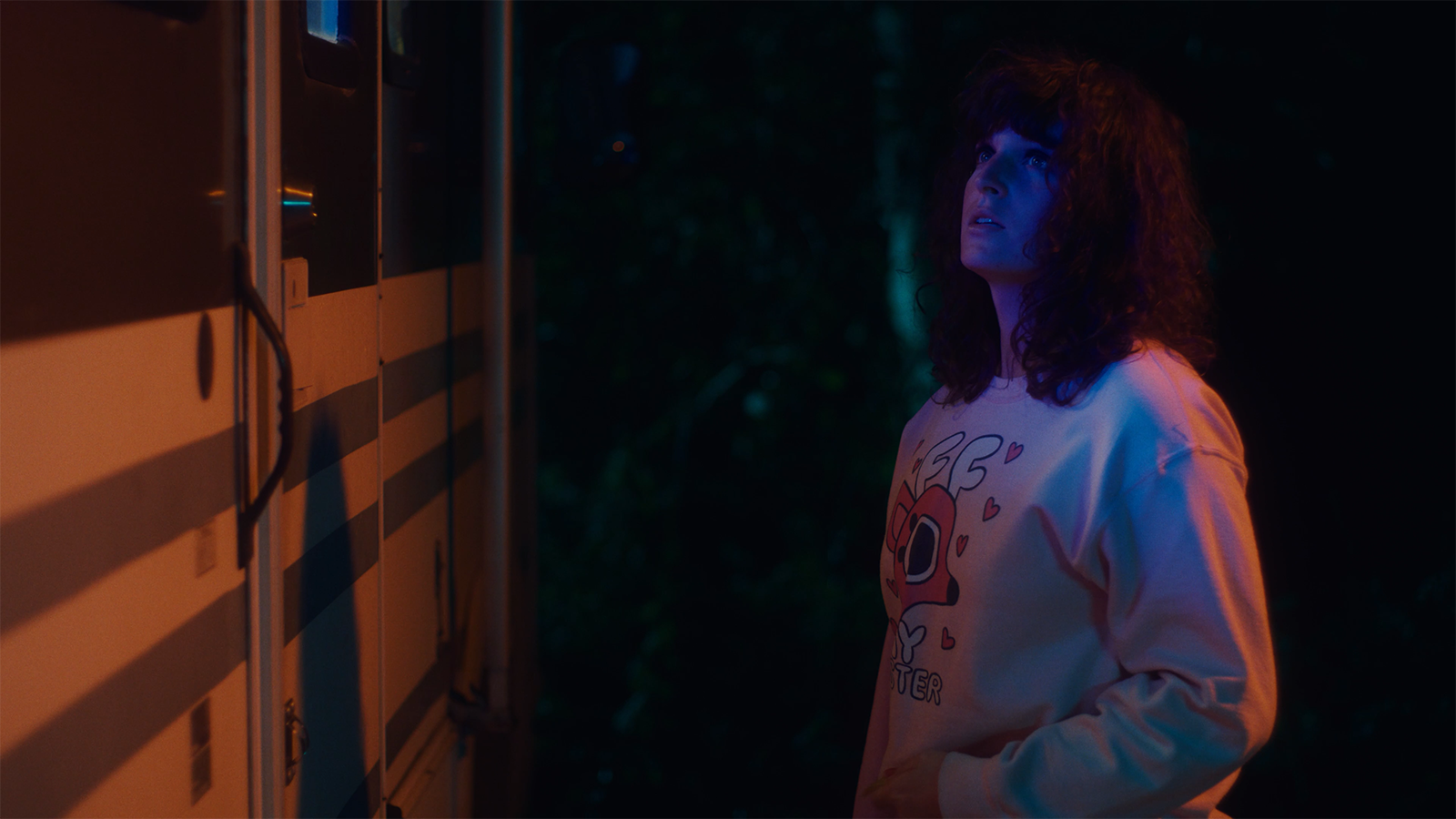
JS: I'm glad you do, because this film was a joy. The time-loop metaphor felt so beautifully done — immediately I read it as a dysphoria metaphor. Mapping it onto a character who's transness is realized and matter-of-fact, it struck me as complex in a way that could be missed by a cisgender audience. What's the cis community's response been, and what questions or reactions do you get from them?
MM: One funny thing is I love tackling thirty themes at once in every story — shoutout Boots Riley, shoutout "Sorry to Bother You." That's such a great way to tell a story: the movie can be about so many different things. Someone watches it and sees the time loop as a lens for dysphoria and trans stuff; someone else left a Letterboxd review asking, "wait, is this movie accidentally about OCD?" It's intentionally about OCD, and about PTSD, and about class — about being a broke-ass loser with no prospects. Everyone who watches it thinks they know what it's about, and nobody really does. That's a fun way to make a movie, because I don't have to contend with straight cis people not understanding what's going on. To them, she's just some woman who loves another woman, and that's its own thing, while the story is doing its own thing too. Hopefully that accessibility lets the movie reach outside the trans community — most people have dealt with at least one of those things at some point, and if they haven't, maybe this isn't their kind of movie.
JS: Beautiful. I also love the setting of the RV — how contained and intimate it feels inside, and how middle-of-nowhere it feels when we’re sitting on the roof. Right before I was able to come out to myself, I had this fantasy of disappearing into the woods in a camper or RV. After coming out, I realized — I just wanted to disappear, not be seen, and exist outside of gender expectations. How did you land on that setting, and could you ever do van life yourself?
MM: I've had that dream too — not from a dissociation angle, but now I think, I'd love to live in a van with a laptop and a guitar, travel around, sleep on the beach every night. I'd get murdered, though — I know I would. That's terrifying. But I love Kerouac, "On the Road," I'd love to do that.
When my parents divorced, I was fourteen and my dad lived in a motorhome for about two years. I spent every weekend in it with him and my two siblings. That's something I cherished — being able to spend that time with my family in such a close space, even though we'd fight and be at each other's throats. I wrote this movie in a hotel room, and then went on a trip with my mom and stepdad — it ended up being seven people in a motorhome driving to Disneyland. I was sleeping on a wooden board wedged in the front two seats. I was excited to go to Disneyland, but this was purgatory — the Catholic idea of purgatory. If I had to do this every day for ten years, I'd lose it.
That motorhome had so much character, and I loved being able to shoot in there.
For me, that moment of Aggie being in a vehicle meant to escape, and yet stuck in the same place — your purgatory being something most people would see as the most freeing thing in the world — that was a fun contradiction to play with.
JS: If there were a post-credits scene showing where Tess and Aggie drive next, where do you think they'd park?
MM: Maybe they get into a car accident immediately after the movie ends, who knows. They're in western Washington, so I'd guess they head straight down to California. First stop somewhere in northern Oregon.