
Privilege, Play, and Post-Colonial Satire: A Conversation with ‘Filipiñana’ Director Rafael Manuel
Director Rafael Manuel renders the exclusive golf course in Filipiñana with an energy I would best describe as "manicured into oblivion." It's an energy I recognize from visiting my family in Egypt, specifically the gated communities of Tagammo'. The gated communities of New Cairo were built for the middle and upper classes to physically separate themselves from the enormous wealth gaps just beyond their walls. Manuel grew up inside his own version of a similarly engineered bubble. His father, who was president of the country club where he spent his childhood, also owned a golf equipment company (Golf Depot, which you may recognize from his film). Filipiñana returns to that world with the distance Manuel gained from leaving it, but without pretending he no longer belongs to it.
Despite its bright colors, the moral universe of Filipiñana feels deliberately gray. Early in our conversation, Manuel expresses his disdain for the oversimplified "eat-the-rich" label people have tried to ascribe to his film. He believes that framework makes it easy to relegate a universal kind of inequality that we all participate in to other people and places far away. This ethos is clear in how he treats even his most privileged characters with extreme grace. Perhaps it's because he recognizes himself. The social position he now examines is the same one that gave him the mobility to leave the Philippines and build a life abroad.
Living abroad gave Manuel a clearer view of his upbringing, but it also taught him about the limits of the Western gaze. He tells me that art-house institutions often expect Southeast Asian cinema to speak in a language of exaggerated volume, presenting poverty and physical violence in familiar hyperbole. Manuel rejects that kind of exaggerated depiction of violence in his work, instead opting for a different kind of familiarity in Filipiñana; he wants to keep the inequality recognizable, not exotic enough to be pitied and dismissed as a problem belonging somewhere else. It's the same way I saw the wealth inequity in Tagammo' and looked down on it, only to come back to San Francisco, a Western city with wealth gaps just as wide, and stop noticing them.
His criticism never requires him to reject the world that formed him. But because he knows that world, he wants the best for it, and the first step is to be honest about it. Filipiñana allows affection and criticism to coexist in Manuel's ability to see his upbringing clearly without either defending it or disowning it.
This conversation has been edited for length and clarity
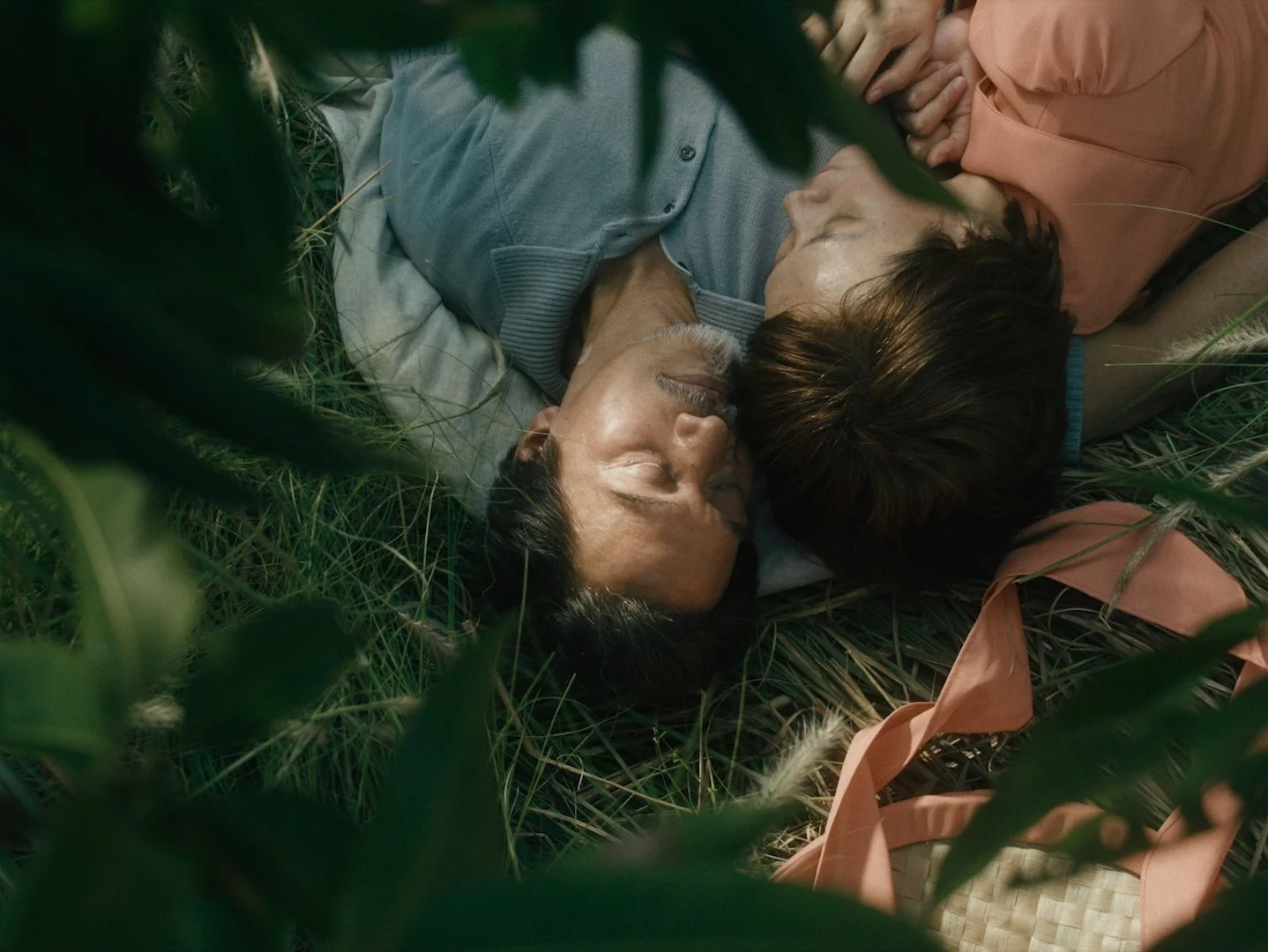
Ali El-Sadany: Golf Depot exists both in the film and in your life. I was raised in America and my family is in Egypt, which has a lot of the same class culture, and whenever we go there's this servant ecosystem I'm not used to. I'm curious about your experience on both ends of it, growing up inside it and then making it into a movie.
Rafael Manuel: Golf Depot was actually a company my parents own. For me the personal and the political can't be separated at all. Beyond all the sociopolitical themes I tried to explore in Filipiñana, first and foremost it's an open letter from me to my parents regarding the world that they built for me, and what gets passed on from generation to generation. It's a reminder to myself of the privilege I enjoyed growing up in the Philippines, coming from a certain social status, and a dissection of that.
Which is why I'm uninterested in an oversimplified classification of this film as an eat-the-rich kind of film. We all have our parts to play in perpetuating a society we're unhappy with. Instead of blaming the other side, we need to look inward and see what it is we do, or more importantly, with the film's themes of inaction, what we don't do that perpetuates the cycle.
I'm very influenced by Fellini. A lot of the characters in his films you can view as caricatures. What's undeniable is the love and empathy he has for all of them regardless. I hope that's seen in how I handle Dr. Palanca, how I handle Renato, how I handle Clara, who could be viewed as villains and are much more complex than that.
AE: Isabel is drawn to Palanca before she understands who he is, and the film never shames her for it. Tell me about the tenderness you have for that world.
RM: I think it was Judith Weston who wrote it, on directing actors. Avoiding putting them in boxes and treating them like villains, which is applicable to writing characters too. Even villains completely believe, the most convincing ones at least, in the goodness of their intentions.
The tenderness comes from being able to see how each character is you, the good and the bad side of you. Empathy and tenderness are completely related, as is trying to inject as much playfulness. Tenderness and playfulness and resistance are very much related.
AE: The film is an open letter to your family and your past. Letters get responses. I'm curious what the response was.
RM: I'll start with the macro and go to the micro. We had our premiere in the Philippines maybe two weeks ago. Before that I'd screened the film in thirty different cities around the world before finally getting to the Philippines. This was the screening I was the most nervous about.
The Philippines may not be an important commercial market for the film, because of problems with distribution and obviously socioeconomic realities. To me artistically it's the most important market, and personally it's the most important market. Thank God, right now we're selling out a lot of the screenings, which for art house cinema in the Philippines is really something. It's a divisive film, because of the pacing, because of the Brechtian style of directing and acting. It's very different from how Philippine cinema, which is very emotive, is normally consumed.
With my personal family, my mom was so cute, because whether or not she likes the film she's going to support it. She brings all my aunties to all the screenings. She's the first person I went to at home after the screening, maybe the next day, and I was like, so what did you think? And she told me, can I be honest with you? I was like, of course. And she's like, I don't think I understood it. Can you explain it to me, so that when I bring all your aunties to watch, I can explain it to them? I was like, what the shit? What don't you understand? Then we had this conversation about it. It was really funny.
My father is still yet to watch it. I don't know if he's going to watch it, because ironically, among everyone in my family, he's probably the one who would understand it the most. Maybe that's scary for him, and it's scary for me as well, because we have a very traditional Asian father-son relationship in that there's a lot of love there and we have a hard time expressing our feelings to one another. So I'm really interested to hear what he thinks about it, if he gets to watch it.
The last film he watched of mine was one I did maybe eight years ago in film school. I sent it to him and he sent me back four pages of what he understood from the film. I know for a fact that of everyone in my family he's the one who would understand it the most. It's funny that he's the one who hasn't seen it.
To go even more personal, my father has vitiligo. And my father was the president of the country club I grew up in. He's very much in the film, very present in the film.
AE: How did that conversation with your mom go?
RM: Honestly, what I shared with you, that was the conversation. That was it. After a while she came back to me, I think she had read a lot of what the critics were saying about it, and she's like, okay, I think I get it now, with using the slowness to do this.
AE: Everyone anticipates Palanca as this charismatic, magnetic man, and he's also generous and attentive and paternal. How much of writing him was making a portrait of how your father behaved, and how much was you trying to understand the pieces of your father you didn't understand?
RM: I love my father one hundred percent. Everything you used to describe Palanca you can use to describe my father. Because he worked really hard while we were growing up, he wasn't very present in the household, with raising me in that sense. This is a portrayal of that.
When people ask me about the references for Palanca, I talk about Godot, in Beckett's Waiting for Godot. My father has this presence in my family where he's omnipresent, omnipowerful, and growing up he wasn't really there so much.
AE: Clara comes home and sees everything from an outsider's lens, with internal context. And you lived on the inside of the golf club as a child, then went back to do the jobs people working the course do. How did those vantage points bridge?
RM: For one thing, I haven't moved back to the Philippines. I'm still very much in diaspora. I live in Amsterdam now.
Clara is obviously the character I identify with the most on a superficial level. In developing her I was having a lot of conversations with other Filipino artists abroad, about whether they felt the same guilt for having the ability and the privilege to pursue your dreams abroad while the rest of our countrymen suffer in the Philippines. I really wonder if this is a conversation other nations' artists in diaspora have. I'm sure it is.
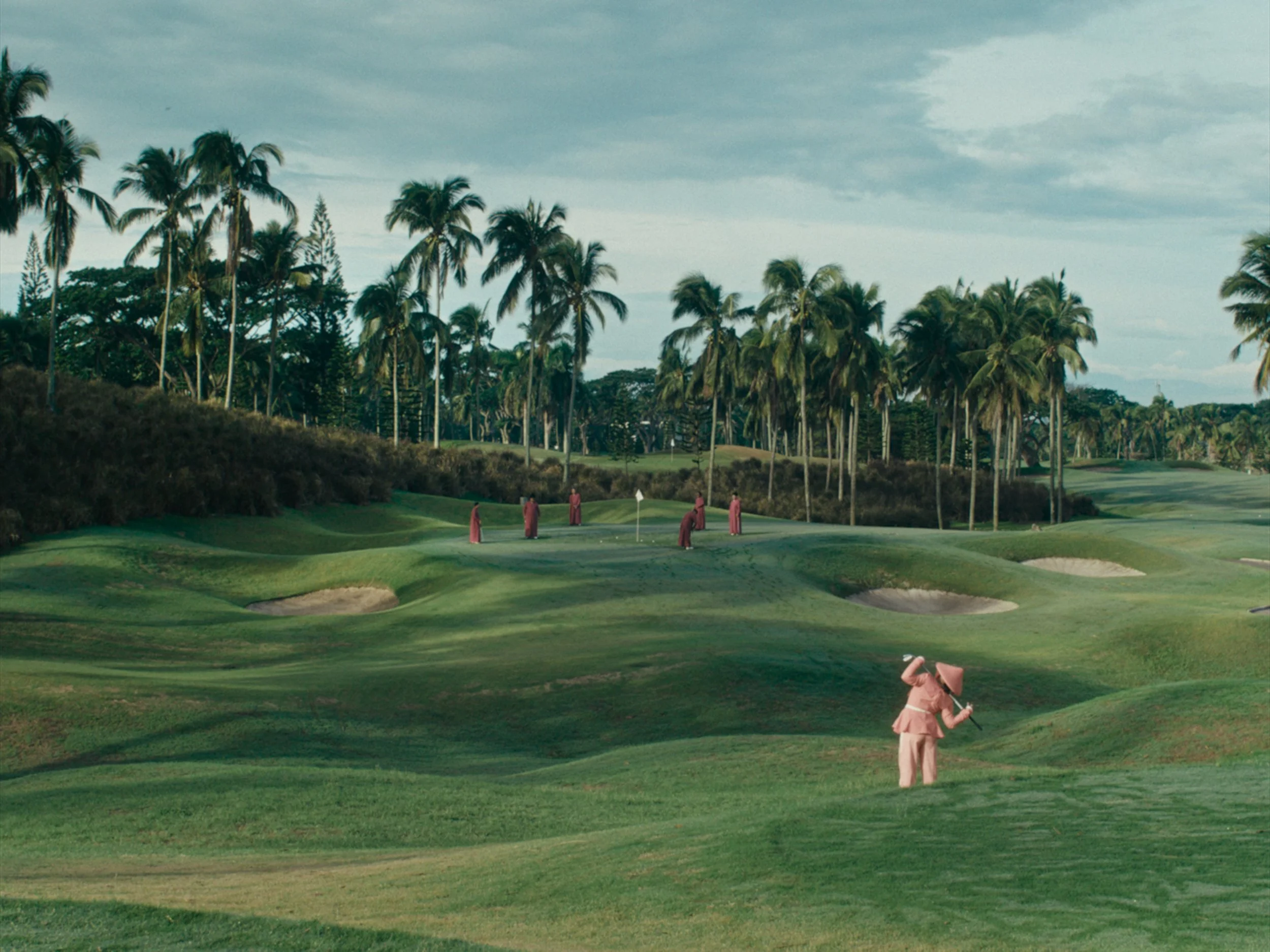
It was in developing the short that I spent a lot of time with the tee girls. Because their job has a lot of downtime, because literally they're sitting on stools the whole day serving golf balls and not even interacting with the golfers, I was interested in what they really thought about. What was going through their heads throughout an eight to ten hour shift.
It surprised me. Some of them were like, oh, I think about what business I want to have when I'm saving the money here, what business I'd like to start. A few of them opened up to me and showed me their journals, and some of them were writing poetry. I loved the idea of poetry and playfulness as resistance to that monotony.
I tried to encapsulate that in the film. Part of the form of the film is this oppressive frame. I include the frame in the visual language by using the 1.33 aspect ratio. In building this world with the actors I did a lot of pre-production rehearsals. Then in production, on set, it became an exercise of getting out of the way as much as possible and seeing how the resistance to the parameters we set in pre-production would express itself on camera. Despite all these limits, how is their freedom expressed through their choices and their movement.
AE: I'm curious what each end of that spectrum taught you about the other.
RM: Even if I did the job, even for a couple of days, there's no way I could fully experience what it's like to be from that part of the social strata, that part of the social hierarchy. Which is why it was important to work with actors who could relate to it.
Moving to the West helped me more than the field work and the research work in the Philippines did. Moving away from the privilege I enjoyed in Southeast Asia. It's something Renato talks about with Clara. If you move back, your life will be much easier here. Living in the West, we have to jump through so many hoops to get visas, our mobility as third world nationals is very restricted.
That's what I drew on when writing Isabel and the other members of the servant class. Obviously it's not apples to apples. Finding my way of connecting with these characters was interrogating how in the West we can be viewed as third-class citizens, coming from the global South.
AE: At home you're living an extravagant life, and here quality of life is also great, and it's a different flavor of privilege. Tell me about moving between the two.
RM: My family in the Philippines, I wouldn't describe them as upper class. Upper-middle, maybe. In relation to the vast majority of people who live in the Philippines, it is an extravagant lifestyle, for sure.
Living in the West and enjoying the privilege that comes with it, even the privilege of public parks, which we don't have in the Philippines, of working public transportation, of sidewalks, and thinking about how those two worlds coincide. It's a tough question. Right now I just got my permanent residency in the Netherlands and I'm in the process of my inburgering, taking my Dutch nationality exam.
All I can do, as one of many artists in diaspora getting used to a new life of privilege in the West, is make sure, and this sounds so cheesy, that it doesn't erase or gentrify my life experience of growing up in the global South. And do my part in helping not just produce but reframe the way the global South is portrayed in media representation produced in the global North.
With Filipiñana, I don't know if it's apparent, but this is not the kind of cinema that usually gets financing from the financial gatekeepers of the global North. They have a very particular orientalist viewpoint of what cinema from Southeast Asia should look like, which features a lot of violence and poverty.
Sometimes I read the Letterboxd comments, and I pay more attention to the bad ones than the good ones, for better or worse. A lot of the time people comment, this is funny because it's anti-colonialist but it's looking at the film through a colonialist gaze. I hope it's not lost on the viewer that Filipiñana is a satire. The form is part of the satire, the frame is part of the satire. And if they've ever had the experience of trying to get a film funded through Western institutions, they should know this is not the cinema they're looking for. This is not the colonialist viewpoint of cinema they're looking for.
They're looking for cinema that's very rich in poverty, very rich in violence, as opposed to the invisible violence Filipiñana is concerned with exploring and giving shape and color and sound to. For me that's a way of making the violence of the global South more relatable to audiences in the global North. It's so easy for white audiences to watch a film set in the ghetto in the Philippines where there's a lot of murder and rape and be like, oh, that's so sad, and then wash their hands, because I have nothing to do with that. Whereas the invisible violence of inaction, and how it perpetuates a system we're unhappy with, and the invisible structures, that's something they can relate to and realize, oh, actually we have our part to play in perpetuating that.