
"I Dare You to Laugh:" Oscar Boyson and Ricky Camilleri Give Satire Its Teeth Back
"It's a two-hundred-million-dollar whitewashing of a man who raped multiple children," Ricky Camilleri says. "That's fucked up."
My conversation with Camilleri and his co-writer Oscar Boyson about their film, Our Hero, Balthazar, is filled with moments like this, where they refuse to soften their language. They talk about the financiers who wanted them to either sanitize their movie or turn it into a horror film. They talk about the press cycle and the people it protects. They talk about their own complicity in the systems they criticize. They talk about all of these ideas with an unfiltered honesty. This unapologetic honesty is a baseline that is reflected as clearly in their conversation as it is in their film.
In this specific instance, Camilleri is talking about Michael, the biopic of Michael Jackson that Lionsgate released this past April. Michael Jackson faced multiple credible accusations of child sexual abuse over several decades, and Lionsgate spent two hundred million dollars on a movie that ignores that reality. Camilleri is equally frustrated with the film as he is with the silence around it.
"They're just silent," he says. "Is it because this is a corporate-dominated story, and people want to make sure they still get reviews or invites to Lionsgate screenings?"
Studios fund the movies, so for most people in the industry, calling them out isn't the right political move. Camilleri does it anyway. The trust he extends to me with his candor is exactly the same kind of trust he and Boyson, who directed the film, extend to their audiences. They trust the viewer with enough maturity to handle an accurate reflection of the world they live in without having it softened into baby-talk first.
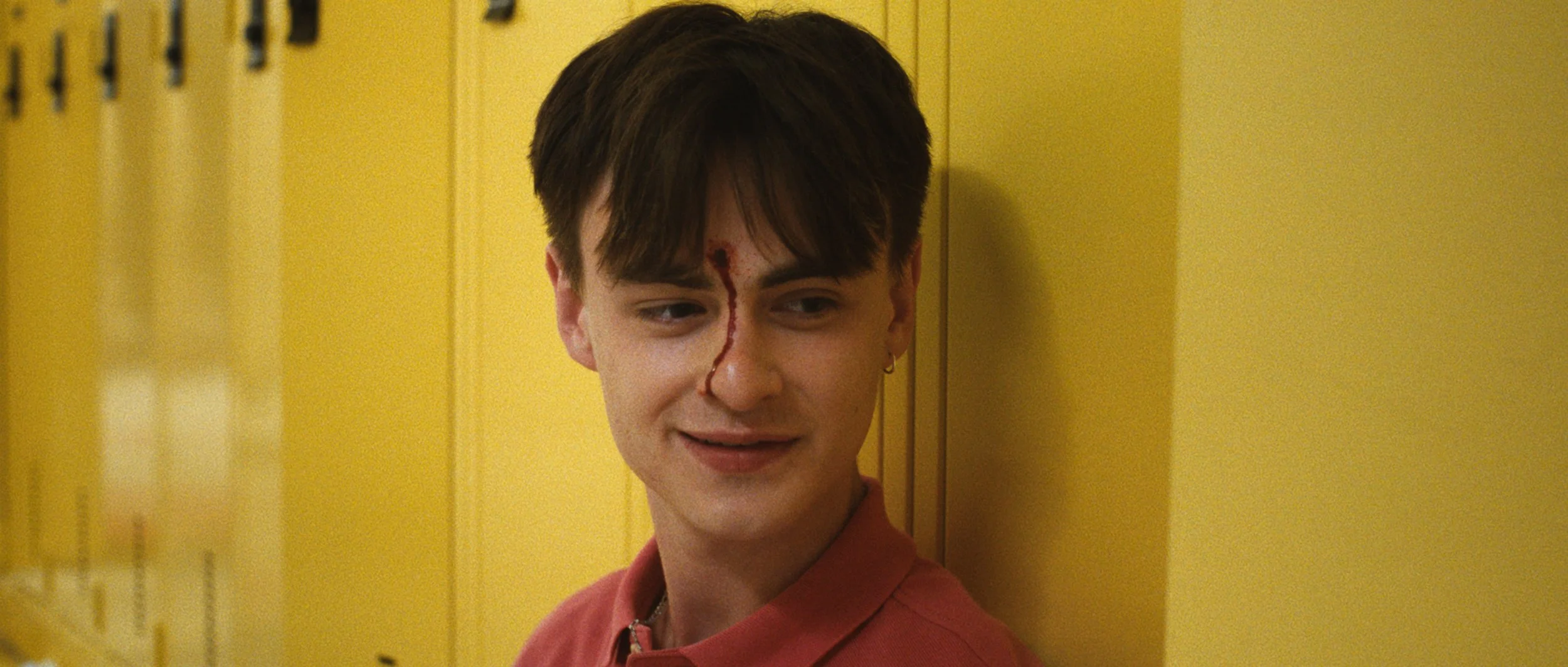
Our Hero, Balthazar is the story of two boys, a rich kid from New York and a poor kid from Texas, both lonely, both performing for an audience of strangers on their phones. The rich kid, Balthazar, played by Jaeden Martell, posts crying videos about school shootings he has not experienced. The poor kid, Solomon, played by Asa Butterfield, posts violent threats because he wants to be seen. They find each other on the internet. Boyson and Camilleri have been friends since they were seventeen, which is roughly the age of Balthazar and Solomon -- old enough to know the world is broken, but also young enough to have no idea what to do about it. Their film is about the fallout when two teenagers, whose entire experience with other people has been filtered through a screen, try to exist in real life together.
For the past decade, the version of teenage life showing up in American movies has borne almost no resemblance to reality. The world has morphed so rapidly into an unrecognizable beast, and there are very few films ready to confront that reality. Hollywood is no stranger to turning tragedy into content, but modern technology has taken it to a new level."Social media is an accelerant," Camilleri notes. "We're not just digesting one or two stories of tragedy a day because we're tuning into the news at night. We're getting fifty different stories of mass murder."
That flattening of human suffering into a metric on a screen has directly colored how so many young people are forced to build their identities. If tragedy is quantified by views, personal worth is quantified by likes. Boyson started writing their film in 2022, inspired by on the impossibility of growing up on platforms where every opinion has a number attached to it.
"How are you going to be a fan of a band that has zero likes or zero followers?" Boyson asks. "How are you going to broach that to the new person you want to be friends with if there's a zero next to their number? It just seemed really hard."
Boyson brings up the woman orchestrated a shooting at YouTube’s headquarters a few years ago. "In a way, I empathize with her. That's what anybody who's ever felt validated by social media has felt. You think, 'Hey, someone's interested in what I have to say, that feels good. I'm going to make more of it.' And then suddenly, nobody is responding to you anymore. You think, 'Surely it couldn't be me. This fucking world is caving in on me, so it has to be the company, right?' To talk about her is to admit how fucked up the whole system is and how much we're all slaves to these companies. And nobody wants to go there."
Our Hero, Balthazar lends that same dark empathy to its protagonists. By the time Balthazar and Solomon find each other, they had both spent years learning that the only way to be heard is to be loud, and that means committing to extremity. Neither has been taught any other way to be seen. In that spirit, Boyson and Camilleri pushed every scene further than they thought they needed to, knowing they could always pull back in the edit. "The ceiling was always 98 percent truth," Boyson says. "If something didn't feel truthful, that was our limit." There was one specific joke they did pull, told it would offend the families of school-shooting victims. They looked into it, agreed, and cut it. Those families, Camilleri says, are who they aligned themselves with. Everyone else was fair game.
"I don't feel bad taking a shot at politicians like Hakeem Jeffries," Camilleri adds. "I don't feel bad taking a shot at the disaster industrial complex that makes money off the bodies of children. I don't feel bad taking shots at estranged fathers who are grifters, or sober coaches that make money off wealthy people in a lot of pain. We exist in a collective social rot, and I don't feel bad taking shots at any of it."
This merciless approach to satire is exactly what separates Our Hero, Balthazar from the toothless eat-the-rich content inundating our screens for the last decade. "It's wealth porn," Camilleri agrees. "Wealthy people get to enjoy it because that's how they live. Those are the yachts they want. The apartments they want. Nobody cares about being made fun of. They just want to be included. Once you start making the wealth feel seductive, any sort of criticism you could have against the wealthy just doesn't feel as strong."
"The best satire is so cutting," Camilleri claims. "It is merciless and brutal to almost everyone involved. If you're going to make a satire, everybody has to be subject to ridicule. Everybody has to fall victim to the blade."
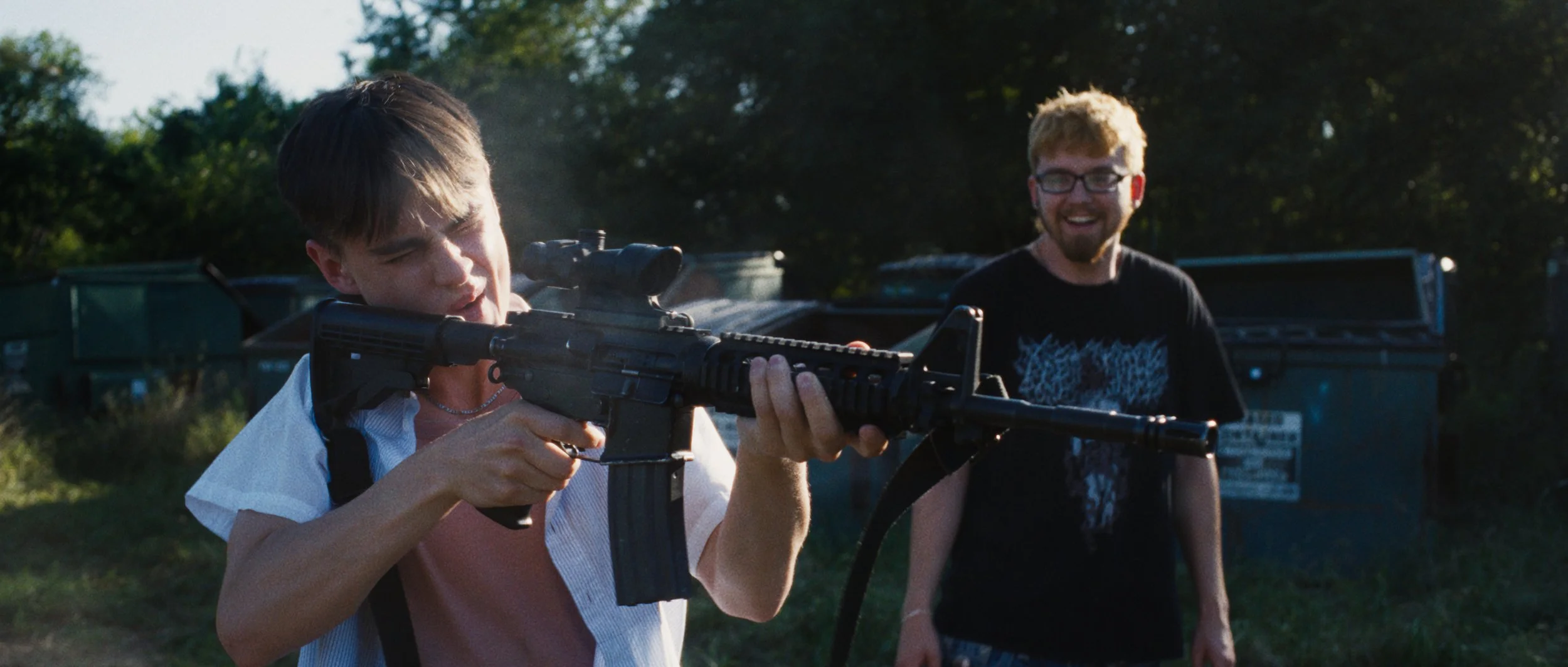
To ensure the efficacy of their critique, Boyson and Camilleri had one guiding principle: "We consciously tried to trick you into thinking it's one of those movies at the beginning. And then, boom, you're here with Solomon, and I dare you to laugh at this."
When most reviews started using word provocative to describe their film, the two of them found it funny. "This is shocking to you?" Camilleri laughs. "I grew up with Larry Clark. Kids. The Doom Generation. None of this is shocking to me. Our movie, in some ways, is kind of like a light-hearted romp up until it's not."
That same shock was foretold during the financing process, where some executives told them the movie would be easier to fund if they repackaged it as a horror film. "I found that deeply offensive to the victims of mass shootings, far more offensive than our movie, which was an honest character study," Camilleri says. "We cared about how human beings exist within a story, not about creating a clever commercial package."
When Our Hero, Balthazar premiered at Tribeca in summer of 2025, most of the distributors didn’t want to take a chance on it. Despite strong reviews and audience response, the conversation inside the industry was apparently more cautious. The only reason the film is in theaters now is because a twenty-six-year-old film school student named Peter Gold liked it enough. Gold started a distribution company specifically to release it. It opened on a single screen at the Regal Union Square in New York at the end of March and posted a $33,138 per-theater average in its first weekend, topping the specialty box office.
Boyson has spent fifteen years as a producer with a really impressive resume — Good Time, Uncut Gems, Frances Ha, Mistress America, Funny Pages. His tenure as a producer has made him intimately aware of what gets greenlit, killed in development, and rewritten to clear a financier meeting. "Movies are way behind the internet," Boyson claims. "Film festivals are behind the culture. The gatekeepers of the industry are definitely behind the culture by thinking that audiences aren't ready for this stuff, which most of us are actually living as a daily reality."
Boyson and Camilleri keep coming back to that disconnect. Film festivals and movies in general are indeed behind the culture and the internet. While studios and distribution companies try to shield us from the harsh realities of the world, we are one click away from it all. Our Hero, Balthazar is special because it is built on a refusal to hide the truth and on respect for its audience. It knows that the people watching it are adults and deserve to be talked to as such. Boyson and Camilleri say what they see, and they assume that those listening can handle it. Unfortunately, in 2026, this assumption feels like a radical move. In a healthier industry, it wouldn't even come close.