
Valerie Soe on Mutual Aid, Radical Care, and ‘The Auntie Sewing Squad Resistance Playbook’
Valerie Soe has never believed in the myth of the objective documentary. The filmmaker and San Francisco State University professor treats her identity and her art as completely inseparable. In her early experimental shorts from the 1980s, this connection was glaringly direct. She used her own life explicitly to dismantle Asian American stereotypes. As her proficiency behind the camera evolved, that autobiographical signature became less overt but just as foundational. She no longer needs to be the sole focus of the frame for the audience to know exactly whose perspective they are watching.
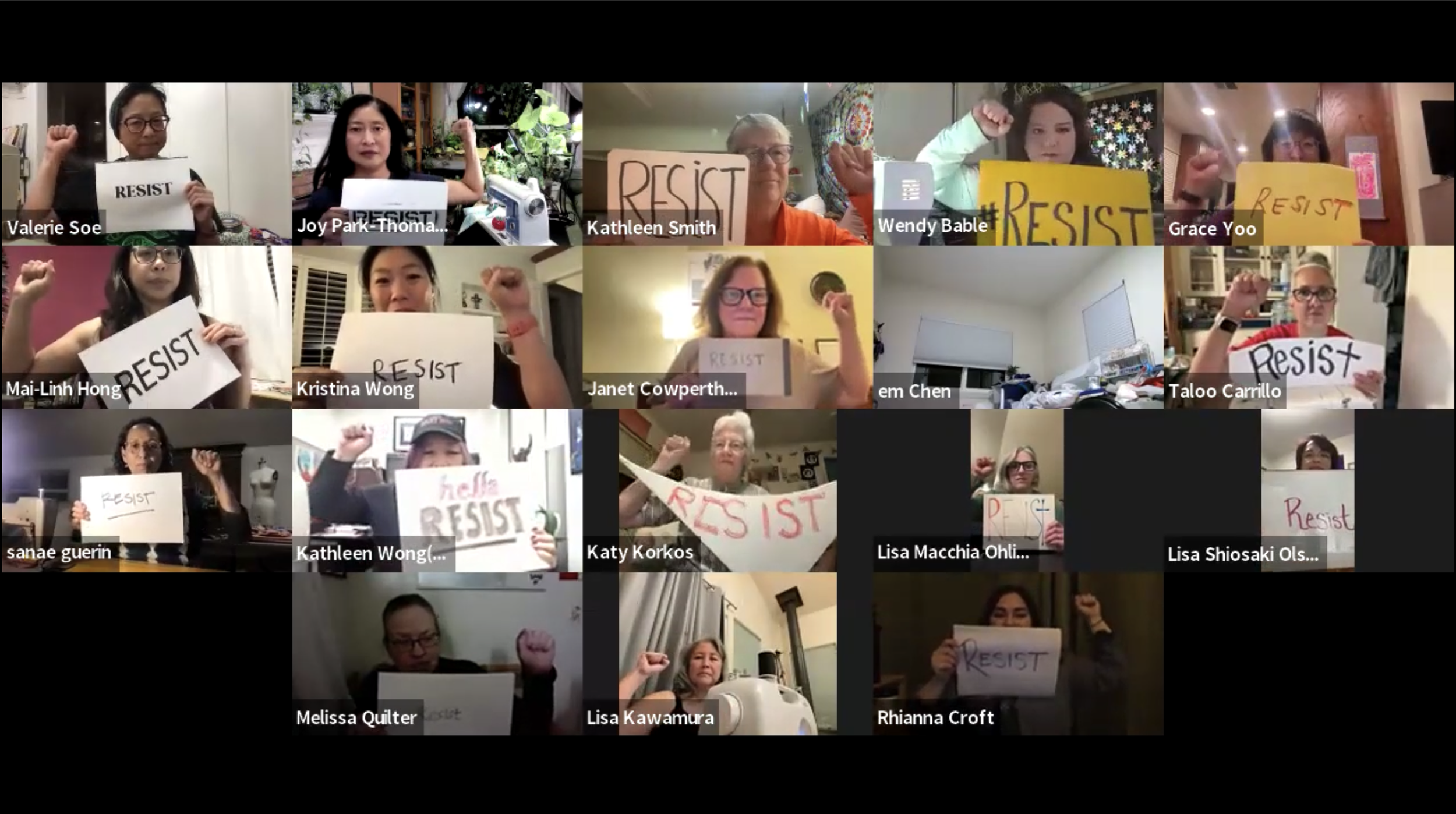
The Auntie Sewing Squad Resistance Playbook, had its world premiere on May 2 at the Los Angeles Asian Pacific Film Festival. It chronicles the Auntie Sewing Squad, a grassroots mutual aid network founded by performance artist Kristina Wong that grew from a handful of volunteers in March 2020 to a nationwide collective of more than 800 BIPOC women, uncles, and non-binary sewists who turned their living rooms into mask-making sweatshops for the country's most vulnerable communities. Soe was an active participant in the group, and she occasionally pops up on screen, but the camera stays on the wider collective.
I sat down with Soe to discuss the futility of objective filmmaking, the ethics of taking dirty money from massive corporations, and why the best way to fight systemic dread is to find your tribe.
This conversation has been edited and condensed for length and clarity. For more information about the film and screenings check out the link here.
AE: I want to start with your role in the film. In documentary filmmaking, directors usually try to remain invisible, but you are actively written into this story. It reminds me of your earlier experimental shorts from the 1980s, like All Orientals Look the Same, where there was this delicate balance of putting yourself directly into the work. How has your relationship to your own perspective evolved?
Valerie Soe: A lot of my earlier stuff was highly autobiographical. I made many short, experimental films where I was talking about my own life to address bigger issues, talking about problems with my family as a way to actually talk about racism.
When I made All Orientals Look the Same in the 80s, the representation of Asian Americans in Hollywood and popular media was abysmal. It was just stereotypes, misconceptions, and cartoon characters. I wanted to show something real that actually made sense to my lived experience. It was a way to say, Look, we are not all kung fu masters, dragon ladies, or nail salon workers. We have complex stories to tell. It was a direct counter to the stereotype that we were just one caricatured mass of people, proving that we have our own individual stories and backgrounds.
As I started making longer films, I carried that with me. I acknowledge my "positionality," the idea that you can never be completely objective in any story that you tell. I'm fully acknowledging my perspective, and sometimes I'm even part of the story itself. You can't get out of your own head and your own point of view, so why pretend?
AE: I relate to that deeply. Within the corpus of Middle Eastern content, so much has historically been born out of stereotype, and it feels like the media that rises to the surface is often just mediocrity. It makes me appreciate how your films focus on deep specificity. To bring that to the Auntie Sewing Squad, there is an anecdote in the film about sewing masks for a healthcare worker named Yaffa who was already in the trenches. Can you walk me through the gravity of those early days?
VS: Yaffa is a healthcare worker here in San Francisco, and she was wearing the same N95 mask for a week straight. They weren't even asking people to wear masks publicly at that point. This was at the very start of the pandemic when there were no vaccines, and people were dying in massive numbers.
To send her masks and help her out was vital because she was completely at risk of getting this disease from her patients and dying. I think she even says in the movie that she didn't think she was going to survive. At that point, I remember thinking, Wow, this is not just about feeling safe at the supermarket. This is life and death. It was so important to help the people who were actively putting their lives on the line.
AE: It’s a very delicate, raw history to approach. What was on your mind when you were trying to bring this to light, especially knowing there are things you had to step around gently?
VS: We tried to directly address the hardest topics we were facing at that time. Most of the group were women of color, and a lot of them were Asian American women. We were dealing with a spike in anti-Asian violence, the President calling it the "China virus," and the total lack of security that came from realizing nobody was looking out for us.
It was crucial to talk about that because we have a lot of cultural amnesia about the pandemic right now. We're still processing it. It was hard for me sometimes while I was editing, just looking at the footage over and over again. Someone recently suggested we put a content warning on the film, because if you're watching this and you see clips of the coffins and the mass graves in New York, it could be incredibly triggering. We want to make sure people know it might be hard for them to watch.
AE: In your director's statement, you quote Sun Tzu on fighting on "desperate ground." It’s an interesting contrast, because the film is entirely centered around radical care and mutual aid, but framed through the language of war. When did the war metaphor start feeling more pressing?
VS: Kristina Wong, the founder of the Auntie Sewing Squad, is a performance artist, and she really recognized that we were in the trenches. She did a fantastic Off-Broadway play about this called Kristina Wong: Sweatshop Overlord. In it, she's dressed in faux pink camo with a bandolier made out of spools of thread.
She used that metaphor of being embattled. Even though the enemy wasn't shooting at us with bullets, there was immense tension. It really was a massive, almost invisible conflict coming at us from a lot of different sources. That’s where the idea of "desperate ground" came from: Don't turn your back, don't run away. Turn around and fight.
AE: I noticed that a recent screening of the film was presented by Bloomberg and Kaiser Permanente, but Kaiser is actually an institution that gets called out critically within the film. I work in the tech industry, so I constantly reckon with institutional complicity. What is your ethical line when it comes to taking resources from these massive entities?
VS: The festival likely organized that specific sponsorship, but I'll give you a funny historical example. When I was in art school at the Art Institute of Chicago, Hugh Hefner donated the Playboy Mansion to the school to use for whatever we needed. And we used it! It was crazy. People said, "How can you take this money from a dude who exploits women? How does that affect your morals? You should just say no."
My thought was: No, you take that dirty money and you use it in whatever way you can. I’m not saying Kaiser or Bloomberg are necessarily dirty money, but you can utilize those resources and turn them into something good. Don't turn away a resource if you can repurpose it to improve the world.
Of course, you have to be strategic. You have to ask what strings are attached. Are you helping that entity greenwash their image? If you're taking money from an oil company, are you just becoming a tool they use to look good? You have to be really careful that you are the one turning it around, rather than being manipulated by it. It’s always a judgment call.
AE: The squad has since disbanded, which feels like a success, since Kristina’s stated goal was to eventually put the group out of business. But you made a feature-length documentary about a movement designed to end. What does the film format do for a temporary movement? What do you want its lasting legacy to be?
VS: I feel like it's an archiving of what we did. It keeps the memory alive so that we can be an example for other folks. It's a playbook. We need all the inspiration we can get these days, because we are still on desperate ground. I'm hoping it can be effective in getting people to think creatively about how to push back against whatever oppressive, authoritarian, fascist stuff is thrown at us.
I teach in Ethnic Studies at SF State, so we work with a collective, revolutionary framework. During the pandemic, we were isolated in our houses to an extreme degree, which makes you feel helpless and hopeless. But the Aunties came together ironically online on a Facebook page, and it made us feel like we were actually doing something. We were fighting.
If someone looks at this film five or six years down the line and says, Man, things are terrible now, what can I do? The idea is to find like-minded people. Don't feel isolated, because there are absolutely people out there thinking about this stuff exactly like you are. Reach out and find your tribe.
AE: As a professor and a filmmaker, where are you currently finding the inspiration to move into action?
VS: Seeing the students at SF State protesting against what is happening in Gaza. Our encampment was super inspiring to me. It was so spontaneous, so well-run, so beautiful, and so full of community. As an older person, it's always great to see younger people carrying on the legacy of fighting back and trying to make the world a better place. It is so easy to become cynical and jaded, but I get a lot of uplift from my students. That generational exchange is super important. That’s why it was great that younger students were involved in the Aunties too. It wasn't just us middle-aged ladies.