
‘After the Hunt’ and Losing My Faith in Academia
After a great start to 2024 with the sexually charged Challengers, capped off by his visually stunning adaptation of William S. Borroughs’ Queer, my 2025 was saved by the promise of Luca Guadagnino’s latest project arriving in October, timed perfectly with the beginning of a new academic semester. From the trailer alone, I was curious how Guadagnino would approach a sexual assault narrative without collapsing into didactism, and whether he would manage to extract something deeper.
Judging by its lukewarm Letterboxd reception (currently sitting at 2.9) and the prevailing consensus among online cinephiles, After the Hunt “lost the plot” somewhere in its second half. Marketed as a film about an ambiguous sexual assault allegation involving a queer black PhD student (Ayo Edibiri) and her male professor (Andrew Garfield), people were surprised to find that the film seldom focused on the case, but rather Julia Roberts’ character. What many viewers seem primarily frustrated by is that the film ultimately refuses to resolve the ambiguity of the sexual assault allegations; but that refusal, as I saw it, is exactly the point.
After the Hunt is not interested in clarifying guilt or innocence. Quite frankly, all of these characters are nowhere near innocent. Rather, it is interested in exposing how institutions that claim moral authority function when morality becomes inconvenient. Those characters that border on corruption make up the very DNA of these institutions. The film’s real subject is not the allegations and what it does to these people, but academia itself, the space where ethical discourse is seeded rhetorically while crumbling in practice.
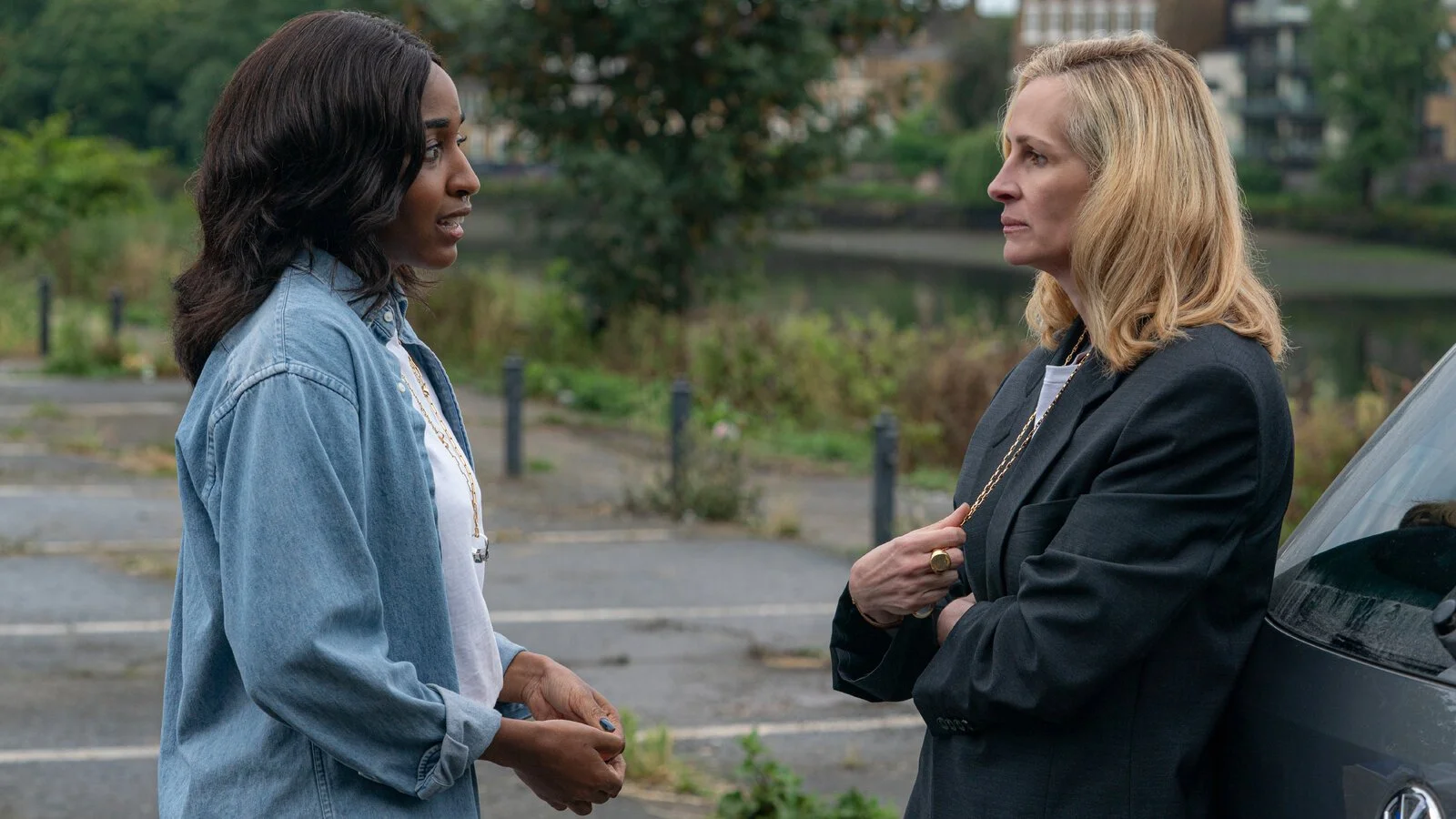
From its opening moments, we’re listening to a countdown. A title card announces, “It happened at Yale.” The university is not simply a backdrop, but the film’s governing structure. Guadagnino leans heavily into the aesthetics of dark academia, not to romanticize it, but to critique its self-seriousness and moral posturing. We meet the main characters at a faculty house party at Alma’s (Julia Roberts) house, too chummy for professionalism, where all the characters from Alma’s professional life are also deeply entangled in her personal one.
In attendance are Alma, a philosophy professor who’s anticipating her tenure, her psychologist husband, Frederik Mendelssohn (Michael Stuhlbarg), the university counselor, Dr. Kim Sayers (Chloe Sevigny), Hank Gibson (Andrew Garfield), another philosophy professor and Alma’s longtime best friend and rival for tenure, and finally, Maggie Resnick (Ayo Edebiri) of the Resnicks, a PhD student whose billionaire family donates large sums of money to Yale every year.
The ethical dilemma arrives shortly after. After a friendly tit for tat at Alma’s party, Hank offered to walk Maggie home. The next day, Maggie confides in Alma that something happened between her and Hank. The conversation unfolds almost entirely in darkness, leaving their faces and gestures completely unreadable. We rely solely on what we hear; the cracks in Maggie’s voice; “When he left, I showered,” and the coldness in Alma’s; “What are you saying happened?”. Guadagnino withholds visual clarity, not to muddy the definition of sexual assault, but to deny the audience the satisfaction of certainty in Maggie’s account: “Isn’t it obvious?” she says with a mirthless laugh, “he crossed the line”.
I mean, the bottom line is that Hank did cross the line, but Maggie had insinuated something completely different and went along with it. Crucially, the film doesn’t ask whether Maggie is lying or whether Hank is guilty. Instead, it shows how quickly moral reasoning becomes transactional. As more information comes into light, namely Maggie’s plagiarism of her dissertation, and the depth of the Resnick family’s pockets, justice becomes less important than the optics. The hunt is not for the truth, but for the least damaging outcome.
This is where After the Hunt reveals its central argument. Universities no longer operate as moral institutions, they operate as corporations. Ethics are invoked, debated, theorized in the classrooms, but they’re rarely ever applied. Guadagnino’s choice of an Ivy League setting is deliberate. Yale’s name and prestige is a stark contrast to its hypocrisy.
A pivotal scene between Alma and the dean confirms this message. When he questions her impromptu visit, she replies, “I believe you know why I’m here”, to which he assumes correctly that she’s there to discuss Maggie’s allegations and how Alma’s testimony might not be without bias. She’s torn between an old friend and past lover, and her billionaire student who also idolizes her. Alma wants her testimony to cause the least damage to her upcoming tenure; either betray her friend and become dean, or betray her student and damage the university’s funding, and thereby her tenure. “I’m just glad you’re not here to talk about tenure,” the dean says as he offers her a drink. Alma remarks on his hidden liquor stash. “What looks good, looks good, and against all odds, I’ve found myself in the business of optics rather than substance.”
This line is almost too on the nose, yet it perfectly encapsulates the film’s worldview: educational institutions’ moral authority is a performance. It’s business.
After the film’s climax, five years later, everyone lands safely on their feet. Hank’s career recovers. Alma secures tenure and ascends to dean. Maggie, too, settles with a woman 20 years her senior, almost the same age as Alma. There were never any real consequences, and that is exactly how the system works.
After the Hunt resonated with me so much, especially since I’ve been in academia for the last couple of years. I work with professors, and I’ve befriended dozens more at the conferences I’ve frequented. I believe the intended role of universities has dwindled drastically. They should be grounds for political dissent, reflect social unrest, and provide sanctuary for their thinkers inside classrooms and on campus grounds. Instead, they carry out hunt quests backed by governmental officials. Since I’ve come to Turkey, I’ve also witnessed this happening in full effect in all private and state universities, and it’s simply soul-crushing.
Just last April, Yale banned pro-Palestinian protests during Ben Gvir’s visit on campus, fearing “violence and anti-semitism”. Especially in the last year, it has been an eye-opening experience witnessing how everything in the US is basically funded by Israel. Harvard, Princeton, Columbia, the very same universities that are not only associated with Edward Said, but hosted him as an alumni and respectable academic, banned and clamped down peaceful Palestinian protests in the name of so-called anti-semitism.
The more time one spends inside these institutions, the clearer it becomes that education is increasingly shaped by economics, global trends, and geopolitical interests, thereby losing its own individualism and authority. Knowledge is no longer the goal, prestige is. Ethics are taught, Hegel is discussed, and Hannah Arendt is cited on final papers, but they’re rarely practiced once the classroom door closes. A degree in International Relations is a new currency to be flaunted.
I admit that that is discouraging me from pursuing a PhD and achieving my goal of one day becoming a professor. If I know that the institution I will associate with might not reflect my values, but also fail to stand in the face of injustice in fear of losing funding, then I don’t think my working there is entirely ethical. I wouldn’t want to associate myself with cowardice and sanctimoniousness.
After the Hunt is ultimately a film about what happens when the scapegoat is released back into the wild and everyone pretends that the hunt never happened. There is no catharsis, no justice, no revelation. Life moves on. Careers advance. The institution survives. It doesn't just happen anywhere. It also happens at Yale.