
The worst thing has just happened to a family: someone announced they are going to be a writer.
During the premiere of Bitter Christmas (Amarga Navidad) at the 63rd New York Film Festival, director Pedro Almodóvar spoke on how this film was a way to explore creation and how artists come up with their ideas to write. Are they all just influences from ourselves, or is there a certain magic spark behind bringing each artwork to life?
He explores this in his new film, Bitter Christmas (Amarga Navidad). Almodóvar has experience in this sort of autofiction genre, as seen in his previous works—for example, in Pain and Glory (2019)—where he uses his past memories and current situations as the centerpiece of the stories as a form of self-reflection. It reads like a Substack article, but on a much wider scale and for a larger audience.
Where our creativity comes from has always fascinated me, and as I get older, the question has become even more prominent. When I was younger, I never thought much about creativity; it was more about what others would enjoy. I drew pictures and made popsicle people, having my loved ones in mind. Once I got older, I began to use writing as a way to self-soothe, turning that care and love inward. Hours typing in my Notes app and overdue library fees filled this phase of my life. Now, in my adult years, more of reality has been weighing on me and has given me the chance to reflect on my past memories. Currently, I am the most emotionally present when creating my art. Since Almodóvar's films have become more personal to him, this has been quite cathartic as I watch one of my inspirations tussle with this endeavor.
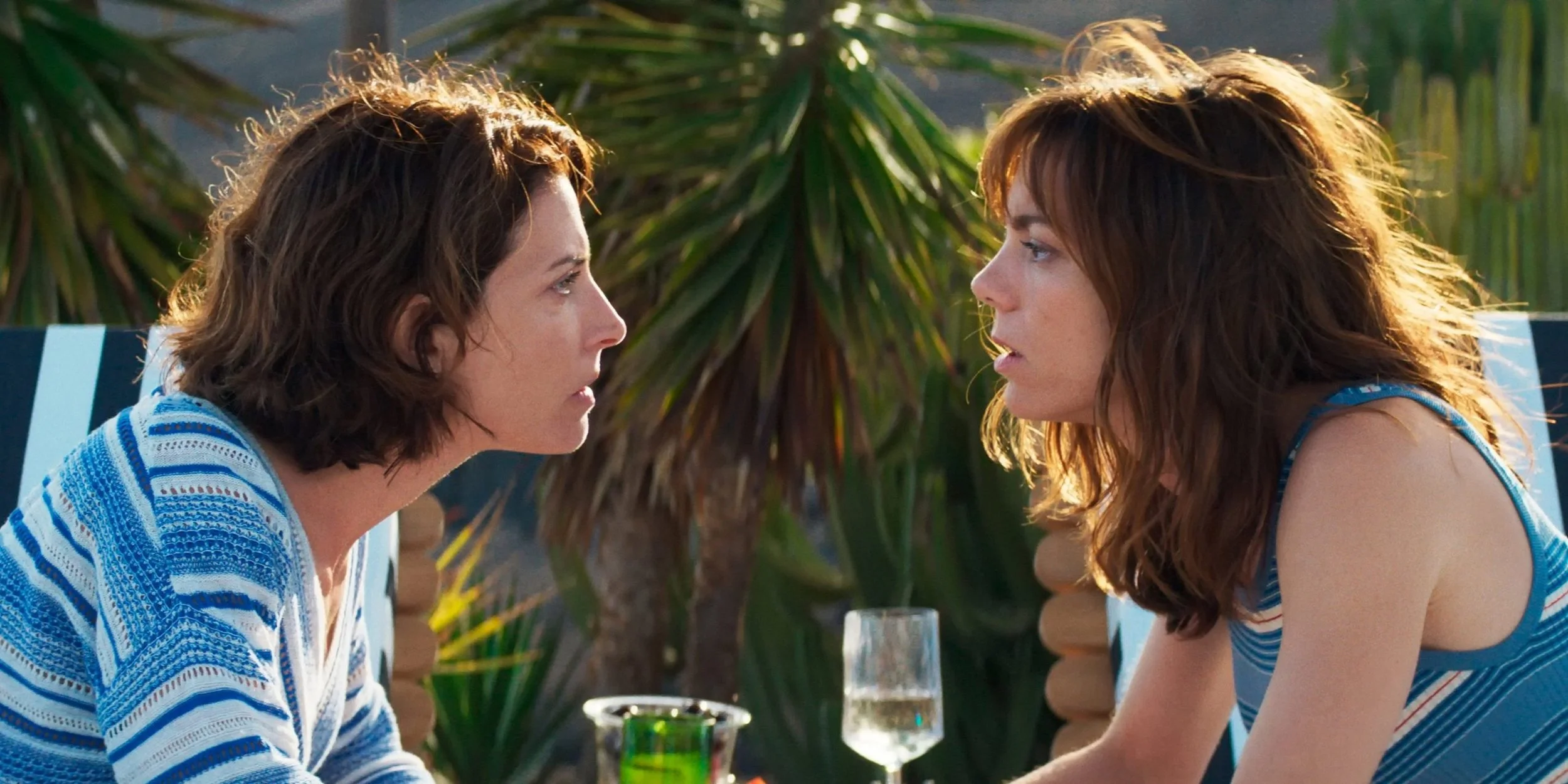
In the opening title sequence of Bitter Christmas, you immediately hear the typing of the main title and cast list, immersing the audience in the sense that a story is being written and brought to life right before their eyes. For a writer, the familiar sound of the keyboard can be intoxicating, making you almost feel the touch of a keyboard beneath your fingertips. You are then introduced to the main character, Raul (Leonardo Sbaraglia), who is currently writing his next film project after a brief hiatus. This leaves him with an intense writer's block that he tries to overcome through the film. What works well is that you actually see the screenplay that Raul is writing, played out by his main character, Elsa (Bárbara Lennie). Here, he portrays his own struggles and fear of putting his work out through her: an individual going through intense feelings about creating and about writing. Despite being known as a “cult” director, she went on to work in advertisements since it provided her with financial security. Her films didn’t reach commercial success and were too costly to make. Now, she has decided to return to filmmaking while navigating her own health issues. This is when things start to get tricky for both our main characters. They are looking for inspiration to write while simultaneously balancing their personal lives, as those closest to them struggle with their daily lives. For Raul, his agent Monica (Aitana Sánchez-Gijón) has to stop working for him since her best friend has gone through an intense tragedy involving someone close to her grieving the death of their child. After learning of this, Raul seems inspired by her story and adds it to his film. His script thus mirrors this situation with Elsa’s best friend, Patricia (Vicky Luengo), who has just found out about her husband’s infidelity. Monica and Patricia are furious when they learn that a dark, painful moment in their lives is being used by their respective friends. They feel a sense of betrayal as well, since this was told in confidence and is now being used for their friends' work.
As writers, where is our moral obligation to the privacy of those around us? Have our personal relationships now become “material” for our written work? It’s a slippery slope, especially now, in a climate where people see themselves as the “main character” and are “doing it for the plot.”
Both Raul and Elsa try to justify their behavior by saying they are only writing fiction and names will be changed, so no one will trace it back to the source. However, this doesn’t ease Patricia’s or Monica’s anger. Since they are the ones living the pain of their current lives, being seen as a “simple character” in a story seems mocking.
This situation brings me back to when I took a nonfiction course while studying for my graphic design degree. I had already taken a poetry class as an undergrad that I enjoyed, so I wanted to build on that. I hoped to enroll in a fiction course, but all the classes were full. Though I could say I was seeking to explore my imagination, the real, underlying truth is that I wanted to use fiction to hide from anything too personal. Also, I love reading fiction and hate memoirs (aka the worst genre to shelve when I worked at bookstores—no space and way too many books). That wasn’t the case for my situation. Having to write about personal moments in my life felt like constantly picking at a scab and exposing the bloody scar to the world. It’s terrifying. Also, I did feel a sense of guilt toward those I was writing about. Having to air out some of my family’s histories just to satisfy a grade requirement felt cheap to me. I came from a family of immigrants, and having the opportunity to even write about them while they weren’t able to voice their side made me feel ashamed. Something my professor told our class is that our lives and situations are all we have access to, and we shouldn’t feel guilty for what we write about. She’d also say that if we really do have guilt, we should just wait for those people to die. As you can tell, she was quite eccentric.
Fiction has always been seen as a sort of cloak the writer can wear to hide from an audience. Fiction signifies “any creative narrative work that stems from an author’s imagination rather than factual, historical, or real-world events.” In Bitter Christmas, the idea that all fiction is imaginary comes under fire since we learn Raul’s writing is all rooted in reality. His agent even says, “You’re more honest in your scripts than in your life.” This could be said about all of us writers who use fiction to make sense of real situations. However, there’s the tricky situation of those around you and how they will take it: the idea that their personal lives are being used for material, and that there is no longer any sense of privacy between the two of you.

Can we stop writers from creating their stories? What would happen if we told doctors not to practice medicine? Or told marine biologists not to care for the ocean? Society needs one of everything. And we need writers. We need them to reflect on their experiences to bring comfort to those who read them. As someone who reads countless things to make sense of this world, I would absolutely feel the void if writing ceased to exist and we were told to keep things hidden within us.
In the end, whether Raul decides to continue his story without the support of his friend or not isn’t really the takeaway. It’s not whether it’s morally correct, but that, in the end, Raul is swept away with his passion for writing. Once he realizes where his story lies ahead, the breakthrough moment is what really matters. This creative rush and adrenaline are what fuel him to continue on, and Almodóvar shows this successfully in his film.
For me, writing has always been a way to process emotions and events. It can even be seen as a sort of therapy for me. I’ve learned that maybe the scab of guilt that I carry will one day heal, and once it falls off, what will remain is the healed skin underneath and the sound of a keyboard.