
Generation Z is hyperfixated on aesthetics. Trends about the best products, lifestyles, and fashion are marketed by influencers and unattainable to the majority of users looking at their posts. Taste is whatever the algorithm is feeding us, whatever comment receives the most likes, or the exact clothing in “what the cool girls are wearing” videos. The cool girls of NYC are wearing camo pants with ruched toe loafers and a trench coat; butter yellow is chic, triangle scarves have personality. While all of these elements are subjective, the appeal is to make them cardinal law, a generation that prefers relinquishing the burden of freedom over choosing for themselves. Social media algorithms are shaping the day-to-day of those who would rather act out their lives performatively than live in them presently.
In Watching the Detectives (Soter 2007), video rental proprietor Neil (Cillian Murphy) is similarly afraid to self-actualize. Obsessed with watching film noir instead of experiencing the world, he sits on his couch and debates with his nerdy friends whether Korean snuff cartoons are better than Japanese death match anime. When a slightly manic new customer Violet (Lucy Liu) asks him out for dinner, the night descends into After Hours–style madness, and the couple ends up vandalizing a rival’s mega movie store before running for their lives from the police.
While the film could be portrayed as a quirky romantic comedy adventure, Violet’s affliction with what she calls “borephobia” turns Neil’s life upside down as she stages arrests, orchestrates chaos, and drags him into a life of petty crime. What begins as seemingly innocent becomes a mutual addiction to adrenaline and to putting their own lives in danger, fueled by her screwball personality.
Violet’s character could be seen as a foil to the prototypical twenty-something doomscroller, but if the advice is to get off your phone and live life, this film takes that mentality and turns it on its head. They are actually more similar than you think. While the two appear to sit on opposite ends of what I will call the spectrum of how to live life, both seem incapable of accepting life on its own terms. Neil retreats into the familiar narratives of film noir, where danger can be enjoyed at a safe distance and uncertainty is contained within a recognizable plot.
Violet, meanwhile, cannot tolerate the possibility that life might be uneventful. She does not want Neil to leave her for being boring; therefore, everything must be a spectacle. Her spontaneity becomes its own kind of compulsion, an insistence that every moment be more exciting than the last. In this sense, she is not entirely unlike myself: I'm compelled to make life aesthetically interesting enough to have my phone eat first. Both characters struggle to experience the present without transforming it into a narrative. If Neil’s problem is that he watches life instead of living it, Violet’s is that she cannot seem to live without constantly staging it. Her approach to life is equally performative as his.
Neil represents one extreme: those of our generation who romanticize an aesthetic life from the sidelines of actually living. Violet represents the other: a philosophy of doing, at all costs, rather than watching.
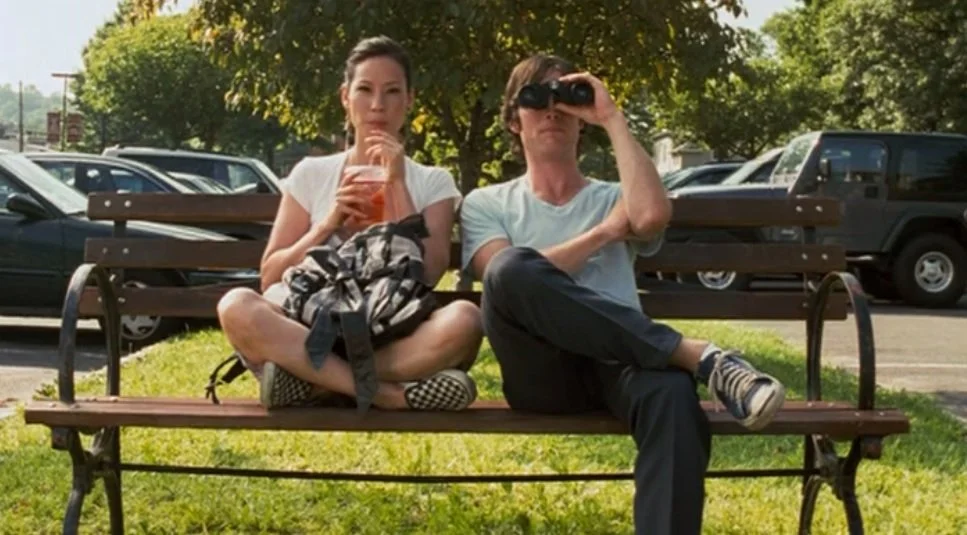
Is there a resolution between these two discordant dispositions? In spite of Violet’s crackpot tactics, Neil realizes that a life devoid of her shenanigans is painfully mundane. He discerns that continuously watching movies in longing is making a choice to sit out of his own story. It absolves him from the responsibility to live freely. Violet’s live-action role play is extreme and could be seen as cynical overcompensation for Neil’s inactive constitution. However, the film doesn’t provide context about her backstory, making her character less three-dimensional. It is therefore difficult to see how her plot progresses beyond that of the unhinged girlfriend.
Hopefully there is a sweet middle ground between Violet and Neil: being a witness to your own life and/or indulging in action, no matter how inordinate. I resonate with both characters, loving to obsessively watch Girls instead of stepping outside, and or standing in a forty minute line to buy pretty-looking froyo. At the end of the movie they drive off into the sunset together, so maybe their antithetical philosophies cancel each other out and somehow lend the balance they both so desperately need.
Nearly two decades later, Watching the Detectives is undoubtedly resonant. Neil hides behind film noir and we hide behind the echo chambers of our feeds. The type of screen has changed but the habit hasn’t: letting someone else’s curation stand in for our own choices. Maybe the answer isn’t Violet’s chaos or Neil’s couch, but something in between: deciding what we actually believe in and making our own meaning in a society that is anything but silent on how to live a worthwhile life.
At the very least, it is a lesson to stay away from girls who carry binoculars in their bags and men who dress up as movie characters when it is not, in fact, Halloween.