
She may have raised two kids in Boston, but my mom — a Queens native — has stayed a New Yorker at heart. Not because of an insistence on maintaining that identity, but because New York City grows with you and, like it does in ‘90s rom-coms, becomes a character in your life story.
So too has it in mine (that ‘lil rascal). I’ve always held it close. I’ve always considered it a home of mine. Growing up, we visited my grandmother and other family there often. And, in a way that feels as significant and familiar as the traits my grandma passed down, my connection to the city largely developed through her.
NYC and its people have their own carbon cycle — a closed system where they’re constantly feeding back to each other. My grandmother thrived on the city’s energy, culture, and knowledge. In turn, she and her New Yorker-ness became part of the fabric of it all.
The Only Living Pickpocket in New York is another person’s story of that relationship, that cycle. Though from when we first meet John Turturro’s character, Harry Lehman, it’s clear he’s already being phased out of it, barely hanging onto a city passing him by. While mathematically we know he’s not the only living pickpocket left, it sure feels like it — especially to Harry. Whatever art he mastered is now lost, in that it’s no longer lucrative. More poignantly, it’s no longer relevant. No one carries cash anymore. Things he can steal aren’t worth what they used to be.
When Harry lays out a “haul” at his usual pawn shop, owner Ben (Steve Buscemi) — also seemingly his only living friend — can’t offer him much in return. Most of it’s junk, but Harry has no choice but to begrudgingly accept (...life’s diminishing returns). Money’s money, bills are bills.
It turns out that bills are even higher for him when we learn that his wife Rosie (Karina Arroyave) is in a catatonic state. She’s alive and conscious but unable to speak or move — unable to engage with the world around her.
Here’s where the beauty of the film exists. As Harry moves about the city trying to keep the life he’s built intact, a quiet contemplation hangs in the background like white noise or, more fittingly, like a character in his life, same as the city. Places that are famously loud and chaotic — the subway, the avenues — are subdued, as if the city is meeting him where he’s at. New York simply hums along with his existential crisis, providing space for it as much as it’s the cause.
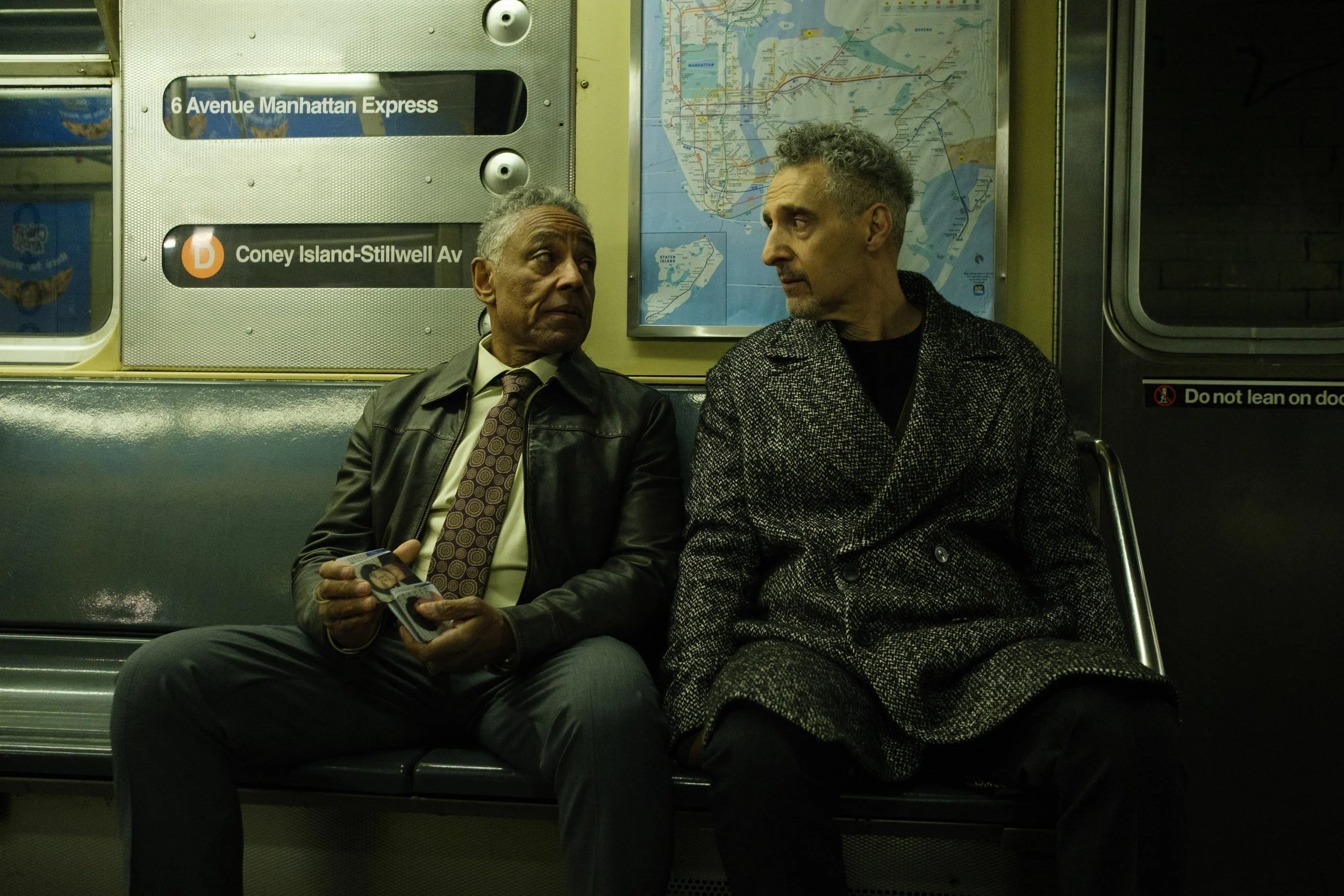
Pickpocket carries a number of themes in its pocket — new v. old, technology v. tradition, money v. values — though the most fascinating part is the quiet hum throughout: Harry’s contemplation of what his life meant and what it means, if anything at all.
It’s amazing, really, how sympathetic Harry is to the viewer considering how alienated pickpockets are in real life. One way writer-director Noah Segan achieves this is through the intimacy he creates with Harry. Turturro’s in nearly every scene, anchoring each one.. When he rides the D train, we’re holding onto the grab bar next to him, staring into his sadness.
The other way lies in the fact that his work as a pickpocket is simply an variable in the equation. Plug in most of our life situations and the math wouldn’t add up all the same. In this world (in this economy!), we’re all some degree of forlorn and some level of uncertain. That even a career pickpocket — someone who’s snubbed social mores to take what he needs — can’t make it anymore says everything about the desperation climate right now.
When my grandfather had to shutter his New York printing business in the ‘70s, I imagine he went through a version of what Harry does, reckoning with a city moving past him and the life he’s built over decades. That was one of New York’s many sea changes; Harry’s is another in a different decade. Both demand similar introspection: If the thing you put your life into becomes obsolete, what does that make you? What do you do now?
Though I haven’t mentioned it yet, there is a mission in Pickpocket that serves to catalyze Harry’s trajectory, which would otherwise likely play out over years of slow demise (like the rest of us). On that mission he’s out to retrieve a token of modernity (a Ledger crypto wallet worth hundreds of thousands) that he initially cast off for nothing because he had no clue what it was, never mind how valuable it could be.
While the symbolism there is the anti-Hudson River (i.e., very clear), it’s the process Harry goes through of truly coming to terms with his life that’s meaningful. There’s also the irony that, in a sense, society’s stealing Harry’s life by leaving him behind. In that irony, the film asks us to think about how we navigate evolutions that leave people behind — evolutions that are affecting more and more demographics over time.
The beauty of seeing New York through my grandmother is that it exposed me to many of its different versions: the romanticized Breakfast at Tiffany’s ideal; the one where you can make it anywhere if you make it here; the one where you need to adapt or die; and the one full of economic changes and disparities, modernization, and demographic shifts. She stayed fully engaged with New York’s cycles until she couldn’t anymore and had to let go. It was one of the saddest moments of her life — the end of an era — but with the grit of a true New Yorker, she faced the realities head-on.
So too does Harry. And oddly enough, they both found solace in the same thing: it’s the people, family, who are most important. As alive as it is, the city will leave you behind no matter how much you give to it. But what you give to family? That’s never obsolete. It’s not pawnable, but it’s the only thing of value when the world moves on from you.
Could Segan have set this story somewhere else with the same impact? Maybe, but doubtfully, because New York’s a paradigm of human existence. It’s chaos, community, creativity, belief, vibrancy, division, hope, despair, possibility, and a myriad of other quintessential human conditions crammed asynchronously into five boroughs. New York’s a beacon because it’s implausible and it persists.
As much as Pickpocket loves this place, it’s just as serious about challenging what we may take for granted about it. A city infamous for its resilience and tough skin seems infallible, but that doesn’t mean it can’t reach a breaking point. If New Yorkers are pushed out of the lifecycle, who’s left to give back to it? What is it they’ll give? Will it be the same love of someone who grew up with it or built a life for themselves? What if we lose something we can’t get back?
Pickpocket is an homage to just how special that relationship is and how desperate it can be. It also captures the temperature of the moment for New Yorkers and, honestly, for any of us riding the subway right now, contemplating the hum.