
Beirut Between A Thousand Eyes: In Conversation with Lana Daher, on Memory, Emotion, Community, Identity, Being, and the Sea
Moving through mementos of the last 70 years from the passenger seat, through a sifted 4,000 hours of Lebanese films, radio clips, music, camcorder homevideos, TV, photographs - whatever medium a person could hold onto life through - we are engulfed in entire universes, bubbling, abundant, alive, collapsing onto one another. Only then, among them all, does a whole, enthralling, scintillating mosaic of Beirut unfold within us, all around us.
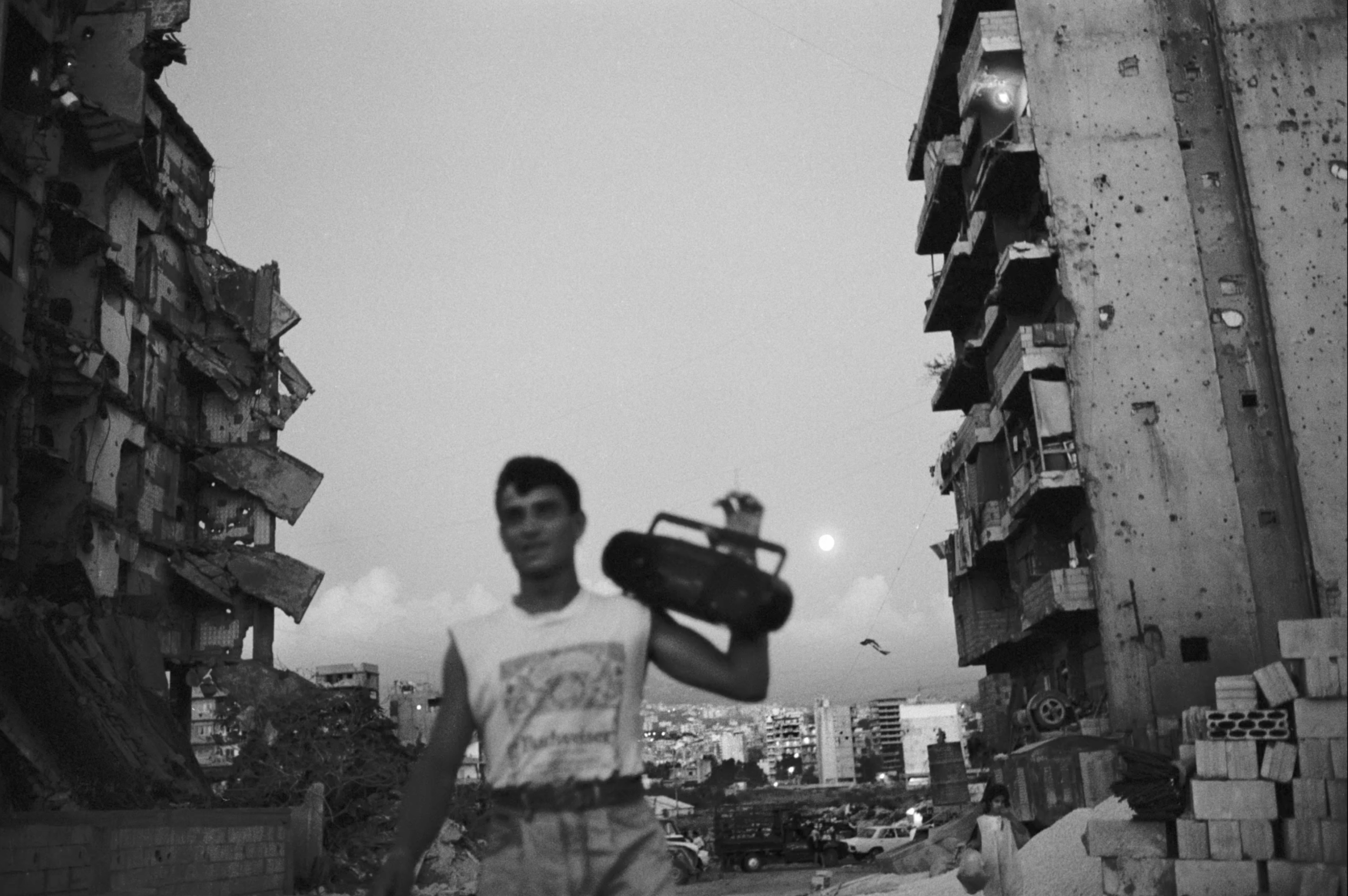
The Boombox (1995) by Fouad Elkoury
Courtesy Icarus Films
Beirut is a kaleidoscopic city the human condition stretches across in every direction; naturally, the millions of eyes it moves within glean, experience, and weave a brilliant, varied tapestry of emotions, expectations, and definitions. Do You Love Me finds us in Beirut’s days, nights, months, and years: in ritual card game nights' banter and spats, childhood laughter, bread passed between eager hands, militia violence, gazes upon familiar streets defined and redefined a thousand times on a thousand different days, a silent moment shared with a mother, your best friend's wedding, the violent eternity in a moment of one Israeli invasion, and in an another from your neighbour’s mother’s window, martyrs’ loved ones, again and again, the same old airport with its open arms and every breath it has ever held, our everchanging blue sky…disorientation is natural, but so entirely natural. Held in the entirety and simultaneity of human experience, only here, in our every motion, emotion and all the space between, does any understanding of Beirut slip into your subconscious and move you around the city.
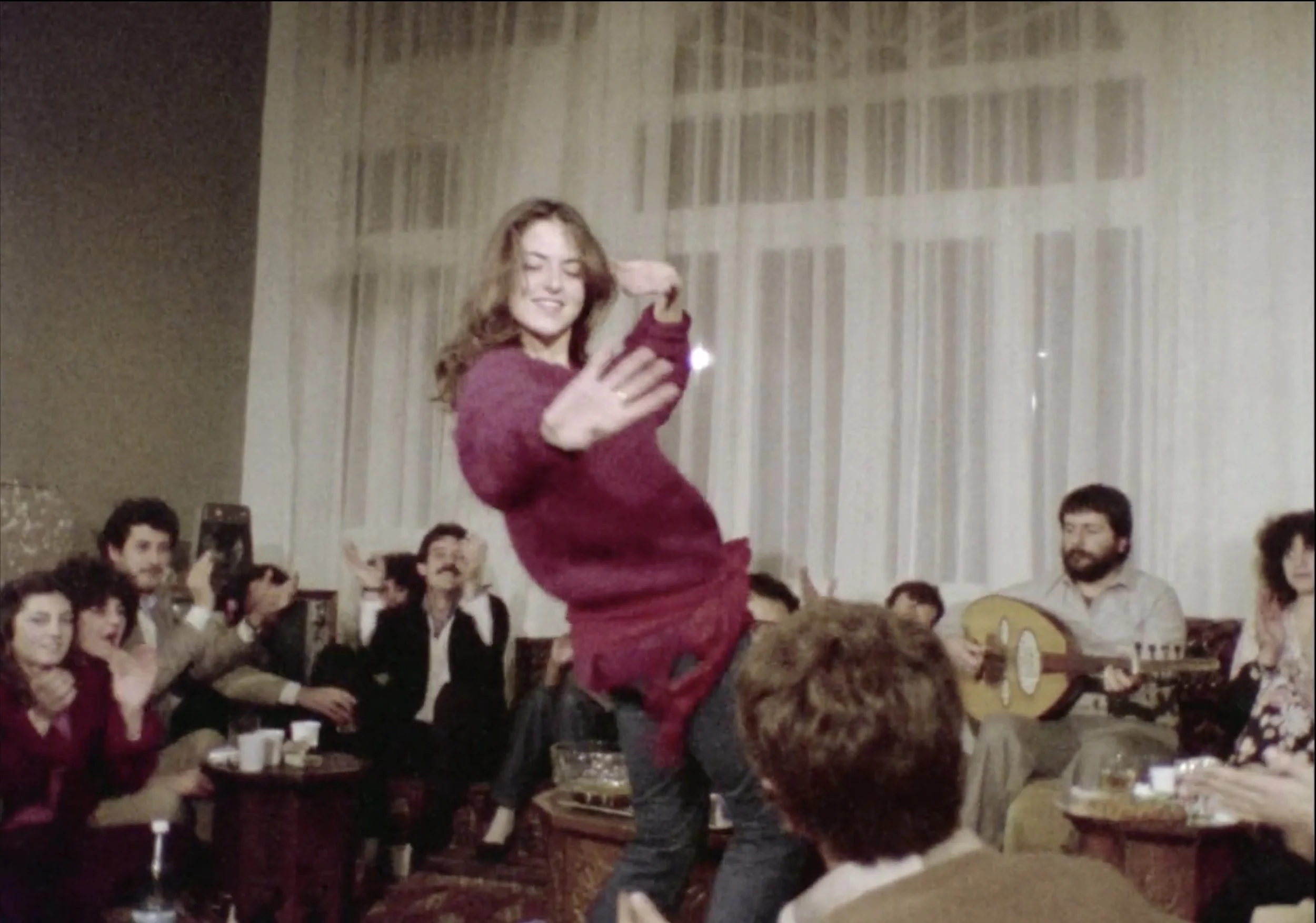
Whispers (1980) by Maroun Bagdadi
Courtesy Icarus Films
As a collage, unbound to the distortively monophonic elements of singularity in narrative or chronological linearity, this film’s threads are woven through the densely layered emotional dimensions we are made of, informing all we experience: the undercurrent whole that (dis-)orients our vision, precedes perception, dictates and filters memory, weaves through and puncture time’s folds, transcending linearity or narrative singularity.
The initial impression is fragmentation. It's true as a technicality, but no fragment of this mosaic is incomplete or isolated. Every reel, every audio holds the event it captures and the entire planet housing it: the sights, dreams, inclinations, confusion, disappointments, motivations, pain, perceptions of the person behind the camera, microphone, etc; the world they capture in constant communication with their emotional centers and our own. Through these audiovisual memories of Beirut, we are immersed by every universe enmeshing to comprise this city, immersed in all a moment contains while these moments make up our lives. The fragmented form is as abstract and surreal as our realities, feelings, and memories: exhilarating, heartbreaking, electric, confusing, enthralling, all at once - memories crack between moments, feelings creep over memories like sound over image, convincingly discombobulated, contradictory on the surface level, until the intense devotion of simply being and feeling threads every fragment together forming in our emotional undercurrent.
Every segment and chapter of the film locates itself in our bodies and communicates with one another; the concatenations of experience itself communicating with, overlapping, and transforming one another; stirring a different, subconscious invigoration every time. Personally, I was left struck by the communication between childhood and fear and memory, transforming, congealing into adulthood—the communication of years with one another…of our bodies and our sea…of my memories with my mother’s with those of someone neither of us will ever meet…how our grandparents’ old dreams communicate(d) with a future not yet fulfilled and with our collective trauma…separated only by time and the colour filters within the self.
After the film's opening night at Metropolis, Beirut's shining independent art cinema, a dear friend said, "the film ended, the lights came on, and it felt like it was cutting to the next scene."
Lana says,
“You could feel that some people were extremely uncomfortable, others were very happy, some found it very moving, others were numb. It's a variety of feelings. This film allows space for all those feelings to come up, I was trying to work on a very emotional experience. One of my closest friends worded it so wonderfully: ‘this is a film that you watch with your body and with your emotions.’
Bringing together so many different people from many vastly different communities all together in this space to share a moment of, not just our collective memory, but of our present, the things we go through, pains, dreams, traumas, all of it - was very special to me. I want us to connect over what we share as people and as Lebanese. People that I know from all these different backgrounds were able to watch this film and come out of it saying, “this is my city, this is my experience, and these are my memories.”
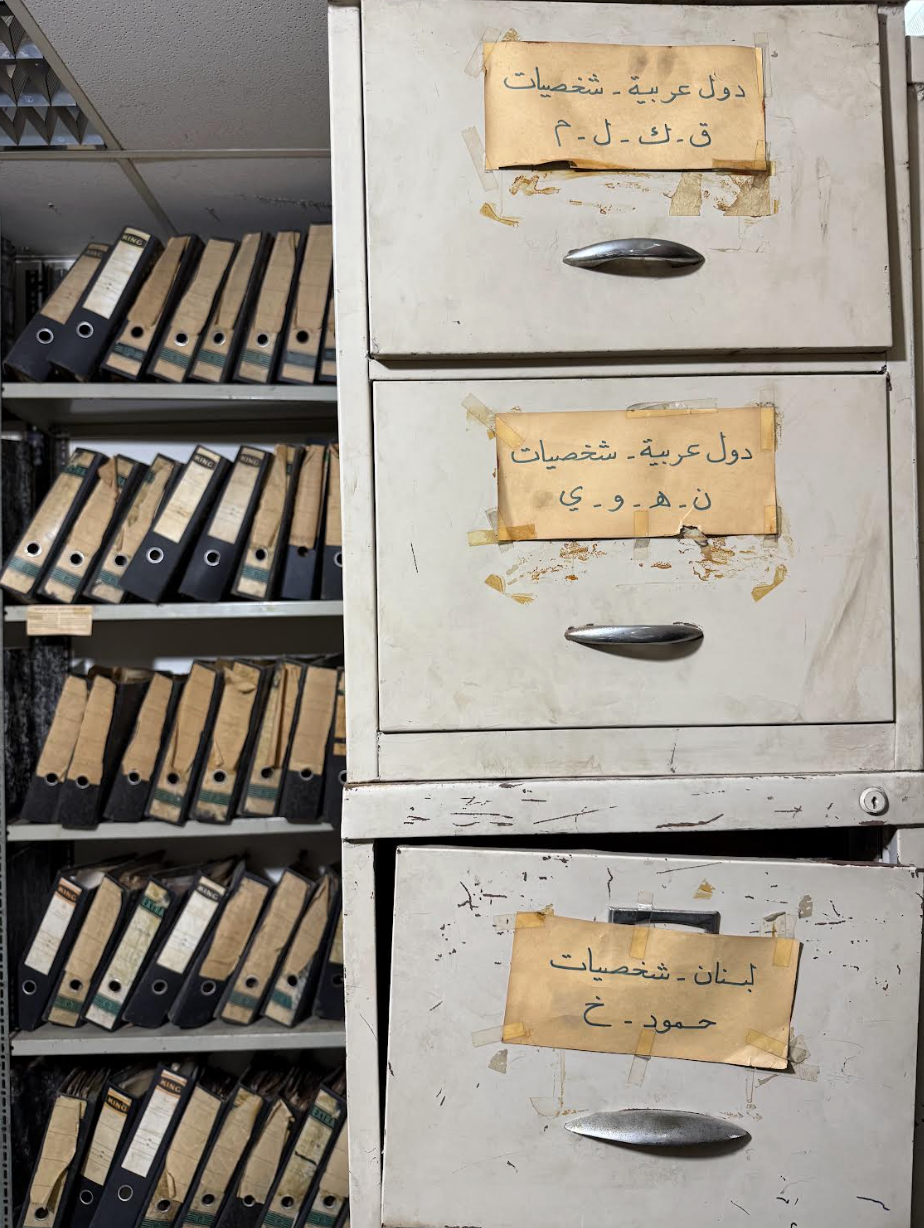
From the research process. Provided by Lana Daher, 2025
The bubbling, electric, chaotic, concurrent constituents of existence are in constant communication in our city and our bodies, moving through and transforming one another, swelling, congealing, glitching, growing, resting, rising into memories, experience, imagination, identity. Living through and reacting to such whiplash emotional immediacies in their relentless cycles, time distorts, swells, and trudges along under emotion’s weight; memory and expectation naturally, then, distort and fragment as well.
"This film came from all of my pain, but also all the love I have for Lebanon. I think I had all the sadness and grief in the world. With this process, I transmuted all that pain, grief, and disappointment. I put all that energy into making the film and it helped with all of it; I was able to see the pain and say, “okay, that's there” - then it doesn't hurt as much. I'm aware that this is a painful place, and for now, it's going to remain a complicated, painful place. Making this film allowed me to stay here, because today, I stay knowing the reality of things here. I found a challenging, deep understanding of this place that we're from. I'm not so naive about it.
I accept Lebanon for what it is now, not for what I want it to be.”
Do You Love Me offers, reconciles, and processes memory and history itself; posing a question we ask Beirut as Beirut asks us the same. Are we really seeing ourselves or one another in all we contain?
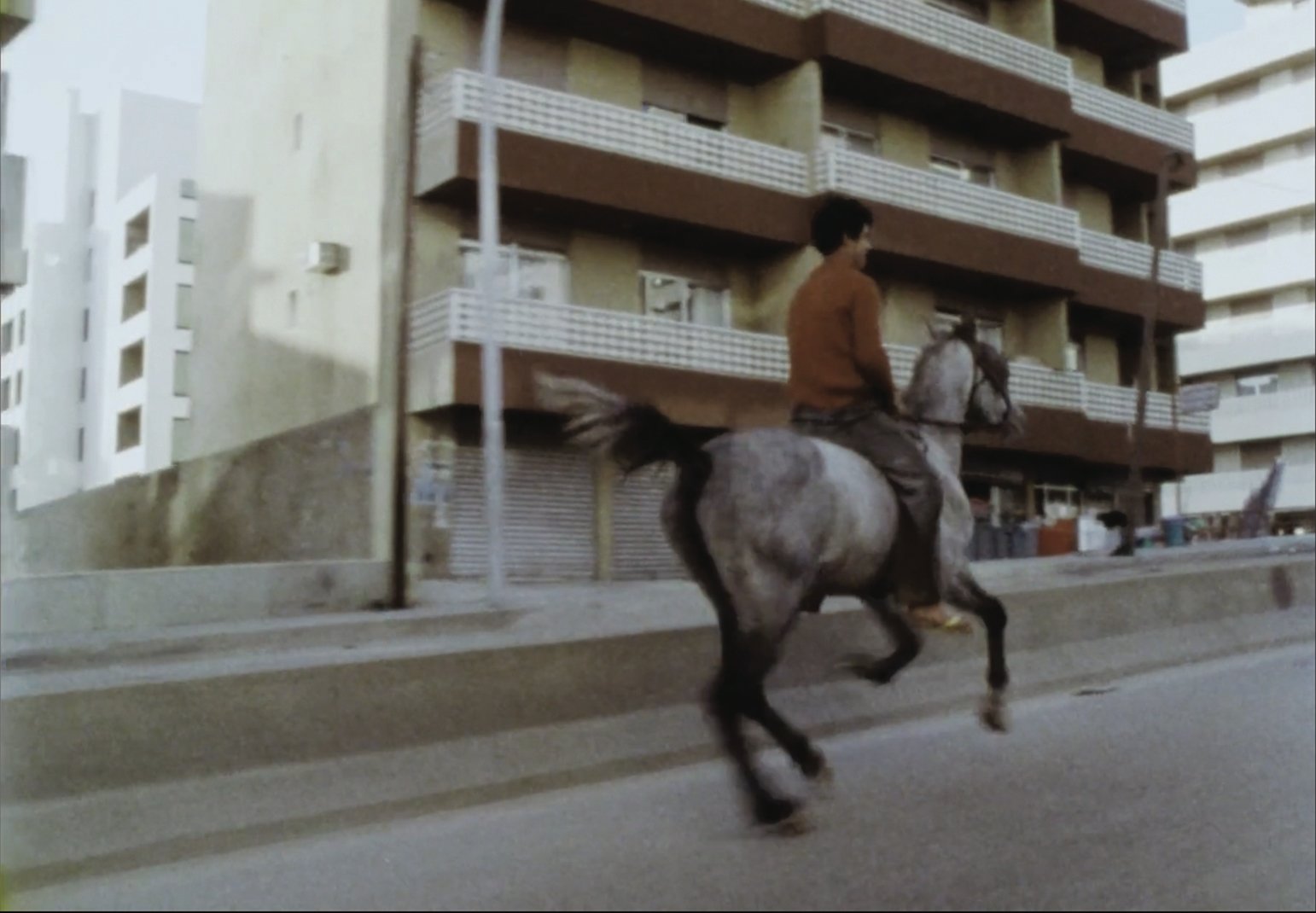
© Whispers (1980) by Maroun Bagdadi
Courtesy Icarus Films
In asking Lana Daher about her entry point to this film and into our archives, she says,
"There's this amazing Chilean documentary filmmaker, Patricio Guzmán, he says, ‘ A country without documentary films is like a family without a photo album.’ Growing up, we didn't have access to our own family archives, our home videos. They had been lost somewhere along the way [war and time]. We had no access to those memories.
And growing up, going to school in Beirut in the 90s, after 15 years of civil war, none of what had happened was discussed. I was a seven year old growing up in a city that was completely destroyed. They would say, "you weren't part of the war generation,” while there was nothing to do, nowhere to play, no electricity, every single wall I looked at had bullet holes. So I had, not just a desire and curiosity, but a strong need to dive into what this shared history was; what was it that had happened that I couldn’t see and supposedly didn’t know?
The film started off focused on music - that's where the title came from, the Bendaly Family song. During the research process, I started to understand that it wasn't quite the music that I was looking into, but more the space and feelings they contain, what they took me back to; my relationship to memory.
From this deep need to see things, came the decision of making a film that was entirely made from existing sounds and images. Many of them are already representations of Lebanon, of Beirut; so in a sense, I was reconstructing my feelings and experience of this place through these thousands of representations of it. We don't have a national archive and we don't have this unified history, but we have so much - it's all there, it's just a little bit fragmented.
The process was very challenging, but one thing that was always clear to me: I wanted a human, emotional point of view: a point of view from society - not politicians - which is made up of ordinary people, our art, culture, musical films, songs…Within them, all the questions I was asking myself, a lot of answers I was looking for, I found. What I wanted to say and was asking myself: other people were too, through their films, voiceovers, dialogues, amazing oral histories and podcasts as well, like Maabar [oral social histories of the Civil War.]
I didn't need any voiceover; my voice was already in the film, and so is everyone's voice.
So the title stayed, even though it was no longer about the family. It became representative of this complex love that we have with home, the place we're from. I don't know if it's a question that I or we are asking Lebanon, or if it's Lebanon asking us if we really love it, because the love we have for this place can be very selfish.”
Daher provides us with what every community should take for granted: the act of constructing our shared memory, our archive, and the exhalation in processing through art and one another.
I, at 27 years old, too inherit Lebanon from the generation colloquially defined as the "war generation," (the devastating 1975-1990 Civil War, not to be confused with the war of 2006, 2023-2026, various uprisings, our failed revolutionary attempt, or the countless violent spillovers since). The civil war is largely unspoken of publicly and unaddressed nationally; no one can agree on what happened. Memory unprocessed, trauma unprocessed; robbed by every unspeakable, nightmarish imposition of war and invasion, and robbed of processing it as well: whether it’s due to destruction, neglect, aversion, an attempt at personal absolution or at absolving the sects we pledged allegiance to long before and long after they’ve plundered and pulverized us with the egos that they’ve pledged allegiance to, or simply, the lack of the privileges of time, of physical or emotional capacity to construct institutions within and beyond the self in service of memory and reflection, to look at and address the pain that lies beneath memory, the hope, regret, desire, love, or perceived lost time...
We are thus a nation without central archives: reflecting and bolstering our factioned, fractured social history with its processing fragmented across our population - structurally disconnected, disconnecting from one another. What then, do we turn to when we look to make sense of the unprocessed immensity we inherit? Memory? What is, and isn’t, in a memory?
Born at the conjunction of experience and emotion, undulating into one another, a memory is coloured and recoloured by our subconscious desires in processing the experience that first stirred it, and in processing all the time between then and now.
Where is that processing steered in making sense of absurd tragedies? How could one negotiate with years, or decades of pain, hardened inevitabilities, and unfulfilled realities? What could we lose when pain and convenience declare inevitabilities to minimize hope, effort, anticipation, thus imagination, in the fear of futility? What does pain inflate (as problems to be solved) or minimize (in elusive desire to avert from,) and what is simpler to just forget? Where does our memory fragment reality and congeal over it? What do we inadvertently inherit from unprocessed traumas of those before us? What do we miss out on in our narrow bubbles without access to our own processing and perspective or of those constituting this nation with us? If trauma informs emotion informing memory informing expectation and anticipation, what becomes of our processing, imagination and our identity - individually and nationally - when all we have to lean on is fragmented/-ing memory? Where do tradition and imposition begin to collapse onto one another?

Memories Lost (2020) by Ayla Hibri
Courtesy Icarus Films
In this information age, we naively take access to information for granted as information itself. To think of all that lies in our arts and substantial social history unseen by us, not as immediately accessible, in its every radiant possibility, difference, beauty, and missteps; even if just to better understand ourselves and the stories we emerge from and inherit, where we came and come from, how so many of us have felt through and processed this place in its paths, possibilities, and dreams - parallel to and vastly different from our current realities. It will not immediately be enough to live up to our nation, to build material security underneath a corrupt mafia government and imperial destruction, but to see it and ourselves wholly, in acknowledgement, imagination, and recognition of past and possibility, we begin to imagine beyond inevitability, reconfigure experience, and rebuild intentionally as we build anyway.
Even beyond Lebanon, what we take for granted as "human nature" is dictated by collective memory, which is dictated by, what exactly? Whose history?
To recollect and render memory whole is a necessity, and the time to process, construct, reconstruct, deconstruct, observe, is as necessary a privilege as life itself: to metabolize time and challenge our own hardened biases and expectations by seeing the whole paths in all their forks and untraversed space. Or, as better put by Milan Kundera, "the struggle of man against power is the struggle of memory against forgetting."
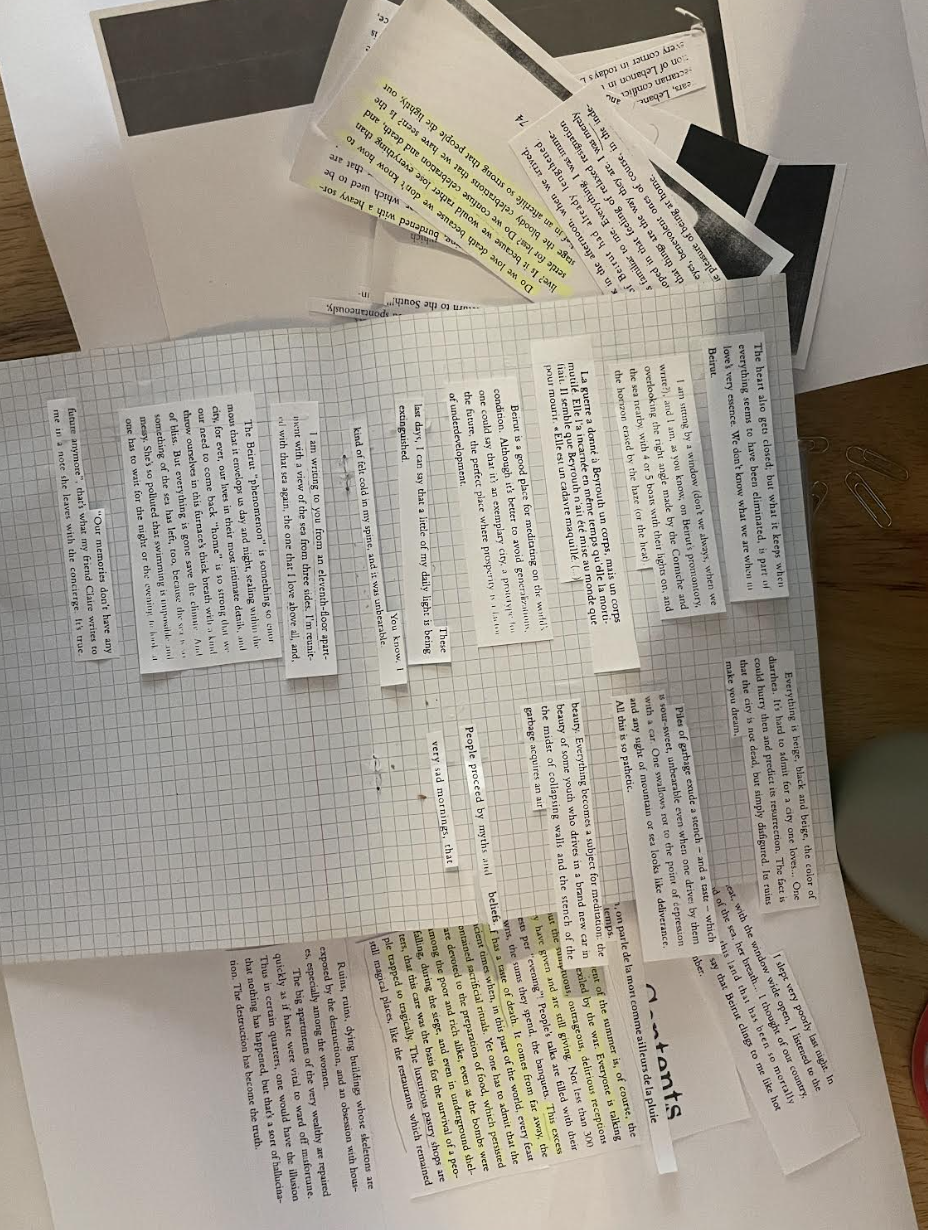
From the research process. Provided by Lana Daher, 2025
This country tears me to shreds in my love for it, as is the condition of the inherent abundance of being alive (with a deep love for a failing state with a certain bloodthirsty neighbour.) I have learned how to be a human being, whole and in parts, on and through this land. I have lain beneath our trees young and old, looked upon the mountains that have looked upon our every ancestor and their entire worlds, I dive, float, sail, melt into our sea holding all of time, enmeshing, our sea that has seen the earliest written words, taken in every irredeemable drop of blood, nourished our every cedar and jasmine - every wave’s beauty, very existence, necessitated by its predecessor and successor.
On the film's motif of the sea, Daher says, "The sea is a place that we keep going back to, for a sense of peace, safety, comfort. As Lebanese and Mediterranean people, we have a very strong connection to the sea. The sea represents a witness of time. No matter how much the coast changes, the city, the people change, the buildings, the seasons change, the wars come and go; the sea is the sea. It's that same sea that's been here, receiving everything, witnessed everything. It's that unchangeable sea that's just there holding space for the city; as a witness of time and still, a place that's so nurturing…it's very powerful."
This film posits us as witnesses to ourselves, one another, our Beirut, in every rich colour and shade, begins to fill the cracks our education system, social bubbles, emotions, isolation, and memories leave behind. To look at the whole moving body and witness our every facet in their simultaneity, undistorted by momentary bias, or constrained by shifting, unprocessed pain, we are able to peek into our relationship to all that we are, all we have had, all our city is, could have been, could be, and our intertwining paths from above rather than below. To really see one another, our shared emotions, our city through each other's eyes, the different colours between our perceptions and processing, dreams, disarray, similarities and variances: infinity realizes. We show one another new light, and orient ourselves with - if nothing else - a little more leeway and grace in our immense pains, our love that carves out the space for that pain, in seeing, being, and becoming.
Swimming in the ripples of memory, art, perception, emotion, ever inextricable, with their interplay emerging into experience, identity, memory, and imagination (individually, collectively, and nationally,) we relish in all that we are and the sea it springs from. The grace of memory and sight move us into reconciliation; being and becoming, not out of habit, but in honor of seeing wholly.
Catch Lana Daher’s incredible debut feature, Do You Love Me, in theatres now.
Upcoming showtimes in the US can be found here, and in Germany, here.
The film will also be screening in Amman, Jordan @ Amman International Film Festival on July 31, August 2, and returning to Beirut @ Metropolis on July 23 (+ Q&A session with Daher,) July 27, July 30, August 3, August 6.
For dates yet to be announced and more, follow Do You Love Me on Instagram. For more information and Lana’s beautiful archive collection, visit the film’s website.