
A Second Language for People Who Can't Sit Still: A Conversation With Breton Tyner-Bryan on 'Rhythm or Smooth'
I don't have the strongest connection with dance. If being a good dancer is a spectrum that starts with the Footloose town mayor who banned dancing and ends with Mick Jagger (I'm not sure if he's the greatest dancer ever, but "Moves Like Jagger" presents his moves as the standard of excellence for dance, and I'm in no position to dispute a 2010 chart topper), I sit a lot closer to the mayor. Unless you count the Macarena. I am very good at doing the Macarena and I love doing the Macarena.
Despite my lack of dance fluency, a lot of my closest friends in undergrad were dancers. Through college, I was lucky to attend shows they performed in and shows they choreographed. For them, dance was their preferred means of expression. They would tell me beforehand a piece was about grief, or longing, or some specific feeling, and I would watch them move in impressive ways and still stand outside the work. Beneath the intricate movement was a language that I was unable to translate. My own language of expression has always been more literal. More recently, I have been conversing through film. Movies have become how I process what I feel and how I explain myself to the people I love, and for a long time I accepted meeting my friends' work at a distance, admiring the body without hearing its sentences.
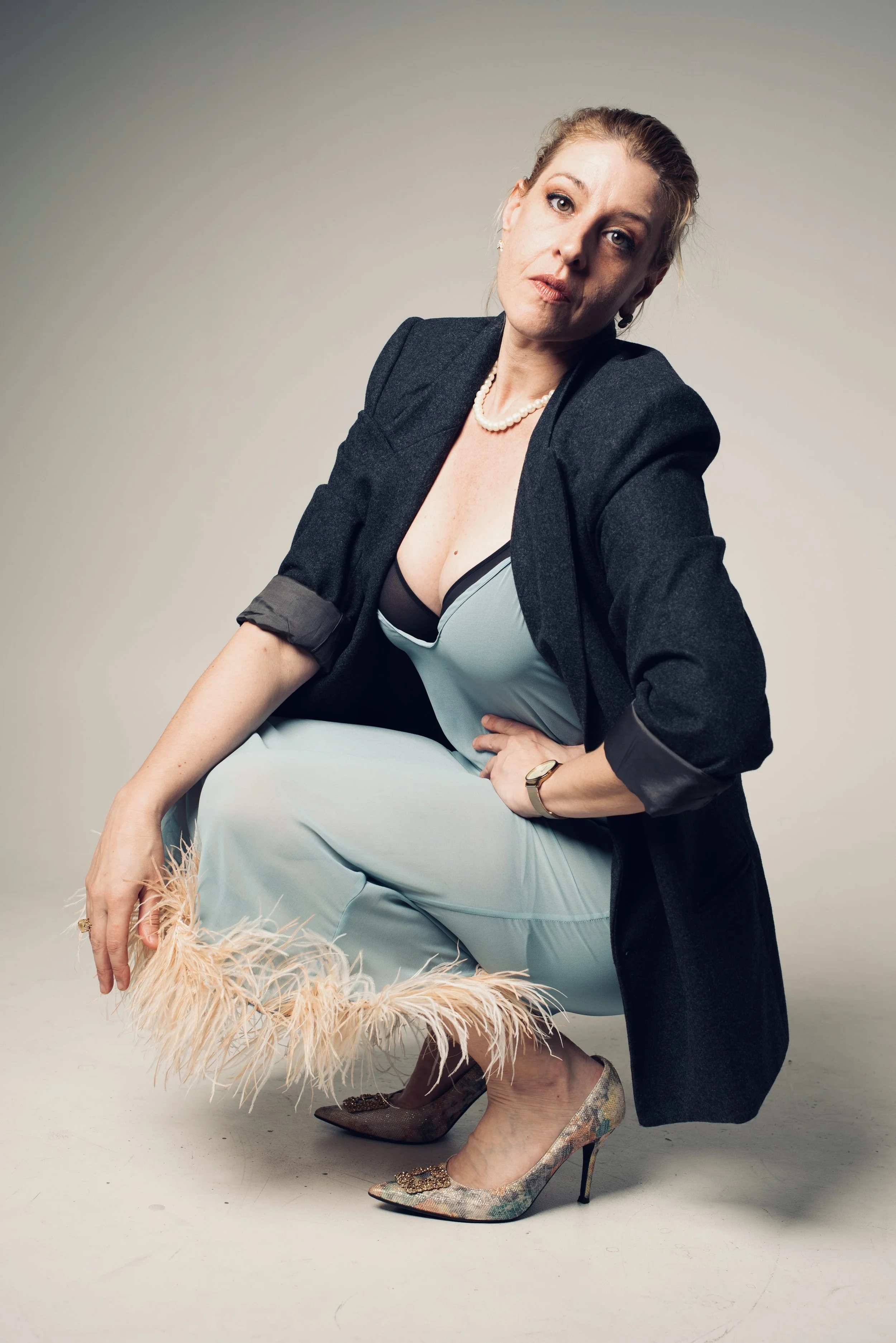
Breton Tyner-Bryan lives between those two languages. She grew up in the ballet world, spent a decade making collaborative dance theater in San Francisco, then another decade in New York choreographing for Broadway, acting in shows like The Penguin and Billions, and writing and directing short films before anyone asked. Rhythm or Smooth is her feature debut, a comedy set inside New York's competitive ballroom scene. She wrote, directed, and acts in the film, and in conversation her two vocabularies run together without ceremony.
I spoke with her about the emotion underneath the codified movement, the spray tans that pulled her toward ballroom dance, walking out of an audition and into a studio to choreograph her own work, and why this film could only have been made in New York, right now, by this version of herself.
This conversation has been edited for clarity.
Ali El-Sadany: I grew up around dancers. Some of my closest friends in undergrad were choreographers, and I would sit in their performances while they told me a piece was about sadness, about one specific emotion, and I never fully understood the language. My language has always been film. The thing I did learn through those friendships is the body says things language can't reach. I'm curious about that belief. When did it first take hold in you, and how does it live inside Rhythm or Smooth?
Breton Tyner-Bryan: I probably felt it as long as I can remember, age two or before. It's a physicalization of emotion, of storytelling, that happens to be in a dance format for me. I experienced the world with a photographic mind, through image and sensory information, from colors to details to architecture to nature. Then I discovered dance through musicals on television and in books at the library. Again, through image. And I was clear I wanted that. I asked for it and demanded it over and over of my parents.
It all comes back to narrative, because I grew up in the ballet world, where you have elaborate narrative, sets, costumes, all to define that. But it's an energetic practice moving through the body with emotions. If you get sad, your heart closes. If you're feeling jubilant, your heart is open. I think it's that simple, and then whether it's ballet or hip-hop or another technique, you're structuring it into something codified visually. Just like music. Music is symphonic, it's emotion, we make sounds all the time, and wherever you are in the world, whatever music you're creating, it's still been systemized.
I'm also the kid who can't sit still. You watch me move, you watch me talk right now. Sitting is painful for me. A dancer is someone who needs to move through the world, and you can say the same about athletes, people with an early tendency toward motion. The filmmaker eye for me, the photographer in me from a young age, loves the image to be so specific. Whether it's a triangle or what's curved about it, the specificity of the shape. But the core behind it is emotion. The core for me is narrative. It isn't always for everybody, and I think that's okay too, but for me there's an emotion pushing me to make something, and I see that in my actors as well. When you make your own movement, that's the thing that's signature, just like when you make a movie, that's what's signature from you.
AE: I want to unpack that. In my mind there's a different communication happening when you speak through a screen as a director versus through your body as a dancer. When you were directing a scene, were you watching it as a dancer? Did you have to put on a different visual hat? How do you bridge those two identities?
BTB: For me it's all-encompassing, it's the hybrid. I can't disassociate or walk away from a piece of myself even if I choose to. All my life experience, everything I've done, directing, choreographing, writing, acting, working as a dancer, it's all on display in that moment.
I taught for a very long time, and I still do, and that's where the director muscle came in. I'm watching people individually, going, what do they need? What's the light bulb? What's going to activate them? I come from very systemic academic environments, creating curriculums for grad school, working in the ballet world, very codified. But I learned I'm looking at the individual to maximize their potential. I was aware I wasn't applying a curriculum to everybody. I was looking at each person for their strength, for what they need to rise, and that translated directly into directing.
When I'm looking at everything on a monitor, it's complete ballet. It's all diagonals, complete movement. I can't turn it off. And that specificity is what makes our work look so distinguished together. It's all about where the camera is, the timing. A great edit is choreography. Good choreography is edit, good edit is choreography. So your compass, your commodity, is time. How much time does it take for someone to express this, and maybe more importantly, how long does it take for the viewer to receive it? Do you want them to understand it now? Do you want it to go rapidly and arrive later? You watch my hands move, we watch someone walk past me, it's all dance to me. It's just whether the expression of movement is macro or micro.
There was a time I tried to separate them. When I was auditioning as an actor, I was successful booking when I didn't tell people I was a dancer. I would keep that piece to myself. But all my specificity of movement, the timing in which I'd deliver a line or collaborate with other actors, came from that dance training. And I love to improvise. A lot of dancers aren't comfortable with that in the same way. I'm always going to be playful. I was the kid doing impersonations of Jim Carrey. I love pushing beyond the expected medium, the expected role. And I think that's the sweet spot connecting theater, acting, dance, and directing for me: we've planned, but I'm still open to something better than what I've planned. I love film for that. I can shoot a scene all day and move on. I'm not doing eight shows a week, looking to do the same thing over and over. I'm looking for elevation and expansion. Theater is pinning it for the stage. We're pinning in the edit.
There are so many artists I know who try to divorce a piece of themselves, and in the end all of it is extremely valuable. The more you've studied, the more you've experienced, the richer the tapestry of collaboration.
AE: You mentioned you weren't necessarily looking to make a dance film. How did you get here?
BTB: I have the knowledge and understanding to do the job. And I love the dance world, I celebrate the dance world, and I love to see it reflected authentically and positively in media. You realize there are only a few people who can do that, and you have to be in the right position with director and DP to make it happen. There are lots of series and shows out there that miss, and the dance world feels like it hasn't been included. If you're in that position, it's important to embrace the responsibility. And also, why not celebrate dance at the highest level? It's such a basic, intrinsic thing humans have done for so long, and it's gotten put in these other places. When it's good, it brings great joy. At the end of the day, the esoteric approach isn't what's going to pull people in. It's the community. It's the joy of it.
AE: This might be a flawed understanding on my part, so correct me where I'm wrong. You trained in ballet, which to me feels individual and rigorous, while ballroom is a different animal, partnered, social, competitive, with its own intensity. How did your body respond when you stepped into the ballroom world?
BTB: I love what you set up, because honestly it's how I feel. I grew up in the ballet world. I was the kid sneaking off to the costume shop, looking at everything, staying way longer than I was supposed to, because there was an elaborate quality of transformation through costume that was loud in ways the studio every day was not. Part of the attraction of ballroom is I met it again watching it on television, or in movies like Strictly Ballroom. And immediately what I'm seeing is over-the-top energy, competition, camaraderie, an element of improvisational structure, because even though they're competing, they're dodging each other on the floor in real time. And I'm seeing sequins and sparkle and bright colors.
I love the ballet world too, but ballroom has a loudness that demands attention in a different way. I call it appetite. The appetite is on display, and they're selling. They are actively selling what they're doing, and whether you think it's real or not, they're pushing that energy, this high-volume expansion of energy. I find it pretty authentic. People are dressed a certain way, hair a certain way, but you can feel in their soul they're giving you everything they have for the next five dances. I find that effort hugely attractive. Ballet isn't always wanting to show effort. We're showing precision, exceptional technique through emotion. Maybe it's the spray tans that pulled me in instead of the Wilis in Giselle. There's also the Latin rhythms, which have always appealed to me as a choreographer. Pointe shoes to heels was my transition, working as a choreographer in musical theater. You're still working with a technique that's up, up, up, but there's so much more hips and sass to it than the ballet vernacular.
AE: I'm curious about authorship. You wrote this, directed it, you act in it, you've run a dance company and taught. When everything is mine, I get paralyzed by it, and I get intense about it. You're authoring across multiple mediums and it all arrives in one product. What does that cost?
BTB: I'd point out Jaryd Farcon is our choreographer on this film. I specifically chose not to choreograph it, and that was an excellent choice, because you can bounce off someone in conversation. I do act in it. My journey as a performer and creator prepared me for this. I spent a decade in San Francisco working with dance theater companies, and in that cultural space you're expected to generate narratives collaboratively with a group. At the time I didn't see that as a gift, but it very much is. It taught me to think beyond what opportunity I could create for myself, and at this stage it's brought me to owning the IP I'm putting into the world.
In New York, I didn't want to wait to be cast in the right role. I'm a very particular look. I'm 5'10", I'm classically trained, I'm loud in my energy, I'm athletic. I'm the individual in many ways. I'm not the person who's going to book out of a Broadway lineup, but I will definitely book if you're looking for someone whose individuality stands out. You see doors close, and I basically finished an audition, walked into a studio, and started choreographing, because I couldn't wait anymore to be fed artistically. I made things because I needed them emotionally, to be in conversation with. I had a dance company, and I attracted people who also had a loudness, who weren't dealing in conformity. The dance world often asks for conformity, and that's never been my strength or desire.
We had no budgets, so I did the costumes, the promotion, the casting, the music. Lack actually allowed me to make choices. And under the directors I worked under, I became aware I had opinions on lighting, set design, costume, casting, in ways they didn't. Then I made a bunch of short films in conversation with the fashion world and the dance world, and I had a mentor say to me, directors are a dime a dozen, go write. And my DP, when I brought him a project someone was going to let me direct, said, this is crap, go write your own thing, come back when you wrote something. Those two moments pushed narrative onto the page. And you realize all of these things are just mediums for storytelling. They're different ways to express an emotion or a time and place. I started writing on personal projects and couldn't stop. Then I got hired to write on other people's projects and adaptations, and I found I loved that collaboration again. Rhythm or Smooth is a collaboration in that regard. I'm taking pieces I know are important to a producer and blooming them into a world where they can sit. It's similar to how I worked as a choreographer. I'd know a dancer in my company had a desire to try something they weren't getting the opportunity to do, and I would create for them. It's the same thing on the page.
Doors open for me when I make something before I've been hired to do it. It's happening now with a book series adaptation from a television show I wrote. Nobody asked me to do that, but I'm getting the call because I felt I needed to do it. I was choreographing before people were calling me to choreograph. Go do the thing, learn how to do the thing, show someone you can do it. At the end of the day, you want to feed yourself artistically, and the people around you, for as long as possible. Satisfaction is such a funny word for artists. We get to hang out and make something beautiful for as long as possible.
And none of it exists off the page without the actors and my DP. I have so much gratitude to them. They make it come to life, and I know what it takes to show up to set and bring that. The DP for me is everything, because without that specificity of visual vision, it's not mine. I bow to them always. I'm not going to play every role, I certainly don't want to, and it's for sure a team sport.
AE: To close, of everything you've made, where does this film sit for you? You've worked in so many forms. Why was this the one you needed to make right now?
BTB: It's such a New York film. I was like, okay, I'm not doing a New York film, I'm not doing a dance film. And it is, to its core, a New York film, in the actors, the energy. It's inspired by every corner you walk in the city. You ask yourself, am I an expert of anything? I don't know. But I'm pretty knowledgeable on these things, and there's a specificity to that, and you have a moment to make it. I couldn't have made this film if I didn't live in New York right now. The connections, the energy, the access, the locations. I'm fanatical about locations as a character in the film. The texture, the volume of detail we were able to capture without building anything, without adjusting much of anything, is phenomenal. They always say everything exists in New York if you want to find it.
I am who I am right now. I'm not ever going to be this version of me again. This was the culmination of my past decade in New York City, across the board, from the writing to the casting to my relationship with my DP. We've worked together for six years. We made a bunch of other films here. And what I like about it so much is the comedy that can come through. That's very much me right now. I write on other projects that are more sci-fi thriller, but coming through the pandemic, I keep getting hired to do comedic work, and at my core it's what I really love. Humor and dance often seem to sit apart, and there's so much humor in the dance world if it's allowed. It's like San Francisco. There's so much humor there, but you have to be in it to have the responsibility to mock it. The joyful piece is the one I'm most excited about, that we have that in the film.