
The Idiot's Guide to Turning Up: Felipe Bustos Sierra on 'Everybody to Kenmure Street'
It’s really easy to lose faith in the American electoral system. After all, the presidential election process is designed like a humiliation ritual. Every four years, you are corralled into a booth where they give you a ballot. On this ballot, you are given a few options. You can vote for Bad, or you can vote for Less Bad. You’re also welcome to vote for the secret Third Option, which is purely symbolic in nature and if you tell people that you did that, you’re usually seen as an idiot. That’s fair. The Third Option has zero chance of actually winning, and if you want your vote to "count" in this system, then you have to choose between Bad or Less Bad. Of course, your vote doesn’t really matter that much, because the entity known as the Electoral College decides the results of the empire based on the geopolitical anxieties of a select few people living in Pennsylvania, Michigan, and some other godforsaken state.

Once you partake in step one of the humiliation ritual, the system runs its course. Bad sometimes wins the election and governs, as you might guess, badly. Sometimes Less Bad wins and governs slightly less badly. You can complain, but you’re encouraged not to. If you complain too much, that means Bad might return next election cycle, and things will be Bad again (God forbid). So you are told to be grateful for Less Bad. Go out and celebrate in the streets for it could be worse. You may want more than Less Bad, but you are not permitted to vocalize this desire.
When Bad is in power, you are encouraged to protest. After all, you live in a free country, and that is your right! Peaceful protest is your civic duty! Go on and put on your best protesting pants! Buy some craft supplies from a megacorporation to make a sign that says something cute! Once you are geared up and ready for protest, you go to the location that the authorities have designated as the Official Free Speech Zone (the small 2x2 plot of sidewalk tucked safely away from any sort of economic motion). The system you are protesting has graciously carved out this space so that your righteous anger does not accidentally slow down the economy.
"Please scream into this designated square," the officer says. "Do not block the sidewalk and disturb the businesspeople from doing their important business."
You are now in a sea of screaming bodies. You accomplish nothing while the American imperial machine continues to thrive off wealth inequality and bomb countries overseas. Your paycheck funds atrocities, and you get to watch all of it unfold in high definition on your phone. You think to yourself: "I am making a huge difference," you tell yourself, standing on a slab of concrete that no one notices. "The empire is surely trembling. I have faith."
This is the bratty jadedness that I brought with me to my first viewing of Everybody to Kenmure Street. This was also the same cynicism (aka the belief that turning up to anything changes nothing) that I realized was so immature during my conversation with the film's director, Felipe Bustos Sierra. Bustos Sierra also had a similar journey regarding his attitudes to protest. I’m not naive. I understand that watching one documentary and making one Zoom call does not magically resurrect a dead faith or wipe away years of accumulated cynicism, but it can give you a little bit of much needed patience. As Bustos Sierra tells me, "I think it's just about turning up, and not expecting something out of it."
My conversation with Bustos Sierra contextualized how limiting my perspective had become. He speaks of a form of solidarity that transcends academic context or historical lectures. As the son of a Chilean journalist who was exiled to Brussels after the 1973 coup that toppled Salvador Allende, he grew up going to Chilean solidarity gatherings in Europe. Drawing on that upbringing, he noted how deeply moved he was by people who supported a cause purely out of natural and genuine compassion, without even speaking the language. On Kenmure Street, neighbors defended one another through a visceral, immediate understanding that removing people from their beds at dawn is fundamentally wrong.
Everybody to Kenmure Street implies that every single body is necessary. Every motion and every presence matters. Films and conversation about films are special in their ability to entertain, but also to make you realize how misguided you can be.
This conversation has been edited for clarity.
Ali El-Sadany: I was really taken by this documentary, and by how pertinent it feels right now. You grew up in Belgium as the son of an exiled Chilean journalist, your father on the blacklist for fifteen years. How did that history shape a film about Scottish neighbors refusing to let the Home Office take their van away?
Felipe Bustos Sierra: Representation has always been important to me. Growing up in Belgium, there was a big film on television every Thursday night, and it was a ritual. One night they showed Missing, the Costa-Gavras film about the coup in Chile, about how the CIA had pushed it forward. I was so excited going in. I thought, finally my classmates are going to understand what my family has lived through. And the next day I was gutted. They couldn't relate to it at all.
From then on I watched films differently. I understood we had a perspective that didn't fit the culture I was growing up in. I found Patricio Guzmán's documentaries young, and that was my way into what had happened in Chile. I also carried these memories of the solidarity events for Chile, all these Belgians who didn't speak a word of Spanish but were so moved by what had happened there. As a kid it was almost embarrassing, because they were so open with their feelings. You'd see the tears coming, and at seven years old that is a lot to take in. But they had this sense of solidarity as something you pay forward. You don't look back, you don't think about yourself, you just keep going.
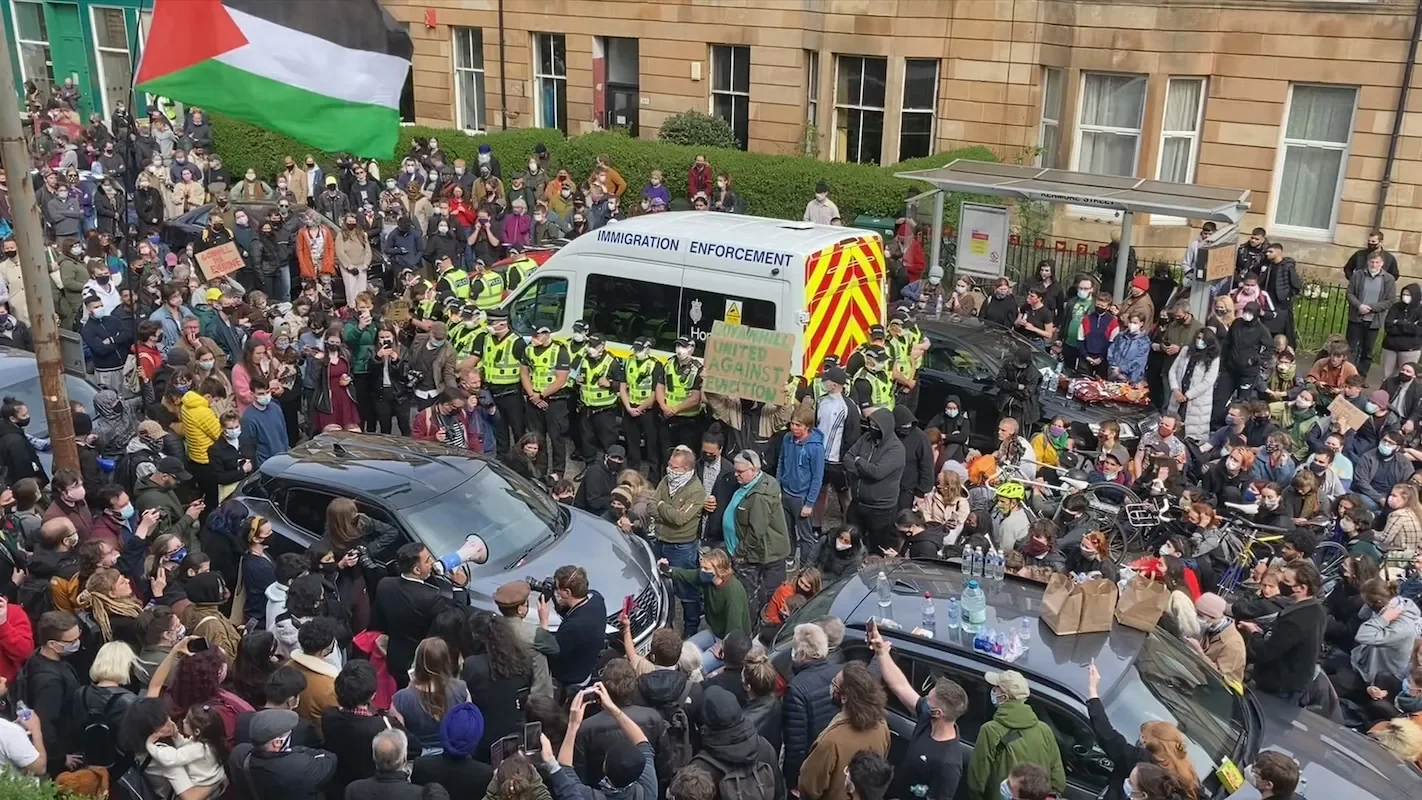
Cut to Kenmure Street decades later, 2,500 people on one street. Somewhere in the edit I realized these were the same people I had met as a child in Belgium. They didn't need a historian to explain it to them. They just knew that pulling people out of their beds at dawn was wrong.
AE: How has your relationship to protesting evolved after making this?
FBS: It is a work of atonement. I got the call that day, and I didn't see the hope, and I didn't go. I was re-sharing things online, but I stayed home. I can justify it a hundred ways, and none of them matter. There had been so many brutal police actions that year, at the silent vigils, at the Black Lives Matter protests across the UK, and it felt to me like there was no hope left. Bodies on the street don't work anymore, that is what I believed. Going felt performative, like you would show up to get hit in the face, maybe arrested, or you would arrive and the van would already be gone.
So when I started interviewing people, I made myself say it. I would tell them, I didn't see the hope, where was the hook for you? And it opened everything, because most of them hadn't seen any hope either. And that created permission. It's okay if you didn't go. It's okay if you couldn't stay to the end.
AE: Did making this give you back your faith in mass protest, or is the faith a different flavor now?
FBS: A different flavor. The faith isn't in the protest itself. I think it’s just about turning up, and not expecting anything to come of it. There is something powerful in that. Nobody on that street believed protest was going to save the world. They wanted to make the day difficult for the police, and that was as far as it was meant to go.
You have to remember the day. The van arrived on Eid, in the most diverse community in Scotland, and it felt like a provocation. Gaza had been carpet-bombed six days before. Sarah Everard had just been killed in London by a police officer, and the silent vigils for her had been violently broken up. People were angry about a lot of things at once. And once they were standing on the street together, something turned, and they started asking whether they could actually get something out of this. A lot of protest is about imagining something better, and they got four or five hours of imagining something better together. The police kept escalating, but people broke it into pieces. It stopped being about whether we could see the end of this. It became: what can I contribute right now? Blocking the street is a good step. So you do that.
AE: You’re documenting a rare example of protest that actually works. What are some of the things you’d credit to its success?
FBS: Through community. It is the only thing that makes a safe space. The south side of Glasgow has been a landing place for immigrants for two hundred years. Highlanders cleared off their land, then Irish fleeing the famine, then Jewish families fleeing Europe, then Polish and Italian, and for the last forty years Southeast Asians. Each wave becomes the new Scots. Some bigotry gets handed down with that, but so does a sense that life has to happen through each other.
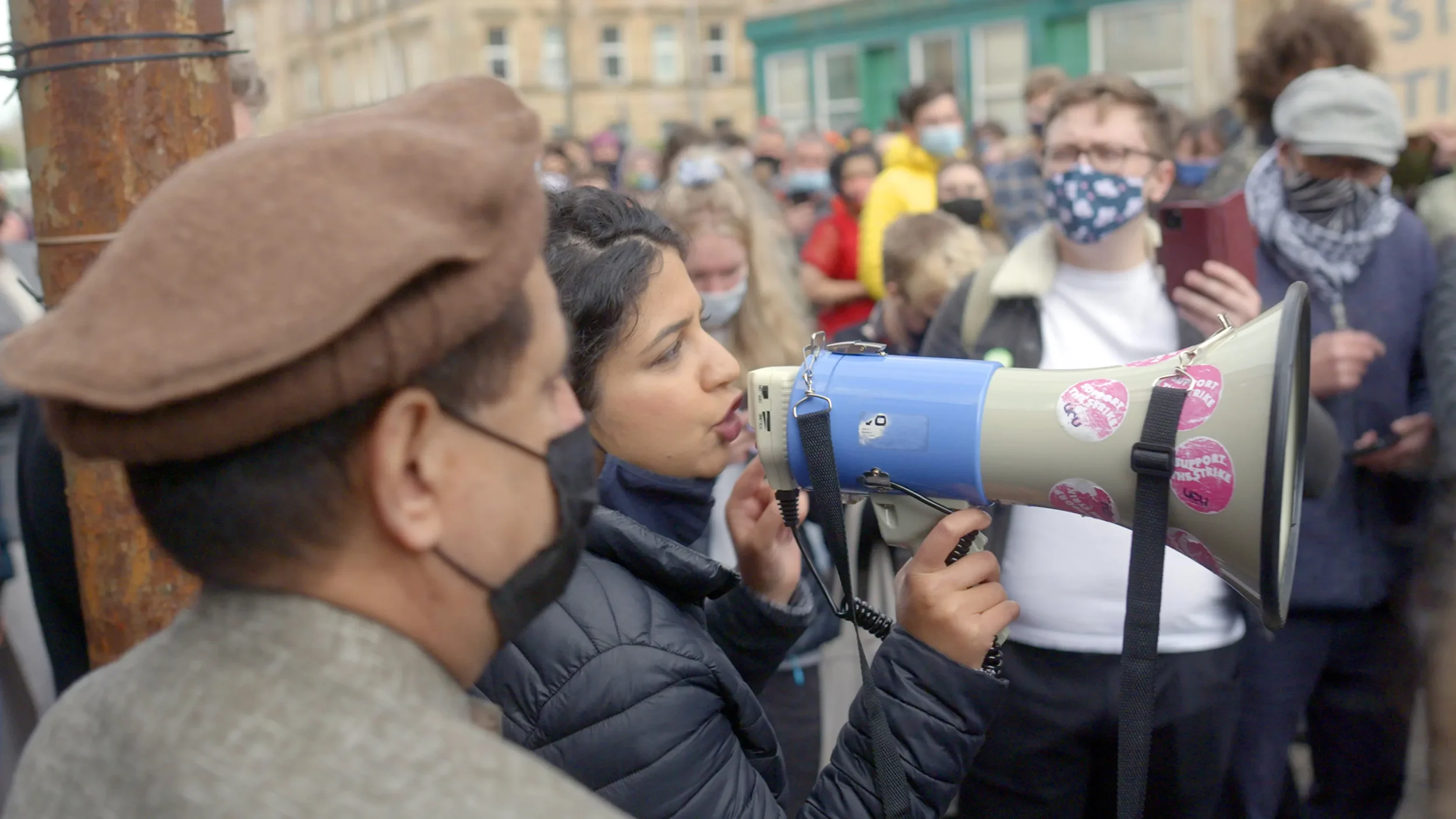
On the day, people organized on instinct. The women started opening their windows and front doors so protesters could climb in and use their toilets and never have to leave the line. People filmed everything on their phones and put it online, and the message was never come help these two strangers. It was come help me, your friend, I am standing next to the police and I need backup. Nobody waited for a leader. Everyone was asking what they personally had learned in their life that might defuse the thing in front of them.
AE: I think in our current day and age, some people are going to watch this hoping for a playbook. I'm curious what you want them to take from it, and what you worry they'll get wrong.
FBS: I have been touring the US for a month, and the first thing I noticed is that most people coming to the screenings have no idea the day turned out well. The second is that they clock that Police Scotland don't carry guns, and they think, well, of course it worked.
I kept thinking about Kwame Ture, who said peaceful protest only works if the opposition has some consciousness. A gun almost removes the need for consciousness. The officers don't have to think, they just come in, in the name of public order, when real peace is about justice, not order. So Americans assume our protesters had nothing to fear. But the police in the UK arrest you fast, and that alone can stop your life in its tracks for a year. It is a civic violence, slower and less visible, and it can ruin a life all the same.
AE: Do you see those same gestures showing up here, now?
FBS: Exactly the same. In Minneapolis I talked to people in the resistance to ICE, up against officers armed to the teeth, and they were finding the same small ways to undercut them. It was freezing, so they would fill buckets with water and throw them over the officers when they weren't looking. And what can the officers do, stand there soaked in that cold? They have to leave to warm up. It echoed our own history, the men in Nae Pasaran who let the Scottish weather rust Pinochet's engines for them.
These gestures repeat across hundreds of years. People might not be getting the outcome yet, but in the meantime they are revealing themselves to their neighbors as allies. There is a moment in the film, a young Muslim woman who comes to Kenmure Street looking for her grandmother, and she says you realize all the radicals you have been searching for your whole life are just living around you. The lack of any education about our own history makes people feel lonely, and the loneliness turns into a feeling of powerlessness, when the truth is there are far more of us who feel this than there are of them. Once people know that, once they start sharing their stories and trusting that someone will have their back when the next provocation comes, that is a huge step forward.