
The Pragmatist’s Romance: Cyril Aris on ‘A Sad and Beautiful World’
Recently, I've been feeling more and more confident that I never want to have kids. Perhaps it's the state of the world, the anxiety of bringing another soul into something that feels like it keeps changing for the worse. Maybe, selfishly, I don't want to sacrifice my agency and have to consider another living being every time I make a decision. Maybe it's that I want to afford living in the Bay Area without selling my soul in its entirety. Or maybe it's that I want the time to go to the movie theater five times a week because I'm an insane person. Maybe it's that I teach third graders on Sundays, and despite how much I love them, they are, candidly, demonic in their behavior. Perhaps it's that I spent my whole life being told that the measure of success for a Muslim man is how well he provides for a family, and I've been vehemently opposed to those norms. No matter the reason, or more likely the combination of reasons, it's gotten to the point where I've had relationships end because I'm certain I don't want children within the next five years, if ever.
The first of those reasons is the only one I can't (fully) control. The West has perfected a trick where it applauds the art of the places it's tearing apart. We call that hypocrisy if we're being generous. Today, I am not feeling particularly generous today, so the word I'll use is "system." My existence as an American citizen makes me complicit in this particular system. Surviving in America means contributing to capitalism. I work a full-time corporate job, which means I spend half my life on a computer making stock go higher. When you sit with that perspective long enough, it makes you sour on the idea of having children.
A Sad and Beautiful World, Cyril Aris' first narrative feature, operates outside that system. It's a love story that runs across three decades in Beirut. Nino and Yasmina meet as kids, lose each other, then reunite in their late twenties. In his film, Aris asks whether two people can talk themselves into building a family in a country that keeps coming apart around them. It premiered at Venice, won an audience award there, and is now Lebanon's Oscar entry.
Yasmina is the more hesitant of the two. She has done the math on her country and her life, and the math does not favor a child. She doesn't lie to herself; she sees things exactly as they are. I was rooting for her as soon as I met her. As a former (thank God for former) consultant who recoils at the idea of fatherhood, I connected with her instantly. She's me, if I were more impressive and also a fictional Lebanese woman (I am neither fictional nor Lebanese nor woman).
Aris, the film's writer and director, also connects with Yasmina more than with Nino. "I was definitely on the side of Yasmina," he tells me that he found himself agreeing with everything she was standing for and everything she was saying. “But even though we identify with Yasmina, I think we're all striving to be a little more like Nino."
Nino (Hasan Akil) is a true believer. There’s no other way to describe him. Aris shaped the character from pieces of people he knows, the ones who choose hope over logic. "In the Arab world, optimism is a choice," he says, "and it's also a double-edged sword." The noble edge of that sword is the harder one. "To stay optimistic, to keep going, to keep dreaming, to keep constructing."
The side of Nino’s optimism that can be described as noble is hard to miss. His friends all leave Lebanon, but he stays because he wants to build something there. But eventually, the audience gets to see the other edge of that sword. "His optimism, which is exactly what Yasmina falls in love with, becomes exactly what pushes her away from him."
Early on, she wants to see Beirut the way he sees it, and he is able to drag her into his fantasy. Later, once reality hits, she tells him his way of thinking is a sickness and asks him to get it checked before their daughter catches it. "The qualities we fall in love with in our partner are sometimes exactly what end up pushing us away from them," Aris admits.
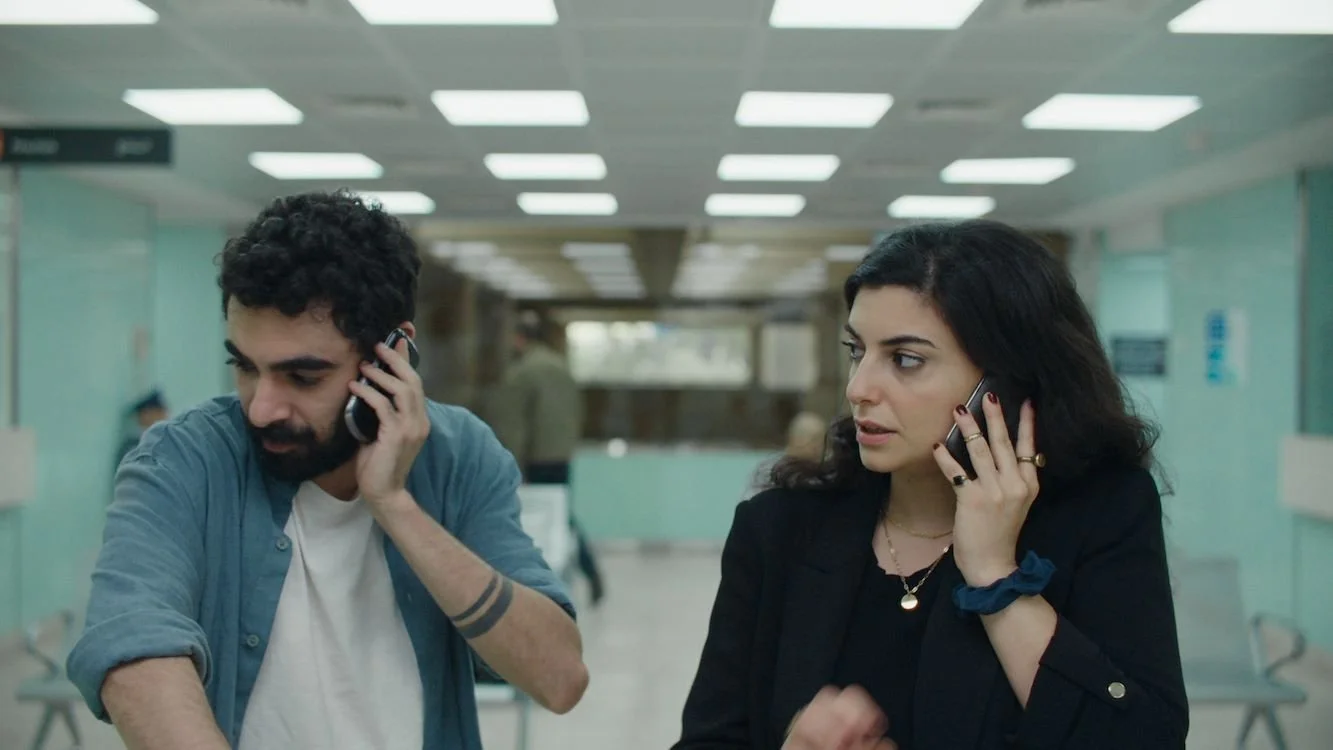
Despite Yasmina’s realism, the real romantic, it turns out, is the pragmatist. "Deep down, the real romantic in this relationship is Yasmina, much more than Nino," Aris tells me. "She's the one that can leave but chooses to come back." She makes the decisions, and she makes the most romantic choice in the movie. Her changing her mind is "a sign of maturity and openness," proof of a romantic innocence buried by a childhood where families are "meant to disintegrate, just like the country." The pragmatist was the believer the whole time. All she needed was for someone to dig it back up.
Midway through our conversation, Aris brings up a word he's grown allergic to - resilience. "It's constantly romanticized and seen from a very exotic eye," he says, "like, oh, look at these Lebanese people, how resilient. But it's very much used against us." People who adapt to anything can be made to endure anything. Optimism runs on the same fuel. He admires it and reaches for it, but some days he wants to grab the optimists by the shoulders and tell them to stop, because their faith is part of what lets the country keep getting away with failing them. The film carries all of these sentiments without lecturing, partly because Aris lets it be funny and dreamy, with offbeat digressions and the odd burst of autotune in the score, and partly because of his realism.
Aris thought, at first, that he was making a film about his own relationship with Lebanon. The love you feel for a place that keeps nudging you toward the door. The more he wrote, the bigger the subject got. "The central question of the film," he says, "was the question of bringing children into our world today," a world he calls cruel and unjust, and, in the Lebanese case, a place where "there hasn't been a single generation that hasn't been faced with a profound crisis or a violent war." Falling birth rates across the West and the Global South are the same question in other accents, mine included. Nino and Yasmina are its two poles, and for most of the runtime the film refuses to break the tie.
The tie breaks anyway, courtesy of an act of God. Aris' first child, Luca, was born while the film was still being made. "He was born on the very last shot," Aris says, "which was a shot of the stars. It's all very magical, in the tone of the film." He had spent years building a careful argument about whether to bring a child into this world, and "the fact that he was born on the last day answered that question." A Sad and Beautiful World is dedicated to Luca. The Arabic title translates to Stars of Hope and Pain.
Luca’s existence informs so much of the central tension of this film. Aris still has his anxietes about the world he’s letting Luca inherit. His own parents brought him into the Civil War hoping he wouldn't live what they lived. Yasmina echoes him when she says she hates that they're living the same stories her parents did. He tells me about a friend who gave birth shortly before August 2020 and looked at her newborn with the same promise: her child would not live what she had lived. The port explosion destroyed her home when the baby was one, and she had to explain a blast to a now-traumatized daughter.
For now, Aris is raising Luca outside Lebanon, splitting the year. Their family spent five months of the last year in Beirut, with Luca in a kindergarten hearing Arabic and French. He wants to give his son every tool he can toward that half of his identity, because he knows the rest is out of his hands. When I ask him about his anxieties, he reaches for the words of Lebanese-American poet, Kahlil Gibran. "Your children are not yours, they're the children of life. You don't own them. You're just the vessel, so the world carries them forward." He's watched the children of expats come out both ways. He mentions a brother and sister who were raised in the same house. The sister flies back every chance she gets, and the brother feels nothing in particular toward the place. "It doesn't necessarily have a very black-and-white answer," he says, and then apologizes for not having one, as if the missing answer were a transgression instead of a blessing.
Movies, Aris says, are witnesses to a time and a place, though not in the textbook sense. "It's much more of a visceral experience," he says, of what it was like "to be Lebanese, or to be a man and a woman, in that period of time in that specific place." When he watches the Lebanese films of the seventies and eighties, Jocelyne Saab and Maroun Bagdadi, he feels set down inside his parents' generation, inside their Beirut and its beauty and its wars. "Film creates an intergenerational understanding that no communication can ever do," he says, "especially since, as Middle Eastern men, you know how bad we are at communicating feelings." He hopes Luca watches his film in twenty years and meets him there, in the frame. I make a website where I try to leave enough of myself in the writing that someone could read all of it and know me, the same instinct from a much smaller chair.
The West "has always given moral lessons to us," he says, on how to treat our people, our women, our minorities, "but then they are providing all the weapons to eradicate us, specifically Palestine, southern Lebanon." Aris doesn't think the answer is to write everyone off. "The role of cinema is to bridge that gap," he says. Palestinian films like The Voice of Hind Rajab and the work coming out of distributors like Watermelon have the power to make a stranger feel "the butterfly effect of your vote, in the West, and the repercussions on the Global South." He thinks the shift is real and that it accelerated with Gaza, the livestreams, the footage the mainstream couldn't keep out of frame. He talks about it like a man who has to believe it, which is its own form of evidence.
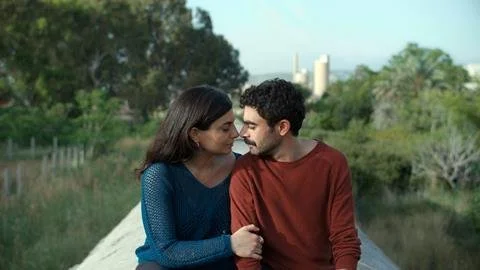
I came into A Sad and Beautiful World with a certainty that I never wanted kids, and I left it less certain, which is the most a film can do to a person. It's also exactly what Nino does to Yasmina. I think deep down I do want to be a father. I think my desire to hide from fatherhood stems from fear. Who knows? I don’t know anything for certain, but I can tell you the case against fatherhood has a movie-shaped hole in it now. I hope that one day I'll love someone enough to throw the case out entirely and feel confident enough to embark on this journey with her. But once again, Who Knows.
I asked Aris where all of this leaves him, between his country, his kid, and the whole mess of this equation. He told me to ask him again in twenty years. In true Arab fashion, respond with a good old-fashioned "Inshallah."