
Maya Annik Bedward on Advocacy, the Black Screen Office, and ‘Black Zombie’
Although George Romero’s Night of the Living Dead popularized the idea of the Zombie in 1968, it stripped away its entire origin while spawning a billion-dollar genre. Within a generation, the monster's original metaphor was reduced to niche trivia, lost to most horror fans. Maya Annik Bedward’s documentary, Black Zombie, carefully traces that theft back to Haiti.
“Before I learned about Haitian Vodou, zombie films never spoke to me,” Bedward says. “They never felt like there was a rationale for why they existed.” The flesh-eating, the aimless shuffling, the boarded-up farmhouses—none of it carried weight for her because it lacked a tether to reality. The genre had buried its own history so effectively that Bedward, a Black woman from the Caribbean diaspora, couldn’t recognize herself in it.
Her father, Marvin, immigrated from Jamaica to Ottawa in the 1950s, arriving in a city with almost no Black families. Bedward grew up tuned to frequencies most people around her couldn’t hear, her Caribbean, African, and Canadian identities overlapping without ever fully merging. When she entered university to study international relations, she attempted a research project on how enslaved labor in the colonies funded Europe's wars. The department shut her down. “I was told I wasn’t allowed to talk about that story, and I was furious, and then right away I was like, I can’t—I dropped out of the program for that reason.”
Being told you cannot study verifiable history because it makes an institution uncomfortable is a perfect illustration of where the academic guardrails lie—and who they protect. Bedward switched to political science and eventually relocated to northeastern Brazil for a year. Brazil ran the longest slave trade in the Western Hemisphere; because fewer generations have passed since abolition, cultural connections to West Africa remained more intact there than anywhere else she had been. “There were people I met who still spoke Yoruba. That was mind-blowing.” The language survived across the Atlantic despite the system’s best efforts to eradicate it. “It was really nice to be somewhere where you could see there was just such independence," she reflects. "They really weren’t influenced by American music in the same way. They have their whole own musical pop music history, their music connected to a lot of African Brazilian traditions.”
She anchors our conversation in an afternoon spent in Pelourinho, a historic square in Salvador named for the whipping post where enslaved people were publicly beaten. “I just was sitting there and just thinking about how lucky I was to be able to travel here and to feel the energies of that space, which were very intense, and thought a lot about my ancestors and everything they had endured for me to be where I was that day. Although there was so much work that needed to be done, I could just see how much had been done. From my father, to my grandparents, my great-grandparents... things at least for me were very, very different from what my grandparents had to endure.”
Every film she’s made since sits downstream from that afternoon. She returned to Toronto and co-founded Third Culture Media with producer Kate Fraser. The short films that followed circled the same profound questions about culture, power, and who gets to tell which stories. The Foreigner inverted the immigrant experience by dropping a Torontonian into a Brazilian Forró party, exploring “the beauty of this specific Brazilian music called Forró and how transformative it can be.” The Haircut, which premiered at Hot Docs in 2018, began with her father’s eccentric grooming habits but ultimately rooted itself in “our immigrant story and narrative and kind of the racism he endured as a child in Ottawa.” Why We Fight follows two Capoeira practitioners using the martial art to carry their son, Nauê, through a life-threatening genetic condition.
“It’s all about how culture and how things that you might not think are political are very much rooted in how culture can empower you," she says, "and how people imposing or taking away or exploiting your culture can also be a form of oppression.”
Academics in political science often refer to this as 'soft power.' “I hate that,” Bedward counters. “Culture and what you can do with it and how you can impose it on people or take it away from people is a very hard power.” The word 'hate' lands with force coming from someone who is otherwise highly measured in conversation. Soft power implies a subtle, ambient influence. Bedward is talking about a seizure—a ninety-year campaign of taking a people’s religion and spiritual resistance, and selling it back to the world as popcorn entertainment.
Black Zombie unpacks the history of this theft, tracing a line from William Seabrook’s sensationalized 1929 travelogue, The Magic Island, to the 1932 Bela Lugosi vehicle, White Zombie, and Romero’s subsequent reinvention. To correct the record, Bedward anchors the film with the voices of Vodou practitioners and scholars.These are people who have spent their lives watching their traditions be distorted, yet agreed to appear on camera despite knowing how these depictions usually go. “There’s been a relationship between Black traditions and stories and film since the beginning of film. Hollywood has been pulling from these stories and misinterpreting them.” Reclaiming the zombie means reclaiming Vodou itself—as Bedward describes it, “this, you know, beautiful, powerful religion that sparked movements of Black liberation.”
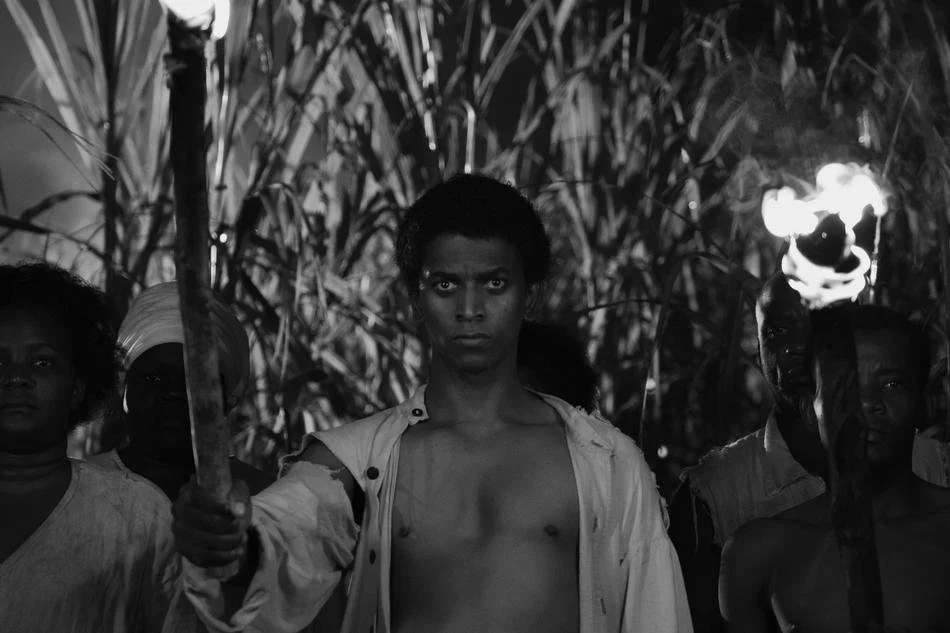
Bedward bookends the documentary with a black-and-white short she directed, dramatizing an enslaved man turned zombie, forced to labor endlessly in the fields. Between these narrative brackets, Vodou practitioners describe their religion on their own terms, some of them visibly cautious. “Our dead don’t go away,” one explains. “They stay to watch over us.”
In this context, Bedward considers Get Out a true zombie film. Jordan Peele’s movie—in which a Black man’s consciousness is imprisoned within his own body while a white family hijacks it for their own use—hews far closer to the zombie’s actual Haitian origins than anything Romero ever shot. It is a story about bodies being used, consciousness being trapped, and labor being extracted even after death.
Bedward is clear-eyed about the monumental task of reforming the Hollywood machinery that built those tropes in the first place. “I would love to start from scratch and to start a whole new system," she admits. "As a young person, I was really pessimistic about the whole system and university really jaded me and I definitely was depressed for many years because of it.” But Brazil pulled her back. “I still don’t want to stop. I want to, you know, at least improve where we’re at at this time and try and make it as sustainable as possible.” Channeling that drive into structural change, she helped found the Black Screen Office alongside Jennifer Holness, Damon D’Oliveira, and Clement Virgo to advocate fiercely for Black Canadian creators.
Bedward wants Black Zombie to make the Haitian origin of the monster common knowledge. She wants it to be something people understand as instinctively as they know Dracula stems from Bram Stoker. “My goal with this film is that it becomes like a household understanding where the zombie comes from. People still get to dress up like flesh-eating zombies," she says. "But are you gonna dress up like a voodoo sorcerer? Please, no.”