
Interview with Simon Panay, Director of ‘The Boy with White Skin’
Filmmakers have long experimented with the line between documentary and fiction. From the work of Abbas Kiarostami to recent projects like Four Daughters and The Rehearsal, cinema has treated the boundary between documentary and fiction as a place for creativity. For filmmaker Simon Panay, acknowledging this history was the only way to survive the eleven years he spent in the artisanal gold mines of West Africa. For filmmaker Simon Panay, this binary is a trap. After spending a decade filming in the mines, Panay discovered that the tools of non-fiction (i.e., observation and testimony) were fundamentally limited—and perhaps even incapable—of capturing the reality he was experiencing. His Oscar-shortlisted short film, The Boy with White Skin, rejects the “factual” in favor of a “dream logic.” It argues that to truly document a culture built with magic in its DNA, cinema must abandon the pretense of accuracy.
Panay’s cinematic temperament can be understood through a specific kind of patience shaped by his upbringing in the vineyards of Burgundy. As the son of winemakers, he understands that time is the only thing that will get the earth to yield its secrets. At eighteen, he left France for West Africa to begin what would become an eleven-year chapter in the unknown. “To me, when I was young, documentary was something boring. I didn’t expect to like it that much. But I really did,” Panay admits. “There is something fascinating when you just step into a new world that you don’t understand. You don’t understand the rules, the culture, or the morality. Everything is different."
This new world he describes is the world of gold mining. Panay sees it as a hermetically sealed universe with its own physics. “It’s a world very specific with its own beliefs, its own rules, its own mythology, and it takes a lot of time to understand it,” he says. “And even after 11 years, I feel I didn't just reach the bottom of this world.” Panay is acutely aware of the weight of being a white filmmaker depicting a world that is not his. This awareness manifests as a refusal to interpret until he has spent a decade breathing the same dust as his subjects. “In documentary, it’s more complicated, because especially when you do those kind of documentary, and especially when you are a foreigner, it’s touchy, you know? To go beyond reality and show something that isn’t necessarily yours,” he admits. “You need to feel confident enough in understanding this world before you can be something else than factual.”
Five years into filming in Burkina Faso, he found himself unable to properly capture the mysticism of the mines through documentary alone. The truth of the mines had little to do with physical labor. It had everything to do with a metaphysical hunt. In the eyes of the miners, gold is not a mineral; it is a sentient, predatory entity. “They believe, first, that the gold is a beast, it's alive. You need to hunt it. And it’s a deadly duel. It’s you or the gold, but only one will survive,” Panay explains. This belief system dictates the operational reality of the shafts. The extraction process becomes a ritualized combat that requires spiritual bait. “To hunt the gold, you need bait, and you need to attract it so it’s close enough so you can kill it. And they believe that the song of albinos has some magical power that will attract the gold.” This operational logic became the underlying logic for The Boy with White Skin.
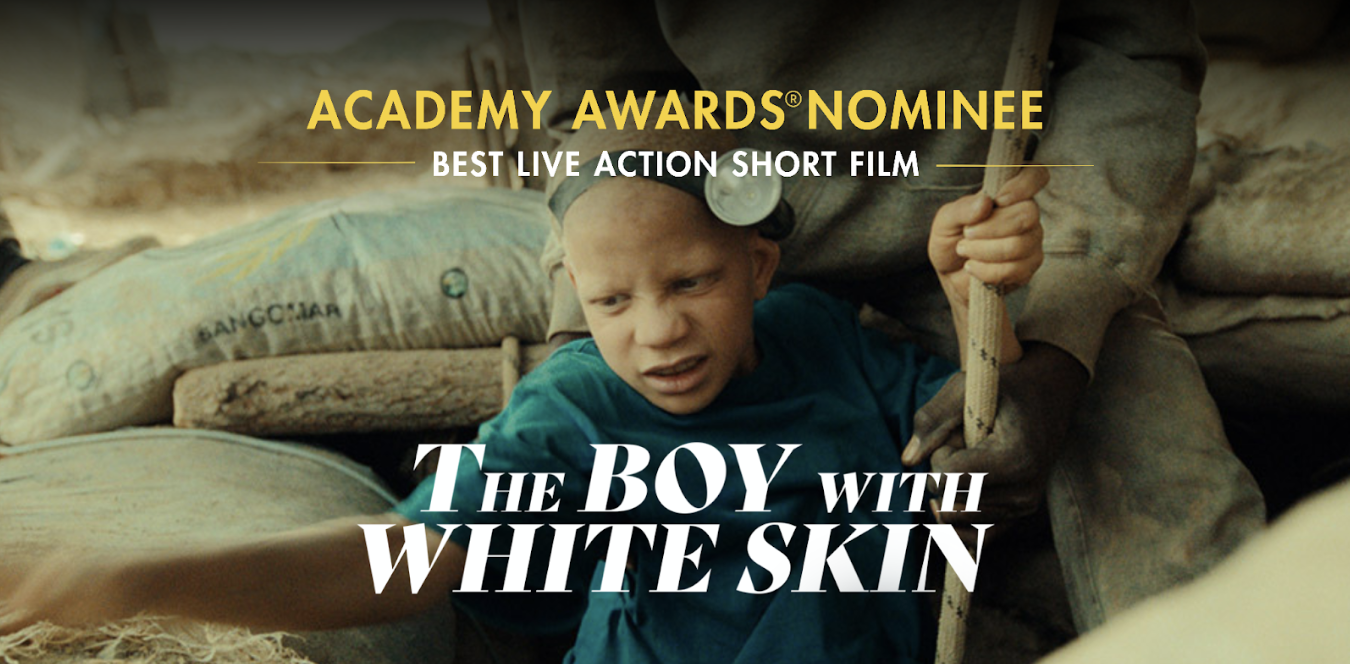
Although Panay witnessed these rituals, the miners forbade him from recording them. A documentary camera might have captured the image of the ritual, but it would have violated its logic. The miners were protecting the efficacy of the magic. “I was not allowed to film [the miners] because they are superstitious, and they were paying for the song,” he notes. “They didn’t know if the presence of me or the camera would somehow break the magic.”
This moment was the catalyst for Panay’s shift toward narrative. Sticking to the facts meant missing the reality. “The underground world is full of legends and mythology, and if you stay grounded, you might just miss what this world is about. And it’s a mythological place.” To document the invisible, he had to be comfortable abandoning the crutches of facts.
This transition into the mythological allows the film to examine the cultural inversion of albinism. A condition often stigmatized as a curse becomes, within the darkness of the mine, a signifier of divinity. “Albinos are never perceived as neutral," Panay explains. “And in the world of gold mining, it’s very different, because they believe that they will bring them good luck, so they are seen as half-gods.” However, this belief is hyper-localized. Panay points out that his lead actor, Boubacar Dembélé, despite his albinism, does not experience this symbolic weight in his daily life. “Our actor, Boubacar Dembélé, he lives in Dakar, and his life is normal. He goes to school, he goes to sports club, he has friends, and his life is just quite normal.” Dembélé’s distance from the narrative, despite geographical closeness, also mirrors the experience of Panay’s own crew. Despite being primarily Senegalese filmmakers from Dakar, they were entirely unaware of a reality just kilometers away. “Most of them didn't know at all the world of gold mining. It's a very specific world, very little known. Even people in Dakar, if you ask them if there are artisanal gold mines in Senegal, most of them will say no.”
The mines exist in a blind spot, remaining invisible to the outside world. Fiction becomes the only bridge capable of crossing that gap. Panay’s solution is to treat the border between documentary and narrative as porous. He rejects the binary, arguing that fiction allows for a personal perception that can be more honest than objective fact. “The border between documentary and narrative is not as simple as that. You can cross both,” he says. “I think in a narrative film, you have more freedom to explore that. I think it’s the most personal perception of the gold mining world.”
Narrative structure also gives Panay permission to avoid the didacticism that often plagues socially conscious cinema. He is less interested in explicit advocacy than in the phenomenology of fear. “It's not a film that has a message. This is good, or this is bad. I wanted to bring empathy before bringing a message. Like you can put yourself in the shoes of this boy who doesn't understand anything. And he's scared.”
The final product is a film that Panay describes as sensation, or a perfume, bypassing the intellect and lodging itself in the body. By surrendering to the dream logic of the miners, Panay achieves a level of immersion often found in documentary, despite operating within narrative. “I see this film as a dream, as something between reality and imagination,” he says. “I like films that create marks in your bones and flesh, and stick with you as a very unique experience.”