
‘Arco’: The Best Animated Film of the Year Hits Close to Home
With its spectacular hand-drawn 2D animation, Ugo Bienvenu’s Arco has been compared to the films of Studio Ghibli. It’s a fair comparison, but more so because the similarities run deeper than aesthetics. Like Laputa: Castle in the Sky (1986) or Princess Mononoke (1997), Arco critiques our relationship with nature — the ways humans are eroding the natural world and, despite boundless technological advances, teetering on the edge of all-out eco-dystopia.
What really sets Arco apart from other animated features is the film’s willingness to take its time. That’s a strength, though increasingly rare in a field crowded by self-referential, candy-colored Disney features that favor break-neck pace and gags over observation. In Arco, silence is necessary, and the film isn’t afraid to alienate audiences (no matter their age) by leaning into these beats.
The film straddles two time periods: the distant future of 2932, which is when the titular character and his family are from, and the not-so-distant future of 2075, the story’s primary setting. On the brink of environmental collapse, 2075 sees its denizens living in homes ensconced by climate-regulated bubbles. When it rains, they’re shielded from the water. It underscores just how disconnected people are from their natural surroundings, from the rhythm of the world. Instead, people watch storms from the comfort of their bubbles, as if tuning into the nursery from Ray Bradbury’s “The Veldt.”
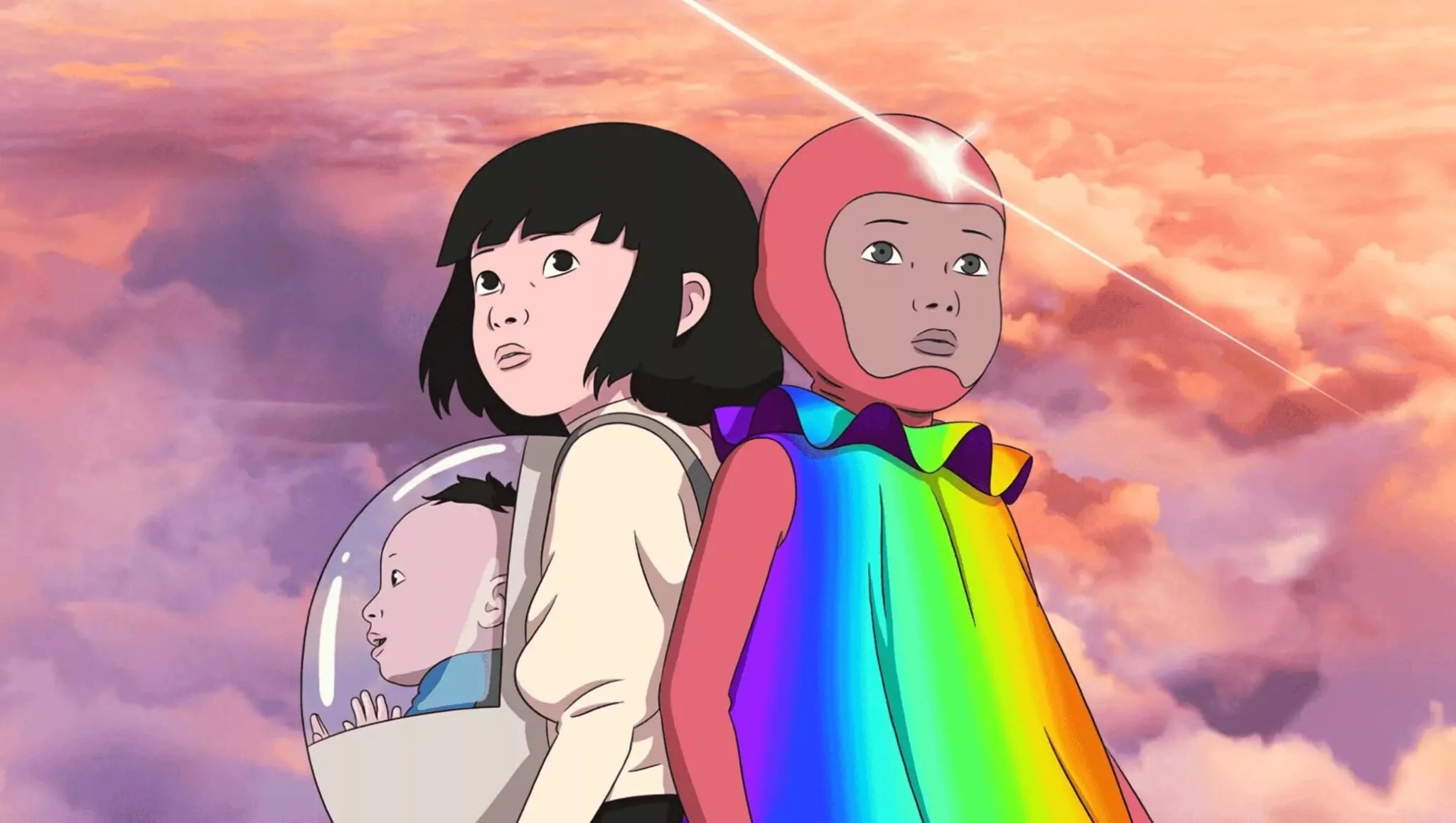
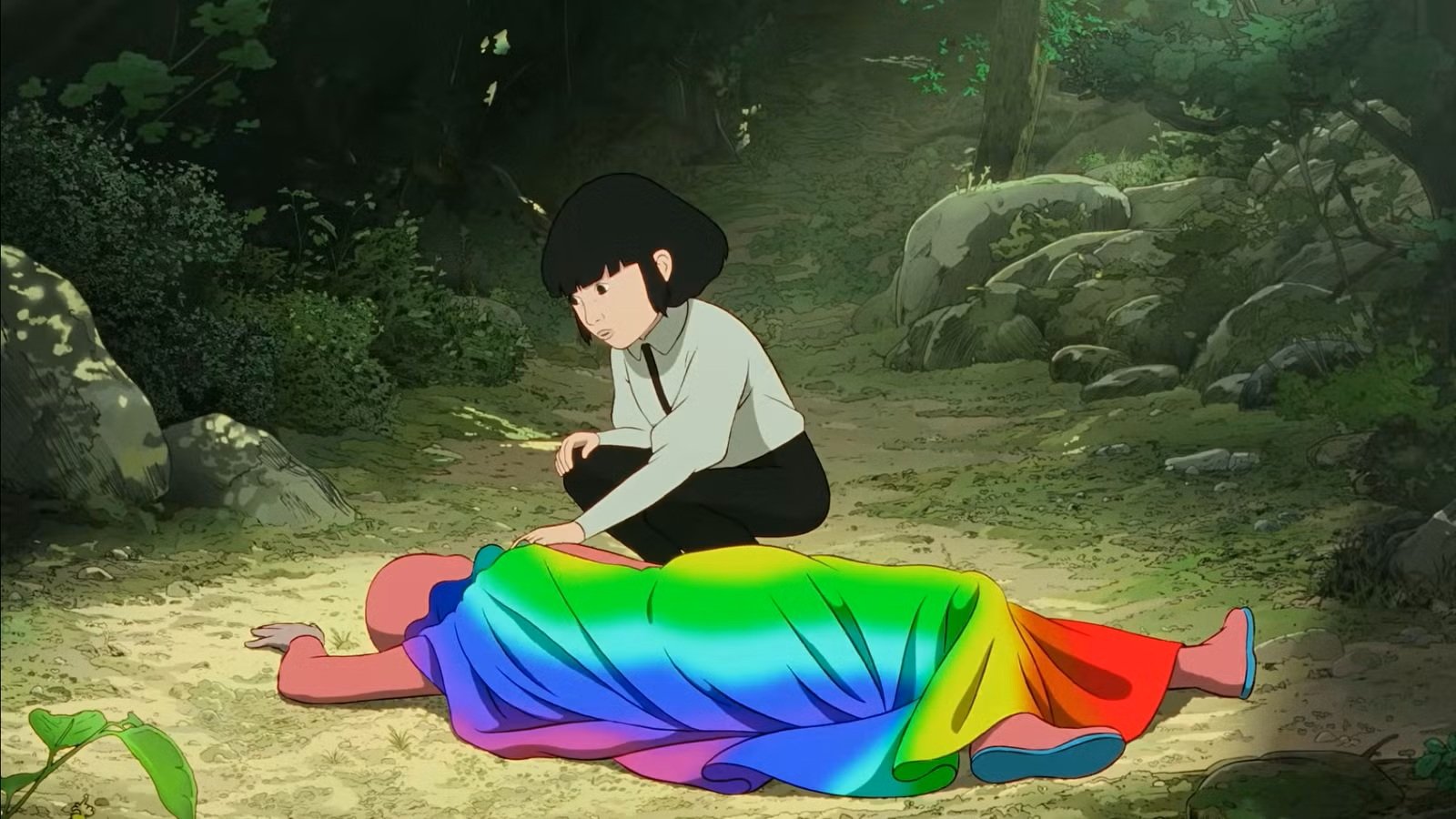
In the paradise of 2932, Arco’s biggest problem is that he isn’t old enough to join his parents and sister on time-travel quests to the past. One morning, he steals his sister’s rainbow-hued time-travel suit, and, after being squished into an arrow of light, charts a path through the ages. Hoping to visit the time of the dinosaurs, Arco lands in 2075 instead.
A young girl named Iris finds him in the forest. Eager to help Arco find a way back to his own time, Iris also becomes a window into how the humans of 2075 live. Iris and her baby brother are raised by a humanoid robot — the twin voices of Natalie Portman (who also serves as co-producer) and Mark Ruffalo, the actors who play Iris’ ever-absent parents who live to work in the city and spend time with their children (and at home) in fleeting hologram form only.
For the film’s runtime, a wildfire grows on the edge of town, ready to destroy and consume. Instead of taking action — if there is any action left to take — people go about their days, either oblivious or complacent. As the fire mounts, Iris grows more resentful of her parents’ absence. The world is falling apart, and all she wants is more time with them.
Despite its heavier themes and thematic slow-burn approach, Arco borrows some delightful animated movie tropes. Namely, its quasi-villains are a bumbling trio of brothers in primary-colored suits, all of whom are obsessed with a time-travel conspiracy theory. The brothers saw a rainbow-cloaked traveler from Arco’s time before, but no one believed them, hence why they’re so intent on hunting Arco down. Voiced by Will Farrell, Andy Samberg, and Flea, these good, old-fashioned goons represent not complacency in the end times, but something more desperate, more bombastic. To them, Arco’s very existence is hopeful.
Without a traditional villain, the film’s real danger stems from the ever-growing fire — one manifestation of the many natural disasters consuming Iris’ world. Characters refer to 2075 as the worst time in human history, and that’s partly because the humans of that time are so disconnected — from their world, from each other, and from time itself.
Arco’s ambling, slow lurch toward an inevitable apocalypse is familiar. But, in the film, there’s at least the promise of a better, more balanced future. In the eponymous character’s time, humans grow their own food, live among the clouds, and travel through the ages to preserve (or reintroduce) flora and fauna from distant pasts. Automation is forgotten. Instead, it’s the methodical, human touch that matters, and that creates something beautiful.
It’s easy to see ourselves and our own world reflected in Arco’s 2075. Beyond pushing viewers to reevaluate their relationship to the environment, Arco illustrates that humanity’s greatest resource is time. And how we use our time, or what value we ascribe to it, is incredibly revealing.