
‘Mile End Kicks’ & The Purity of Writing
Chandler Levack is very good at calling me out and giving me a reality check at the moments when I need it most. My sample size of Chandler Levack films is small, but as of April 2026, I can confidently claim that she’s 2 for 2 in writing characters that understand my lived experience remarkably well. I have been fortunate enough to find myself (and, more importantly, my flaws) in both of her films’ protagonists—both in the way they love art the way you’re supposed to love life and in the way they hide their own stories behind someone else’s.
The first of Levack’s characters that I saw myself in was Lawrence Kweller, the seventeen-year-old cinephile in her debut film, I Like Movies. Kweller hides his entire personality behind scraps of film knowledge (sounds familiar, lol). He can rank Kubrick’s filmography and quote Paul Thomas Anderson like scripture, but he can’t bring himself to have a conversation with his mother about his dead father. Lawrence uses movies like a barricade, putting them between himself and anything that hurts. I don’t say it lightly when I say that Lawrence completely changed my life. I Like Movies found me when I was in a self-destructive spiral, unable to confront the death of someone I knew. Lawrence’s version was much easier to see than mine, and it forced me to take the steps toward growth that I so desperately needed.

Still from I Like Movies
Being called out indirectly by Lawrence was the first step in teaching me to use writing as a way to understand my emotions. I Like Movies is one of those films I affectionately dub a permanent addition to the FilmSlop Canon (full review here), because without it, I wouldn't be able to do the style of writing I do today. I started FilmSlop because I wanted a place where people could use film to talk about themselves honestly, where criticism meant locating yourself inside of a movie rather than quantifying it on a scale of one to ten. So many essays on this site (e.g., using Kedi to understand grief) trace back to what Lawrence did to me. I stopped hiding and started confronting myself through writing. I was proud of that. In the last few years, FilmSlop started gaining legitimacy. We grew our readership (thank you to everyone who reads these, love you all) and started covering larger festivals. By the time I was covering SXSW and watching Levack's next film, Mile End Kicks, I felt a strong pride in the work I was doing.
My second experience with Levack’s protagonists came with Mile End Kicks and Grace Pine. Grace is a twenty-four-year-old music critic who moves from Toronto to Montreal in 2011 with the intention of writing a book about Alanis Morissette's Jagged Little Pill. She has the contract, the advance, the taste, the passion, and most importantly, an ability to see her own life through her love of the album. But instead of looking within herself and her lived experience to write the book that only she can write, she hides from confrontation. She gets distracted trying to live a life that isn’t hers when she meets an indie band called Bone Patrol and volunteers to become their publicist. She books their shows, designs their flyers, and gets romantically entangled with two of them (Archie and Chevy), while the book—and the opportunity to truly reflect on her lived experience—collects dust all summer.
Grace is Levack with a decade of distance on her, and Barbie Ferreira plays her uncannily well. Their styling is identical, from outfits and hair to the way they both talk. Levack has the confidence and bravery to directly confront herself, refusing to protect herself from that proximity. It's an evolution from I Like Movies, where any confession Levack was making came through a body that wasn't hers. Mile End Kicks refuses that disguise.
Grace loves writing. She loves the book. She can pitch it wherever she goes, and no one can defend Alanis like she does. The only thing she won't do is the actual work, because loving the idea of the work is more intoxicating than the work itself. Eerily familiar.
Levack has a talent for writing characters who find a way to call me out on my worst habits. With Lawrence, I was already most of the way through my recovery by the time he called me out. I was aware. I already knew I was hiding behind grief before he showed it to me. Grace, on the other hand, made me realize something that I hadn’t even considered. My relationship to writing started as a form of self-reflection, but somewhere in the last year, I began writing mechanically. Subconsciously, I was writing for the sake of writing, for the sake of having a platform. I started getting efficient with my patterns, repeating the same formulas and phrases, telling the same stories because I was afraid to get deeper. In some rooms, I would spend more time talking about FilmSlop than I did actually doing the work. I wanted results, but I found ways to hide from the work and began to abandon the reason I started slopping.
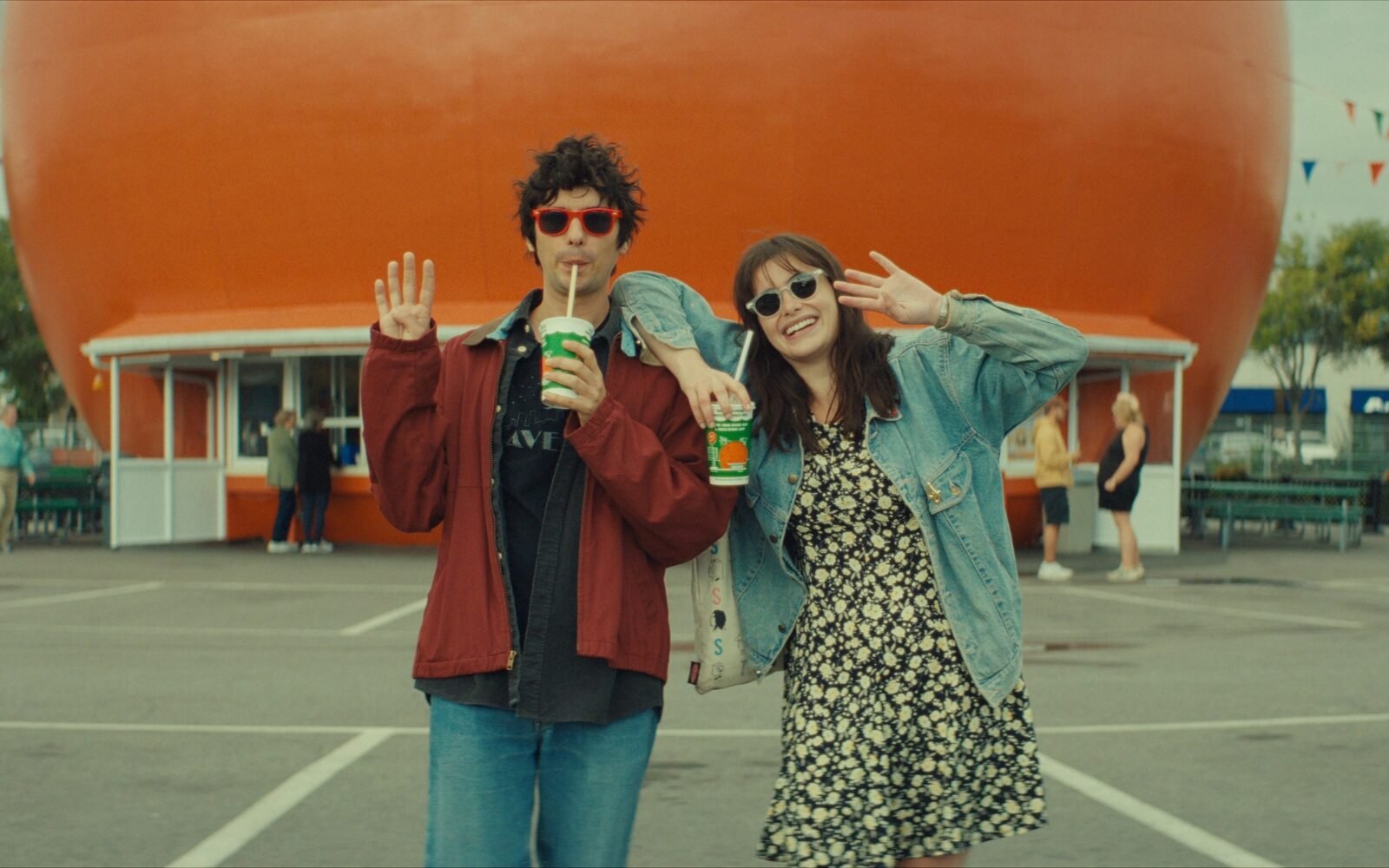
Still from Mile End Kicks
As I watched Grace avoid doing the things she needed to do to write her book (i.e., avoid exploring her true self and putting it into writing through the veil of art), I realized how much I had avoided doing the real work.
I love FilmSlop. I want to say that clearly because every piece of writing that I do now is in service of it. FilmSlop is one of the realest things I've ever made. When George and I started it, we both believed, and still believe, that the nature of the internet cuts away our uniqueness and is designed to reward the opposite of self-reflection. We are constantly inundated: short, fast, vertical, disposable. The pull toward that pattern is intoxicating, and I've been part of the problem. Grace isn't in an attention economy, but the shape of her avoidance is the same as mine. She picks the band over the book because the book requires accepting herself and putting it into writing, while the band is an escape and a life she can hide behind. In that same vein, the worst version of my writing has been picking the brand of being a critic over the practice of being one.
Grace spends her summer in Montreal surrounded by music, convinced she's inside the thing, while her real work (and thus herself) collects dust. I have spent a year surrounded by writing, convinced I was fighting the good fight against the evils of algorithmic slop, while my real work collected dust. Mile End Kicks opens April 17th. It made me realize some things, and I hope it does for you too.