
‘Sheep Detectives’ Made Me Cry?
Two years ago I was on a light hike at the San Mateo Coyote Point Recreation Area with a few friends. The San Mateo Coyote Point Recreation Area is a very lovely park. You give the Park Man five dollars and he grants you entry into a serene and beautiful landscape. You might be dissuaded by the fact that you have to pay five dollars to see what this park has to offer, but this is in fact the deal of the century. Candidly I would have paid up to twenty. At gunpoint, maybe even fifty. But don’t tell this to the Park Man. He will hear about it and he will come for the rest of my money.
At the San Mateo Coyote Point Recreation Area we ran into a woman with her dog (whose name I don't remember but for the purposes of this story will be named Mildred. I am a firm believer that animals should only be given old people names or named after items on the Taco Bell menu). Mildred possessed the size and bearing of a midsize SUV, the calmness of a river, the beauty of a prize-winning heifer. We chatted with Mildred's owner who told us that Mildred had an older sister, recently put down, and that she had brought Mildred to the vet to watch her sister be euthanized.
My first reaction was shock, but after talking it through with my vet friend, I realized it was an act of mercy. It was the first time it really clicked for me that animals understand death. Mildred's owner had decided to give her dog the gift of closure about grief, on purpose, as a kindness. She had chosen for Mildred to be a mourner instead of a watchman. She had chosen to give Mildred closure. She allowed Mildred to watch so that Mildred would not be confused about where her sister had gone. So that Mildred could grieve, in whatever way a dog grieves, instead of becoming the lifelong mayor of the front door, waiting for a sister who was never coming back. I think about that a lot, because making the conscious choice to look at death instead of waiting blindly by the door is essentially what I use movies for. If you’ve read anything I’ve written you’ll know that my relationship with film is almost entirely synonymous with my relationship with grief (e.g. here, here, here, and basically every other thing I have written for this website).
Enter The Sheep Detectives. I want to be honest about the spirit in which I went into this movie, which was that I went in to do a bit. The bit was airtight. The bit was that I would corner everyone I knew at parties for the next eight months and explain, with the devotion of a man delivering a sermon, that the Hugh Jackman sheep movie is our gift to mankind. I was going to call it the best film of the decade and not specify which decade. I was going to say the cinematography reminded me of Tarkovsky, and when pressed for which Tarkovsky, I was going to say "all of them." I was going to become the guy at the party who refused to talk about anything but The Sheep Detectives. I was going to terrorize everyone I knew with a fake obsession with sheep detectives until they had to stage an intervention.
Unfortunately I must confess, the sheep won. If you know anything about me, you know that I will stop at nothing to commit to a bit. I had the perfect bit planned but I was deeply moved by the film to the point of speechlessness.
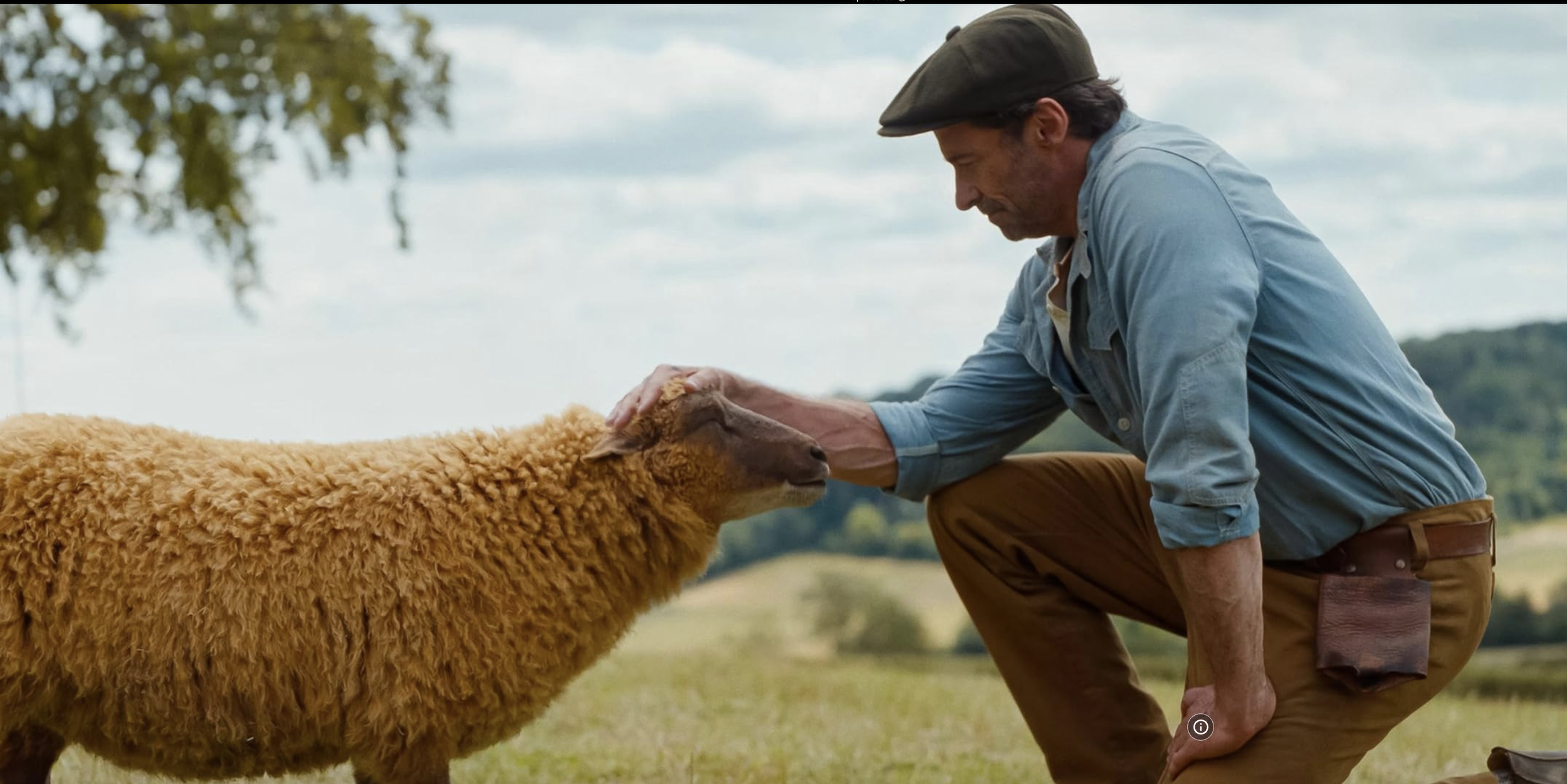
The Sheep Detectives, as the name suggests, is a film about the titular Sheep who also happen to be detectives.. Hugh Jackman plays a shepherd in the English countryside who reads detective novels aloud to his sheep every night, assuming they cannot understand. But they can. They argue about whodunit for hours after he goes to bed. When Jackman is found dead in the field, the sheep, led by Julia Louis-Dreyfus as a Shetland ewe named Lily, set out to solve the murder. Nicholas Braun plays the local buffoonish cop and pratfalls his way through the same investigation at half their speed.
The sheep, in this film, do not believe in death. When one of them dies, the rest of the flock decides, collectively and gently, that the dead sheep has turned into a cloud. You can see her up there. The flock has further developed a social technology where they will themselves to forget any unpleasant memory, sloughing off grief the way they slough off wool, on a schedule, by mutual agreement. It is a beautiful system. It works perfectly. There is one exception. Mopple, voiced by Chris O'Dowd, cannot do it. He stands in the field carrying every loss the rest of the flock has handed off to him, the librarian of the dead, holding a bibliography no one else has agreed to read, while his friends look up at the clouds and wave. Mopple does not get to wave. Mopple knows the clouds are clouds.
When Jackman is found dead, the sheep have to do something they have never done before, which is to decide to remember on purpose. The shepherd they loved cannot be allowed to dissolve into weather, because they loved him too specifically for that, and grief is what love does when it has nowhere left to go. So they refuse the cloud. They walk toward the knowledge of death because the alternative is letting him disappear, and they will not let him disappear, because he read them mystery novels in the field at sunset, and once you have been read to like that you owe the reader your sorrow. This is the same thing Mildred's sister was given, except that Mildred had grief delivered to her by someone who loved her enough to spare her the worse fate of confusion, and the sheep have to deliver it to themselves. They are their own merciful owner at the vet. They are doing it on purpose. They are doing it because they have decided that loving a man means knowing he is gone.
Last year I convinced my friend Sam to adopt a second cat. Her first cat, Alexander, hates me. Alexander is the only cat I have ever met who has taken such a deep personal dislike to me, and he has done it with the precision and care of a man who has read my entire existence and concluded that I am not for him. On rare occasions he allows me to pet him without hissing, and on those days I walk through the world four inches taller, I leave better tips, I forgive my enemies. I assume he associates me with Sam being gone, since I mostly see him when I am catsitting, which means from his perspective I am the angel of Samlessness, the herald of the empty apartment, the patron saint of nobody coming home. Fair enough. I would also hiss.
So I told Sam she should get him a brother. My own brother had adopted two cats, and watching them coexist had been one of the great tendernesses of my recent life, a small ongoing demonstration that loving something does not have to be a defeat. Sam, generously, agreed. Enter Root Beer Float.
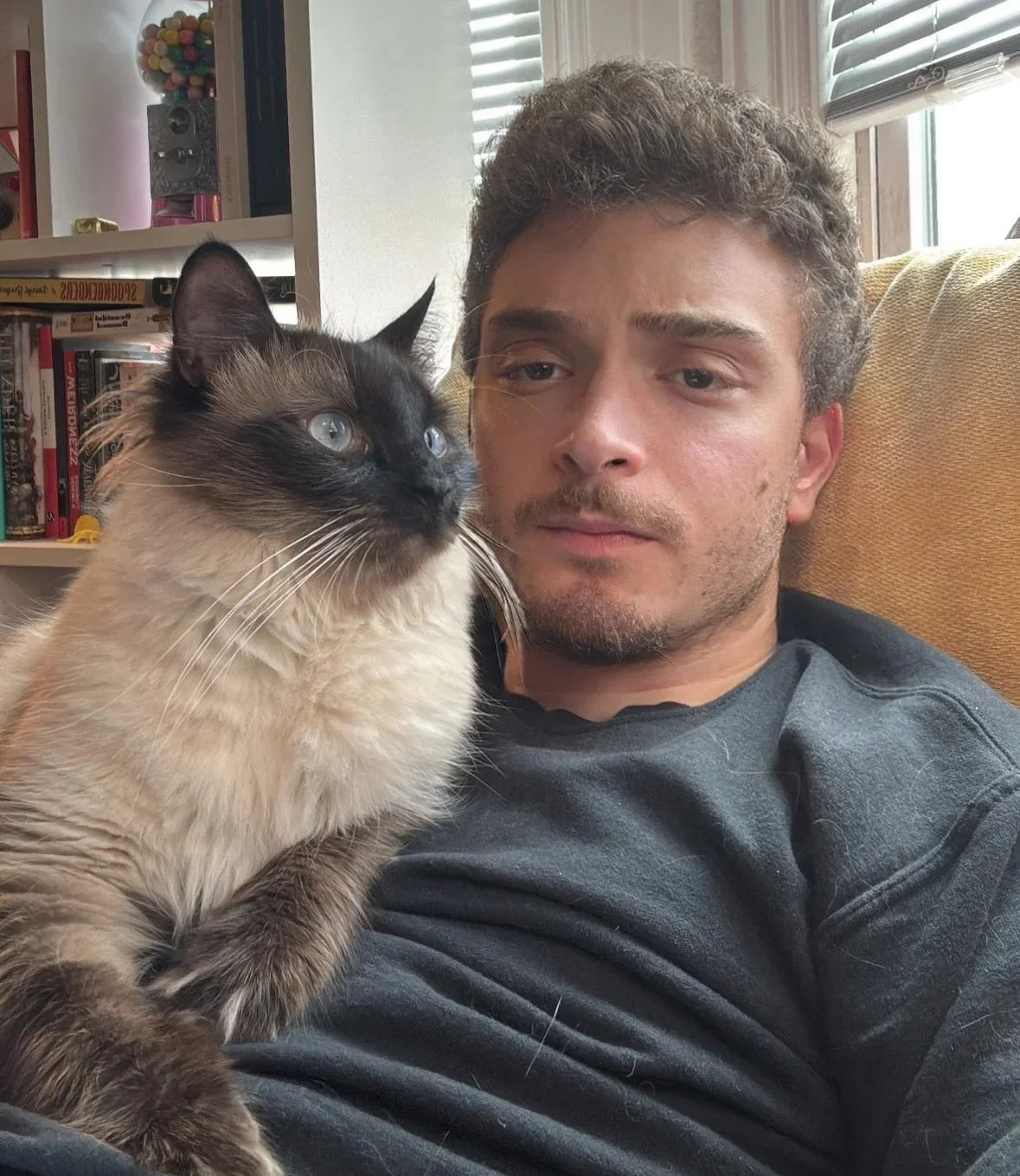
Float is a Siamese-Siberian engine of pure and dedicated chaos, a long-haired demolition contractor, a mop with intentions. He locates the most expensive object in any given room and sits on it. He has destroyed a plant, figured out how to open doors, and personally dismantled the concept of a quiet evening. He once knocked a potted plant off the top of a fridge with such intention that I had to consider whether he was on someone's payroll. Float, unlike Alexander, loves me. Possibly he understands on some cellular level that I am the reason he exists in this apartment. Possibly it is the Churu. Possibly I have a good vibe. Float greets me at the door with the enthusiasm of a soldier returning from the war, and I greet him back with the enthusiasm of a soldier who has won.
When they first met, Alexander hated Float. Alexander hates all things. This is his job. He has been very consistent. Within a month Float had cracked him. Alexander now grooms Float. Alexander has even softened, very slightly, toward me, which I can only assume is because Float has been putting in a good word, telling Alexander in the language they share when I am not looking that I am not so bad, that I bring the sticks of Churu, that the angel of Samlessness might also be the angel of Float, and that those are perhaps the same angel. Whatever Float said, it worked. I owe Float a lot.
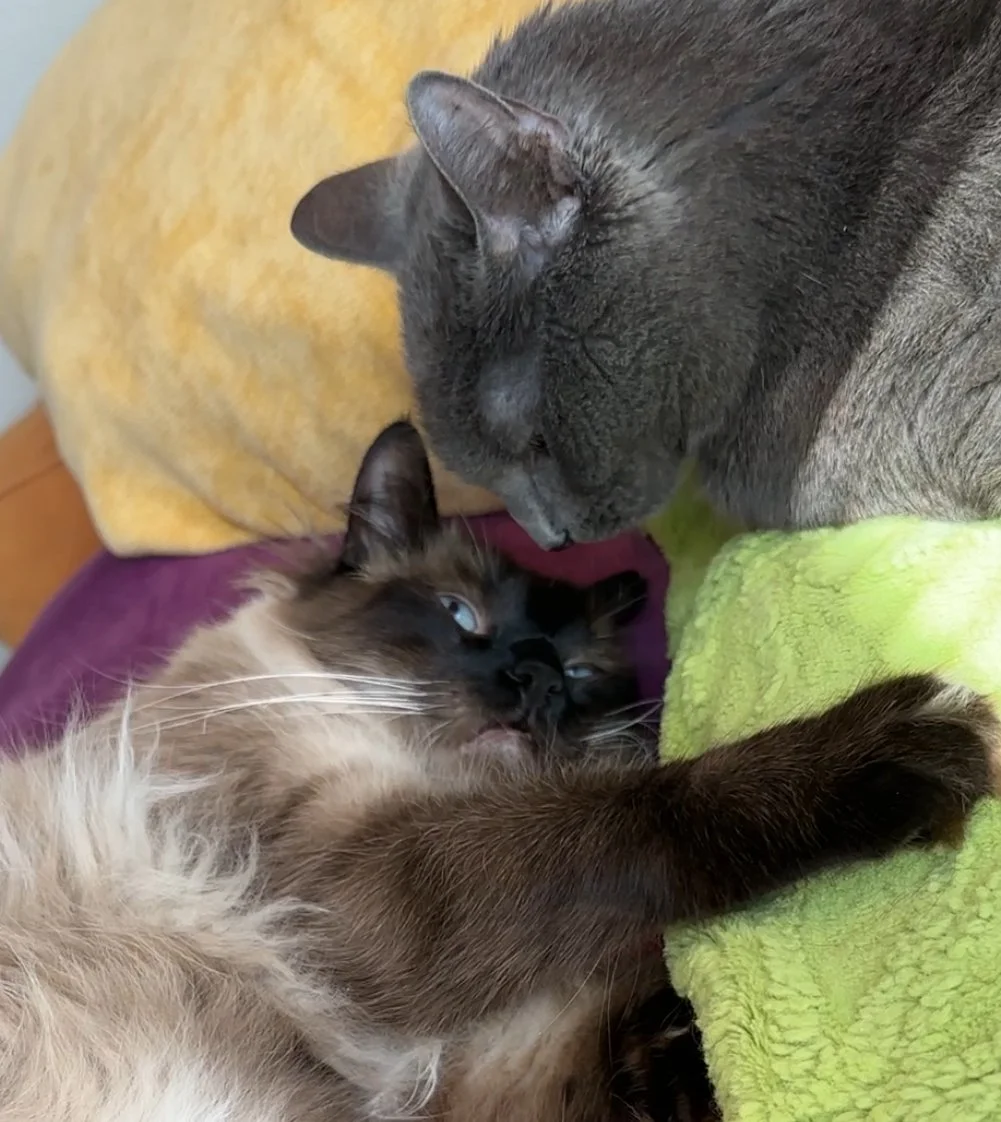
Float might outlive Alexander. Cats are not sheep. There is no cloud mythology they can fall back on, no collective social agreement to forget on schedule, no Mopple in the corner of the apartment carrying the burden so the rest of the flock can graze in peace. When Alexander goes, Float will look. Float will wait by the door the way Mildred would have waited if her owner had not loved her enough to spare her the confusion. Float will become, briefly, the mayor of his own front door. He will be confused first, and then he will be sad, and then, on some long timeline that none of us get to watch, he will be grateful, for the grooming, for the warmth, for the older brother who finally accepted him after a month of considering it, who taught him, late in life, that you can hate someone for thirty days and love them for the rest.
I was really excited to jokingly obsess over sheep detectives and wanted to turn it into a bit. Sad to announce that The bit has been taken from me by a flock of computer-generated sheep who looked up at the sky where they used to put their dead, decided it wasn't enough, and came down to learn what death actually was, because they loved a man who read to them, and because love, eventually, asks you to know things you would rather not know. The Sheep Detectives is the film of the year. I am being deadly serious, which, as I mentioned at the top, is the worst part.
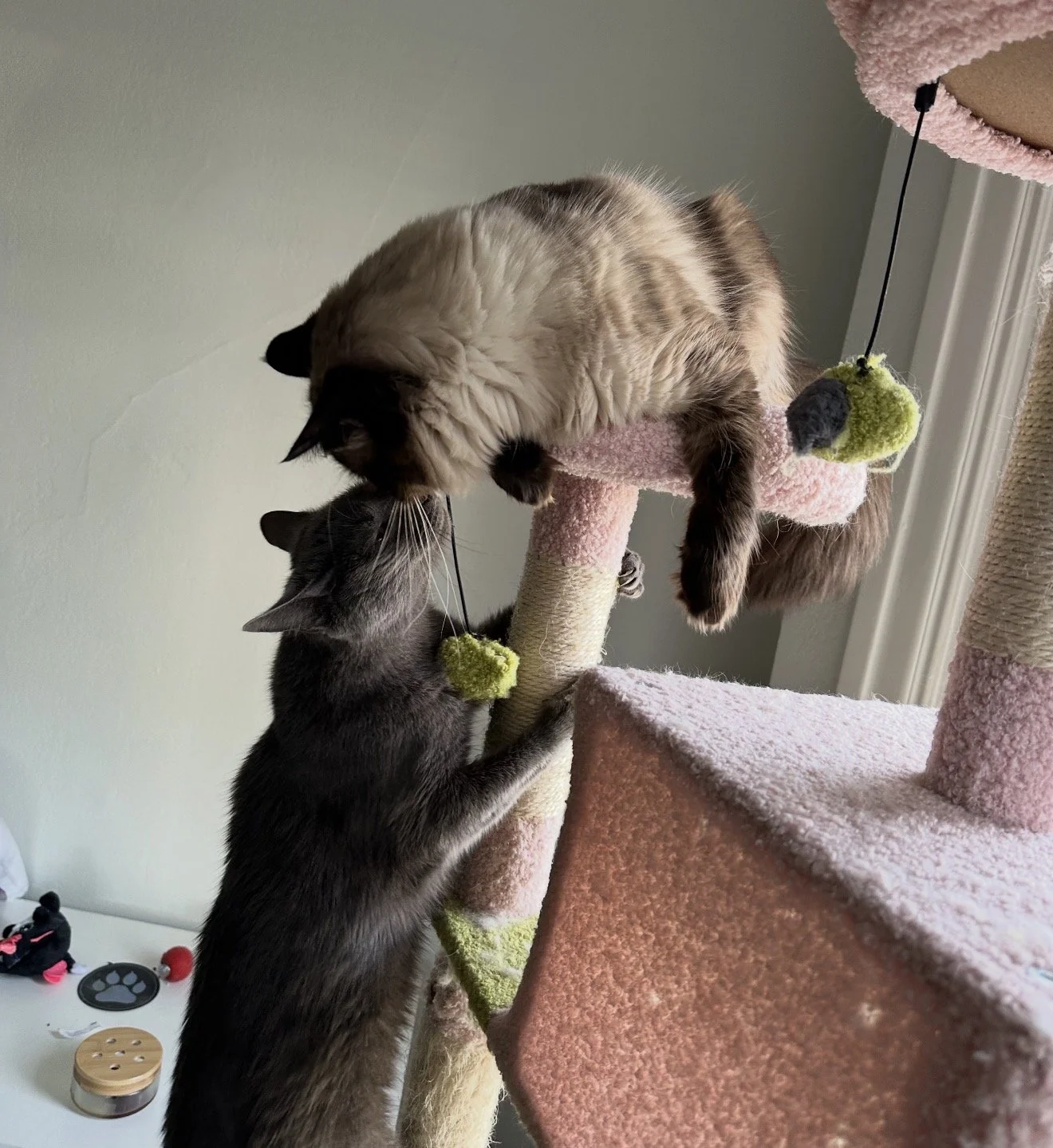
Of course, none of this matters, because Float and Alexander will live forever.