
Love in a Drought: ‘Perfect’ and the Cost of Proximity
Perfect (2026) captures both modern environmental anxieties and modern relationships in one fell swoop, and although it falls short of being legitimately exploratory of all these feelings it gets closer than it probably had any right to. The visuals do a lot of the heavy lifting, the murky waters in the middle of a drought-stricken land, the stark contrast between Mallory's cabin and the outside world the others exist in. Ksusha Genenfeld's camera identifies who has power before anyone says it.
The film follows Kai (Ashley Moore), a young woman who briefly pulls over at a rest stop in the middle of running to a new life and gets caught in the sights of the enigmatic Mallory (Julia Fox), a wealthy pregnant woman whose attachments to the land seem vague. Kai intends to only stay a night or two but upon her car being torn to shreds in the middle of the night she's forced to stay, Mallory takes this opportunity and encourages Kai to stay with her, starting the two's troubled romance. Fox and Moore have an easy, warm chemistry. Fox brings her whole persona to a role anchored on contradiction and Moore grounds the film emotionally.

Perfect is a feature debut from Millicent Hailes, a British filmmaker who studied fashion photography and styling at the London College of Fashion, founded the queer magazine yves.2c, and has directed music videos for Billie Eilish, Pussy Riot, and Young Thug. Notes of her illustrious career shows up in the film's textures through the fashion-editorial framing of bodies and the way music cues from FKA Twigs, Sevdaliza, and Shygirl dissolve into the film’s atmosphere. A looming sense of a nearing end hangs over everything, the world's drought, the pregnancy that will bring their relationship to a close as the real world intervenes in their blissful escape. Even the romance feels styled toward its own destruction.
While the film falls victim to tackling more ideas than it has runtime for, the ideas themselves are sharp. Perfect reflects the current era of neoliberal feminism in which the divide furthers from men versus women and becomes wealthy women versus poor women, in which wealthy women, in a similar vein as men have for ages, can have someone do the disposable emotional labor. Catherine Rottenberg writes in The Rise of Neoliberal Feminism on how women entering the workforce and fighting to prosper there end up outsourcing care work, nannies and surrogacy and caretaking, to poorer women. The exploitation just follows the money down. Mallory talks of her "narcissistic" desire to have her child be "perfect" and while not going into detail it's something that's presumably in reach given her access to resources, something we see her having while others suffer from the drought around her.
Perfect takes on the premise of queer wealthy women taking on disposable lovers. Kai is stuck in nowhereville, car smashed up and sweltering heat, but while her peers suffer the drought, Mallory offers a place to stay for a nice shower and nicer amenities to live. Affairs have oft been portrayed as outsourced to someone that could never fit into a wealthier world. They exist in narratives in a way that maintains marriage, the cruel, nagging wife who doesn't put out isn't quite as easy as the young ingénue who's desperate to be loved that they can look past the life their partner hides from them.
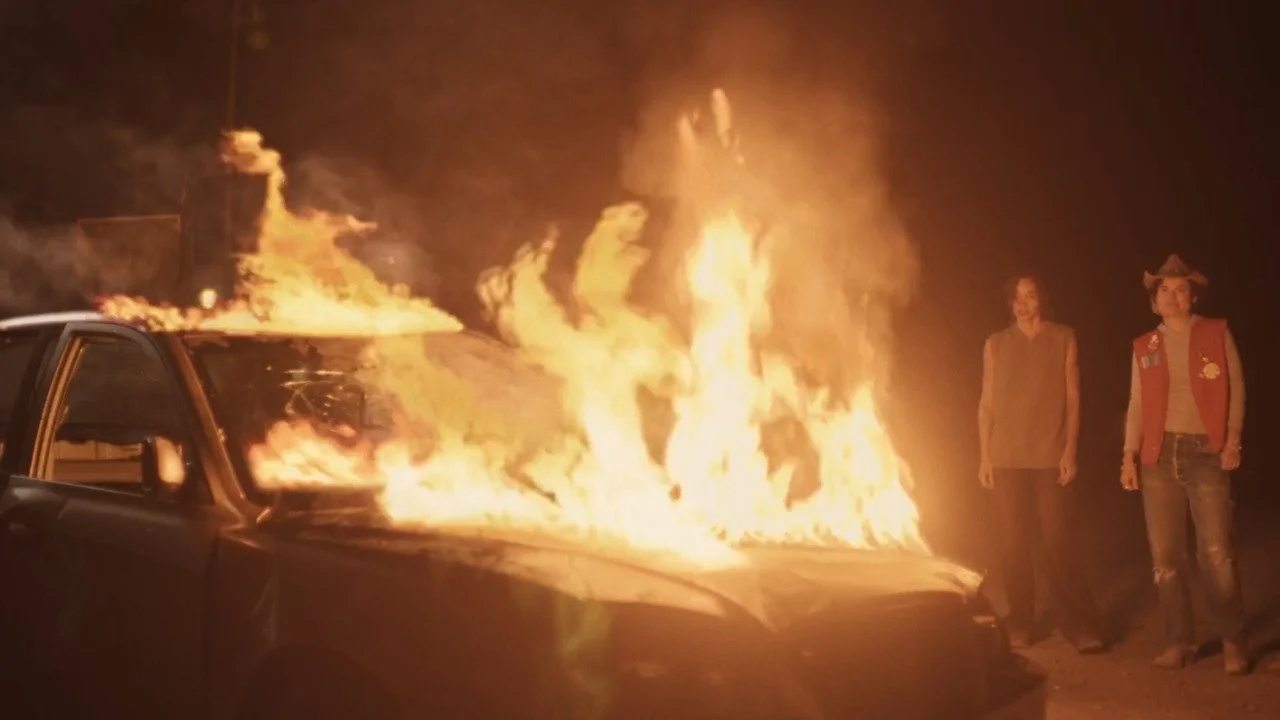
As we slide into what Yanis Varoufakis calls technofeudalism, an economic order where platforms and rents replace markets and profit and digital lords control the land everyone else works on, the literalism of Mallory's wife having bought up the land Kai and their friends live on physically demonstrates the precarity of this exact relationship, the exact shaky ground she exists on is unbeknownst to her, owned by her lover's wife. Everything about the incoming environmental doom takes hold, and the power dynamics become deeply literal. The drought isn't metaphor, the land ownership isn't metaphor, Kai's car getting destroyed so she can't leave isn't metaphor. Or they are, but they're also just the conditions. The film is saying the quiet part of a lot of relationships out loud, that love across a class divide operates on borrowed ground and the person with less power is usually the last to find out how borrowed it really is.
The movie resonates strongly with modern desires for connection, the optimization of dating, and then its fall because it made us feel more distant than ever, the flocking to social media in an emergency to make a joke. Constant disaster looms near, but there's still a push to abide by the same systems. To operate in capitalism. To operate in everyday life. Neoliberalism needed to adopt feminism, queer rights, and non-white leaders to promote the rest of society into believing they could work up if they worked harder. The resistance people push with has come in every which way, revivals of trad movements, denials of modern medicine, rising gig work, people want to find happiness in the system that kills them. They want to find connection, something that capitalism provides within very narrow lines.
Perfect exists in this present, an affair that shows the strained lines of wealth versus poverty, of community versus insular couples. The film pushes to show the dissatisfaction and uniformity that capitalism presents. It doesn't damn it but it points to the stifling nature of what's encouraged. And Hailes built the whole thing from queer creative infrastructure, nearly every department staffed by queer and female voices, so it ends up feeling less like a film about the experience and more like a film from inside of it. For a debut, for a movie finding its legs, that counts for something real.