
‘Cameron Winter at Carnegie Hall’ Turns a Long Day for Jesus into an Extraordinary Night in New York
On October 1, Lincoln Center’s Alice Tully Hall was packed from front to back with impassioned moviegoers, indie music lovers and members of Geese fandom, all awaiting the premiere of a brand new documentary featuring Cameron Winter. The film captures Winter’s performance at Carnegie Hall back in December 2025. The gaggle’s don was accompanied by legendary filmmaker Paul Thomas Anderson, who shot and directed the now formally titled Cameron Winter at Carnegie Hall. Taking place on a frigid night in New York, the concert was seen as a climatic moment in the then 23-year-old frontman’s already acclaimed career as frontman for NYC alt-rock outfit Geese. And there are few more impactful ways to harness one’s musical prowess than traipsing atop the stage walked by generations upon generations of masters. “Thank you to Carnegie Hall, and Andrew,” Winter sardonically quipped as he introduced the film with minimal words and maximal “umms.” Immediately after, the vision graced the screen and the warm embrace of Andrew Carnegie’s enclosure greeted Alice Tully.
For some context about myself and live music, I never saw Talking Heads perform (not born), nor was I at LCD Soundsystem’s false farewell in 2011 (7 years old). So thank goodness for cameras, as they stick their lenses into places so many could not reach. And an even larger thanks to concert documentaries –– turning live performances into cinematic behemoths. I liken the experience of seeing a concert film to being the most shiny consolation prize to all who couldn’t attend the real thing. You get an experience depicting the show’s festivities from all angles: the stage, the crowd, the sound booth. I remember being an eight year old with older, millennial brothers who loved indie music so much that they dragged me to watch the aforementioned LCD concert film. The movie, Shut Up and Play the Hits (2012), was my first foray into the genre — at a likely now-defunct NYC indie theater. It played with this energized catharsis that persisted and, even at 8 years of age, never lost my interest. I’d let myself enter the millennial music psyche. I wanted to be there and, at certain points, felt like I was one with the “Movement,” as James Murphy would say. In hindsight, that felt like a great distillation of what the confluence of concerts and documentaries should look like.
Certain films tend to be more pared-down in their usage of documentation and interviews. Stop Making Sense (1984) is a concert from end-to-end — replete with all the Talking Heads’ dancey tunes for a joyous night at the movies. The Maysles brothers and Charlotte Zwerin’s work on Gimme Shelter (featuring The Rolling Stones) is a more converse example: the film is a great hybrid, merging the concert experience with a more intimate look at the band. Through interviews and backstage content, we get an ostensibly real-life view of rock royalty on tour. Found within is the stylistic breadth of what can make an engaging concert documentary: lots of music and lots of reflecting, lots of music and little reflecting or all music and no reflecting. There’s no wrong way to go, but there’s circumstantial value in combining the right blend with the specific story. Paul Thomas Anderson focuses entirely on the latter of the three with Cameron Winter at Carnegie Hall. The film is a brisk-paced, musical masterwork with almost all singing and no talk; and at this juncture, I don’t see how it could’ve been done any better than this. Knowing Cameron to be a man of few words, unless sung or harmonized, the lack of interviews or backstage mischief allows for undivided focus on the concert. I found the songs to be enough of an emotional POV that the lyrics’ methodical and abstract metaphors gauge the personal side of Winter, and they do so in an artsy, read-between-the-lines way. It’s as if the man is telling you his life story, but via truth-adjacent experiences. And as devoid of emotion he may sound… his face, eyes, mouth and body appear so, so vulnerable.
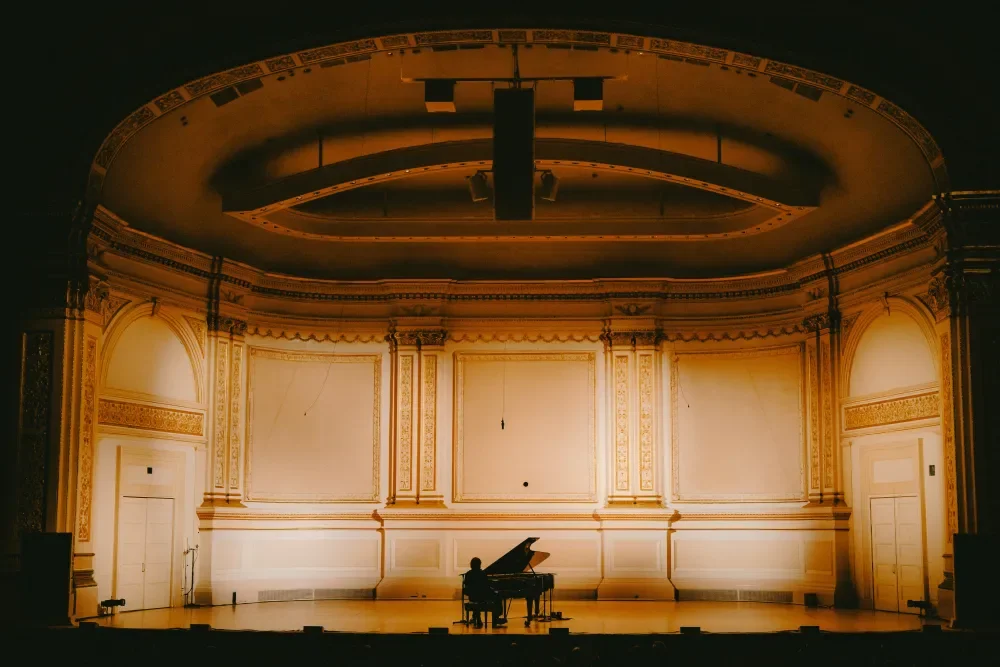
The film opens with grainy exterior shots of Carnegie Hall: it draws attention to the 35-millimeter format as it reveals the antiquated charm of the venue. Paul Thomas Anderson shot the entirety of the performance using 16-millimeter and 35-millimeter cameras, yielding a product with a certain minimalist feel. It leans into the vintage appeal that can be likened to watching classics such as The Led Zeppelin DVD (2003) or Pink Floyd: Live at Pompeii (1972). The fuzziness in both the snippets of Zeppelin’s Bonzo playing his Moby Dick solo and the mesmeric stun achieved by Pink Floyd’s Echoes all feel so entrenched in that 1970s old-school charm. With this film, the grain single-handedly ages the film into that vintage concert setting. The wide shot of Carnegie Hall’s interior that functions as the movie’s one-sheet shifts from a silent and barren room to a jam-packed room, still silent. The audience includes revered creatives like Michael Stipe (R.E.M.), Trey Anastasio (Phish) and Lee Ranaldo (Sonic Youth). The individuals who defined their respective categories of rock all congregate. Winter, being a part of this new shift in the indie music current rooted in Geese’s punky art rock, has carved out a fandom consisting of those, like me, who’ve awaited this freshening of the rock genre. They sit there at Carnegie, and me in Alice Tully, and await the future of music.
Cameron plays his opening number, “It All Fell in the River,” with some of the most crisp live mixing you will hear; the piece reverberates off the walls with its undulating tempo. Throughout the performance, Winter takes the complex compositions on his record “Heavy Metal,” spanning five or so instruments, and whittles them down to just a piano and a voice. But nothing is lost as his dramatic wall of sound on showstoppers like “If You Turn Back Now”, shine through with only his fingers and mouth. The stripped down approach on tracks like “Love Takes Miles” or “The Rolling Stones” or even “Drinking Age” sounds more clarified and intense than the studio recordings. Stripping away all the instruments, apart from the piano and vocals, singles out the emotional heft. I connected with it almost instantaneously. How the songs still sound so intact and whole, even through the bare-bone arrangements, is practically unfathomable. Months and months of studio time, all superseded within a mere hour.
As with any concert, the most energizing part is the musician only gets one shot to get it right: no do-overs, no excuses and, for the film’s sake, no re-shoots. In The Last Waltz (1976), Martin Scorsese couldn’t just ask The Band to play “The Weight” a second or third time for optimal visuals and angles — the film’s title would then be erroneous and could be dubbed, more accurately, The Penultimate Waltz (unreleased). In a similar way, D.A. Pennebaker could never demand a reprise of the Tiny Tim backstage jam in Monterey Pop (1968). With all its ad hoc glory, the scene’s mirth and unexpendable realness is entirely owed to the fact it happened once. Cameron Winter at Carnegie Hall has those same instances where blemishes add to the charm and further imply what Paul Thomas Anderson looks for in concert films. Anderson’s imagery and Ariel Rechtshaid’s mixing captures the concert’s thoroughgoing fullness, but it also maximizes the smaller, more human moments. The still, unabated shock on people’s faces in the front row during “Nina + Field of Crops,” the obligatory — and accidental — iPhone camera flash sending a bright bubble of light surging through the stage, the camera moving down the aisle as it bobs up and down to the cadence of the operator’s walk with not a single onlooker glancing back. It’s the subtle and unguarded hypnosis Cameron placed over his audience that night as he wielded his grand piano like a Steinway scepter. These effects cannot be sought out. They just happen.
The film takes the visual mechanics oft-cited in Anderson’s features — the graininess, the occasional, untempered lens flare — along with the heightened, one-shot-only stakes of a documentary and nutribullets them together until they fit like jigsaws. The merging styles provide a splendid hour and fifteen. Quite frankly when you put the collaboration into perspective, it seems almost improbable: a young, up-and-coming musical phenom plays the biggest show of his life and has it captured through the eyes (and camera) of a tenured master. I’d even go as far as to call it unforgettable — it takes two trailblazing artists from two art mediums that are so similar yet so different. Music and film bear the hegemonic power over every medium in the pop-culture lexicon — and add one more and you’ve successfully copped the Charli XCX trifecta. And so here we have the two forces paired together with intergenerational creatives. It’s like an alchemy of sounds, visuals and ideas.
“God is real!” Cameron exclaims as dim bulbs illuminate the rafters of Carnegie Hall. The lights beam a white hot glow over a motionless sea of indie sleaze and New York royalty. On the track “$0,” Paul Thomas Anderson unleashes the climax of the performance with Winter’s splintering roars. The director fuels the intensity of the concert until it’s more a drama than anything. “I think God is actually for real!” shouts Winter as he tacks on more words to a potent, stream-of-consciousness verse. Those billowy vocals deliver his agnosticism in a nut shell: confusion alongside the will to believe. And without warning, you are guided into this rhapsodic swoon. If God is for real and there actually is a heaven, I wonder if, at such a place, you can hear Cameron. Yes, this is a thought that crossed my mind at this moment. The recurring mentions of divine subjects sticks you in an ethereal headspace. God, the Devil, Jesus — all characters in the Cameron Winter multiverse, all addressed with an earnestness. The tender approach makes me wonder if the afterlife has good acoustics.
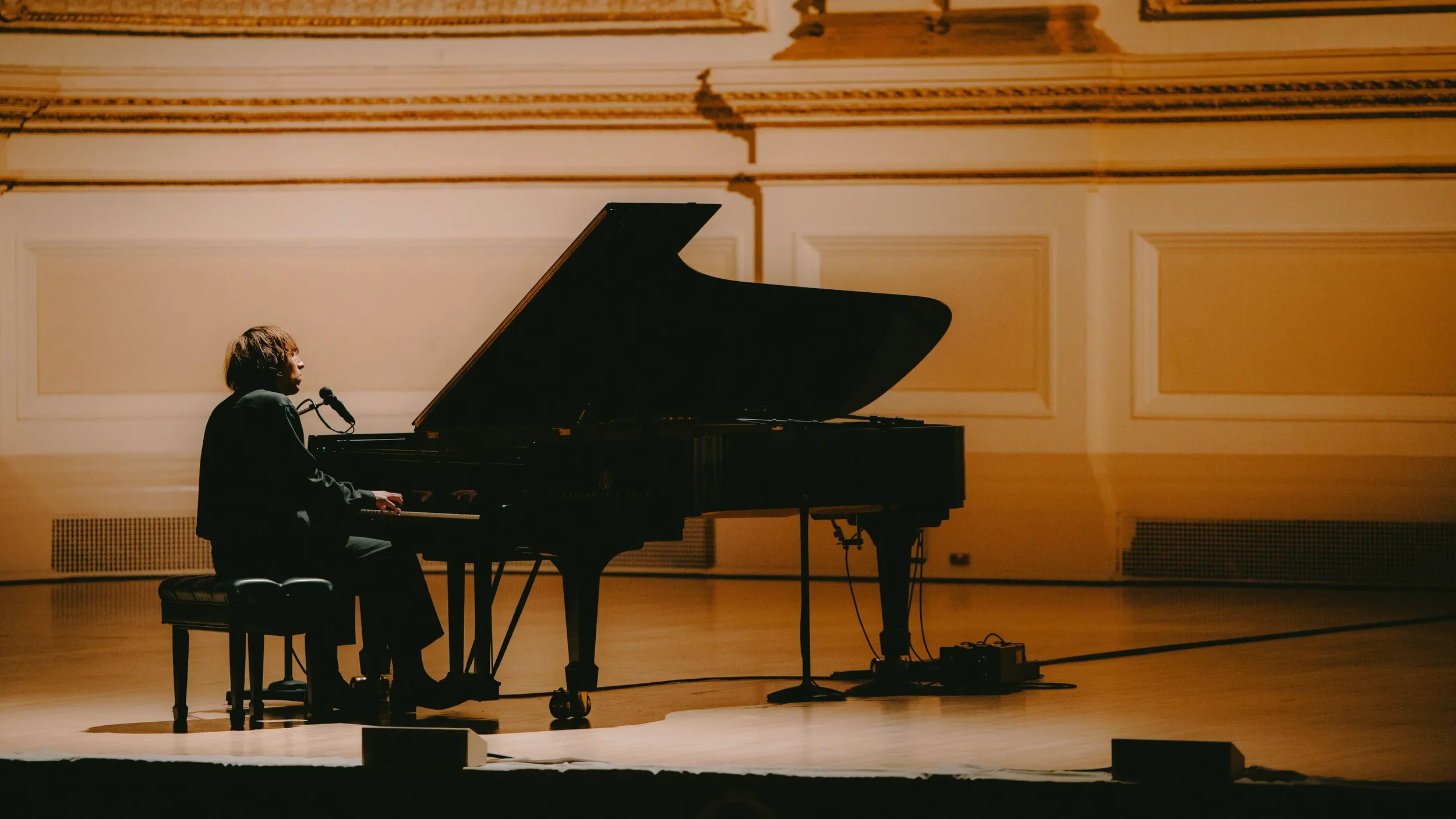
As Cameron takes his curtain call, “Cameron Winter at Carnegie Hall: Dead at 23” drapes across the screen. Even if it was unintentional to draw some focus to how young the musician is, they still did it. 23 years young and you’ve managed to captivate an audience of 3,000 — alongside countless cinemas across the country, some of which may have 8-year-olds reluctantly dragged by elders only to be introduced to a whole new side of music and movies. And with Paul Thomas Anderson, a director who needs no more feathers in cap, he manages to swivel his career trajectory in unexpected ways. But with this project, he took the concert documentary aesthetic, and made a Paul Thomas Anderson movie. I brushed up on my favorite techniques used by the filmmaker, like his use of glare and sunbursts and shifting between in-and-out of focus, and recognized that the film bears all the makings of a PTA classic. At disparate ages and career stages, two artists put their brains together and made something that’s truly and unequivocally unforgettable. Now we all can embrace it, and you can, just as I did 14 years ago, “take it with you when you leave” and carry the events on in real time, and craft a relationship with music, film and self-expression.