
“You see how this looks, right?”: ‘Primetime’ and the Ethics of Spectacle
Before I’d even seen Primetime, Lance Oppenheim’s recent release chronicling the legacy of NBC’s To Catch a Predator, I could see the backlash coming from a mile away. Oppenheim embraces the “show, don’t tell” maxim of storytelling onscreen: his previous documentaries – works like Ren Faire (2024), Some Kind of Heaven (2020), and Spermworld (2024) – tell stories seemingly untainted by him as a director, without any apparent fourth wall for him to break. In other words, Oppenheim doesn’t tend to spoon-feed his audience any intended message: he lays it out on a platter and waits for you to wander over and pick at it. That’s the job of shows like Predator, anyway.
For some, the message has proven confusing indeed: “Promotes the worst people in the world. A miss by A24”, one Letterboxd user wrote with their two-star rating. “Hollywood, making a movie depicting a predator catcher as an insane person,” writes another, “I mean, you see how this looks, right?”
The consensus of Primetime misanthropes online seems to amount to the same sentiment: that the crux of this story is the phenomenon of pedophilia itself, the ugliness that lays the foundation for a show like Predator. Alongside these criticisms, Robert Pattinson’s parodic performance of Chris Hansen is misinterpreted as a complete condemnation of crime-fighting itself. But Oppenheim’s film doesn’t ask its audience to pick a side in some great war between the pro- and anti-pedophilia camps; nowhere does it laud or protect its depicted pedophiles. What it is asking us to do is to regard the larger cycles of violence that Predator helped to preserve – and to consider that we, as audience members, might be complicit too.

As my colleague Ali El-Sadany identifies in his own writing on Primetime, the film is a veritable period piece, set starkly in the year 2006 – and 2006 is everywhere. El-Sadany notes that the film is stitched together with
[P]ieces of the media circus of Saddam’s trial, the reporting of the Iraq invasion, zero-dark-thirty adjacent raids, and War on Terror money turning suburban police into an armored column for a TV shoot. War abroad became reality TV at home, and reality TV at home became war abroad. It all operated at the exact same programming altitude.
We’re plopped into the cultural climate of the mid-aughts, one that encompasses spectacles like the Saddam trial and the co-occurring advent of the demotic turn as defined by Graeme Turner. Reality TV was pitching its tent in the American media landscape, and Predator was one of many (though it was aired under the guise of being news media, it more closely resembles early reality programming than it does a legitimate news segment). Unlike some of its kin, Predator does not promise some version of the American dream by way of participating in its pageantry: programming like American Idol and America’s Next Top Model promised stardom, Survivor and Big Brother promised wealth and glory, and The Simple Life and Laguna Beach provided aspirations of upper-class life to its audience. (I appreciated the Cash Cab reference in the film, present for a moment on a crew member’s hoodie – a show where you can be randomly picked to earn gobs of cash.) Instead, Predator offers the fulfillment of a desire that dates beyond the establishment of America itself: to witness the punishment of a criminal, to see someone get what you think they deserve. The exploitation occurs solely for the imagined benefit of the audience.
The formula is simple: the Perverted Justice team bait a potential predator behind-the-scenes by posing as a pre-teen online, and when the man shows up for a rendez-vous, he’s greeted by Chris Hansen and confronted by cameras. If the man tries to escape, he’s tackled by law enforcement waiting in the wings. In the line of fire are two decoy actors, Dan (Skylar Gisondo) and Del (Phoebe Bridgers), who pose as children over the phone and at the door. The predators who show up looking for sex from a child are rudely awakened, and viewers feel safer for having a face to assign to the phenomenon.
Chris Hansen’s job, regardless of the who and why, is to orchestrate the public humiliation of predators – and to profit from it. The fictional Hansen says so himself when he drunkenly compares Predator to the town pillory. So when our host is approached by tabloid media to answer for his sins – fit with ineffable evidence of his infidelity, just as Hansen approaches his subjects with records of their messages – the camera is turned around on him. This is the first cycle of violence we see in Primetime: the self-appointed hero earns a taste of his own medicine by facing the scrutiny of tabloid media. While the tabloid machine is perhaps less legitimized than Hansen’s show with news media window dressing, its function in Primetime is essentially the same: to pinpoint, publicize, and profit from the bad behavior of others.
This film isn’t a means by which to weigh two immoralities against each other; we’re not being asked to consider adultery as equal to pedophilia, or to list the reasons why one is worse than the other. We’re given an opportunity to consider the common denominator in these parallel cases: the spectacle being made of individual punishment.
There’s a cyclical ugliness in how grooming itself, the essential act which makes the show possible, is represented in Primetime, too. Grooming broadly refers to the process of coercion or manipulation that occurs in the context of a power imbalance. From social experience, that imbalance can amount to an age or status discrepancy, for example – sometimes, the concept is used beyond situations involving an underage victim to describe any relationship that seems formed on unequal ground. In a sense, the film portrays the grooming that occurs as curiously two-directional: the predators believe they’re speaking with a pre-teen, when in reality they’re conversing with a crew of adults dedicated to luring and trapping them.
Grooming has an effect within the production, too, as best evidenced by Decoy Dan. The 23-year old, eager to earn his SAG card, feels that he’s bitten off more than he can chew when he’s confronted by a penis covered in whipped cream (and without a puka shell necklace, even). Hansen and his producer Andie (Merritt Wever) set out to retain him and avoid triggering an H.R. event through a series of intimate gestures meant to placate him. This manifests in the gradual infantilization of Dan – Andie speaks to him as a mother does a child, rustling his hair and gushing soothing platitudes: “You did greaaaaat! You were amaaaaaazingggggg!”; Hansen plays catch with him and compares him to his young son. In the scene where Dan interrupts a tense moment between Hansen and Andie at the airport for gum money, the trio seem more like a nuclear family than ever: Dan is an oblivious kid gleefully interrupting an adult argument.
At the same time, the primary relationship in Dan’s life separate from the production is with Troy (Eric Rahill), a friend who assumes the task of preparing him for his role as a prepubescent boy. Through this Rocky-style training process, their relationship becomes increasingly homosocial: Troy insists that Dan remains “nubile”, and his inquiry into his friend’s masturbation habits lands with very little cushioning. Dan is ostensibly the audience’s point of access into the narrative – he’s the character plopped into the pandemonium of Predator as we are into the story of Primetime. It’s significant, then, that we see these influences as integral to Dan’s character. He’s being made to feel like a child and sexualized all at once.
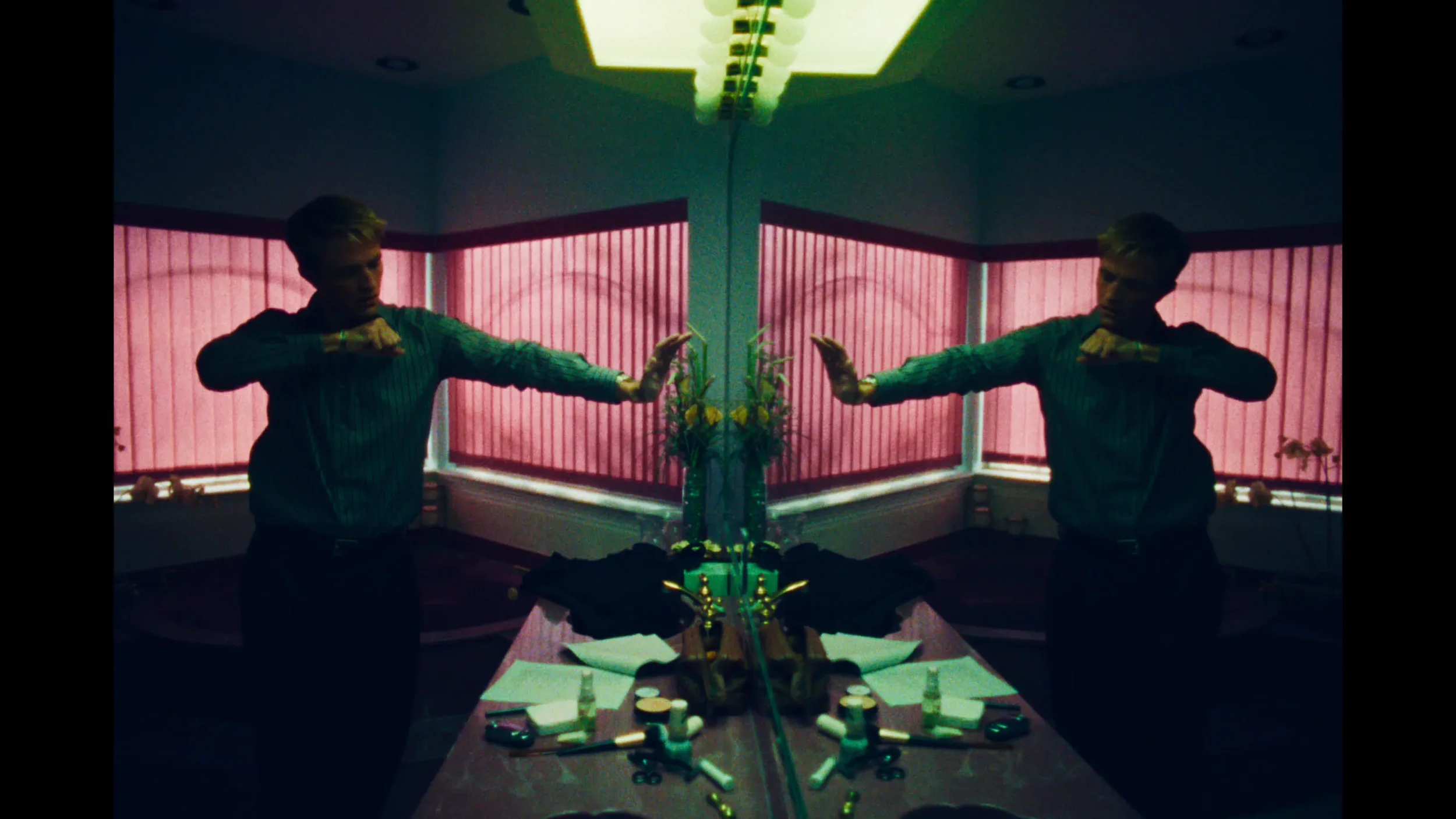
What emerges from the analysis of these two cycles of violence — the first being a reflection of a media market turning toward an exploitation economy, and the second being the mechanisms of coercion that surround the production – is a thorough and effective criticism of what happens when we embrace public punishment as a fundamentally valuable spectacle, a necessary function of society. The former can’t exist without the latter; there’s nobody to exploit without the process of objectification that reality TV subjects undergo. To Catch a Predator, in Oppenheim’s telling, did not destroy the evil it broadcasted – it repackaged it.
Today, there exists an entire genre of copycat Predator content online, streamers and creators who broadcast their own amateur sting operations with, shall we say, sometimes less finesse than Hansen. This New York Times analysis from Aric Toler and Neil Bedi recounts the work of one popular creator known as realjuujika, whose trademark is to show footage of his targets’ credit card numbers. These creators are wildly popular, especially among young people online. In early 2025, a group of teenagers in Massachusetts – themselves admittedly inspired by this cache of content – infamously lured, filmed, and attacked a 22-year old who showed up expecting to meet an 18-year old. Many of these amateur stings have resulted in suicides, too: a member of the group Dads Against Predators wrote that “We don’t count arrests and catches, we count bodies.”
The problem of child sexual abuse has emerged more than ever before in recent years, perhaps beginning with the Wayfair conspiracy theory of yore. Maybe we can see the light being shed on this as a reaction to the collective suppression of it for so long: silence is what allows these terrible things to occur, and I agree that it’s ideal for us to foster an environment in which the effects of pedophilia are no longer ignored but actively prevented. But it seems that our society is only able to grapple with this injustice within the framework of the spectacle, and that’s in large part due to To Catch a Predator. Would these content creators do the same work without an audience? Would Chris Hansen?
In my encounters with negative reviews of Primetime, I’ve noticed a recurring question: “What’s the point of this movie?”. The point is ever-present in the mutated media market of today. The effects of To Catch a Predator are everywhere in our surveillance-forward world – the show promises to protect us by filming the bad guys, just like Flock cameras do.
The point of Primetime is not to further investigate the predators in the show. It’s to further investigate the very thing between the spectacle and its audience: the camera.