
‘Teenage Sex and Death at Camp Miasma’ Is a Postmodern Playground, But Tread Carefully
Being “less real” is what makes Jane Schoenbrun’s Teenage Sex and Death at Camp Miasma so stunning. So when I call Schoenbrun’s film Brechtian, it’s like opening a bottomless can of worms; it’s a claim that tacks on more questions the deeper you go. My English-major brain is drawn to these jargony concepts. It’s an intrinsic thrill and curiosity I first felt in college. Taking classes on psychoanalysis, reading Žižek and Lacan and Freud opened the floodgates — and also helped with opening that aforementioned can of worms. Within the sweeping paradigm of critical theory, Brechtian art – named for playwright and poet Bertolt Brecht, can reshape a drama’s outline, jolting you out of the story at points. It reminds the audience what’s before their eyes is not real but a constructed reality: out the window goes the classic Greek tragedy, Aristotle-adjacent poetics and all those cliché codes for wow-ing and immersing an audience, this is Jane’s game now!
Teenage Sex and Death at Camp Miasma opens with, well, death: a murderous scene as Tarantino-esque blood geysers gush into the sky like beacons of gore. A montage reflects on the maligned reputation of the Camp Miasma series: old newspaper headlines and dusty merchandise reveal a series failed from waning fandom and poor sequels. But, in an attempt to rekindle any specks of nostalgia, a young filmmaker and “Sundance wunderkind” named Kris (Hannah Einbinder) is entrusted with reviving the series. Kris functions as a poster child for the Gen Z creative; her progressive ideologies are useful to studio executives. We then follow Kris’s journey to the site of the series’s original film where, upon arrival, the film disengages from reality and drops the viewer into a constructed set. The place, Camp Tivoli, strays from reality as it simmers in a pot of Brecht’s theories. Carving its own beaten path — one that’s shrouded in artifice — the camp steeps in a world of hyperreality. You can say Tivoli is one with its sister town, Dogville, Colorado, a la von Trier.
Camp Tivoli is a candy-colored, highly saturated wallpaper enclosure with as much realism as the clouded walls of Seahaven (setting of The Truman Show). Suddenly, you’ve stepped out of reality and into the movies. Kris walks through the campgrounds and finds the reclusive Billy Presley (Gillian Anderson) — the lead in the original film. Her Miasma character fits the peg as a classic female stereotype in film: a “final girl,” a “damsel in distress,” a “manic pixie dream girl.” Yet, the real Billy Presley is not what she seems, enamoring Kris’s fangirly side. She’s angelic, living in the camp amongst the heirlooms and trinkets that define her long-gone prime. But fear and death are merely dramatized in this fake movie-world.
For Schoenbrun, this fake world reveals what reality can obscure: the depression, the loneliness, the need for love. Camp Tivoli is a stage for the cinematic and personal desires of Kris and Billy. Through its lack of connection with the real world, it’s constructed to be a place of limitless possibilities. Technical qualities underline this disconnect even more so: when Kris and Billy first embrace in front of an iridescent, snowscaped green screen, the frame rate drops as if you are watching a film projection. Schoenbrun resigns us from this cohesive — and beautiful — queer love story, reminding us Tivoli is only a film set. I found the bright wallpaper and glittery filters to be an escape from reality, and a cathartic one at that. The joy of “Escape” aligns with Kris and Billy’s wants — they seek out imaginary worlds as there are no other places less resistant to change. The only plane free from external judgment is the one in our minds.

As characters, Kris and Billy pose a divide between the traditions of new and old Hollywood. Kris harps on the blatant transphobia in the early Miasma films, which center on the antagonist, Little Death (Jack Haven): they were a camper ostracized for being queer, and their vengeful killing spree leads to the film’s climax. Billy is seen having sex when she is the final girl murdered by Little Death. Kris confesses the voyeuristic arousal she gets from watching said scene. She recognizes that playing the role of another — the inescapable victim, a mode of life independent of herself — exposes a brewing horniness.
Kris, like myself and many more, watches movies to escape. The film’s denouement tracks Kris’s thirst for this experience, unraveling her layers of insecurity and liberal Hollywood shell. What’s revealed is both a cinematic and primal goal: having sex and getting killed… and having it turned into a movie. Miasma is a film about exposing artifice, recognizing everything happening is only a recording — giving the viewer permission to reach for our deepest desires. The result is the jarring impression that cinema is a lie, a gorgeous photograph obstructing a plastic nucleus; something overly preachy controlling our emotions and fueling stakes — but, in the end, it’s just a proxy. As Orson Welles announces at the start of F for Fake, “What we professional liars hope to serve is truth. I’m afraid the pompous word for that is ‘art.’” Miasma’s first line might as well be “please remain seated for the duration of the performance.”
Miasma clings to forms of surrealism reminiscent of the David Lynch canon. For instance, Mulholland Drive’s overly dramatic performances and in-your-face Hollywood backdrops warp it into a literal melodrama, and let us not forget the emcee’s words at Club Silencio: “It is an illusion”. Other similarities lie in the smaller, more tactile objects – the visuals of Little Death, specifically the air vent atop their head, marked by a hole in its center; the faceless hole appears as an endless void. Mulholland Drive ensnares the minds of its protagonists with the blue box and its Little Death-like keyhole. Through the keyhole of the blue box or the center of the air vent we bear witness to the lumbering effects of banishment — or “the abject,” to echo French literary critic Julia Kristeva. At the bottom of each hole are these slanted personas: in Miasma, Little Death is first an innocent camper admonished due to their gender fluidity; in Mulholland Drive, Betty is a migrating Ontarian with starlet dreams squashed by the moral decrepitude of Hollywood. Kristeva’s writing neatly defines two opposing poles of human emotion: joy and despair. Betty, through the blue keyhole, and Little Death, through the air vent hole, house these “abject” personalities. Here, they are both defined by their despair, feeding a desire for retaliation.
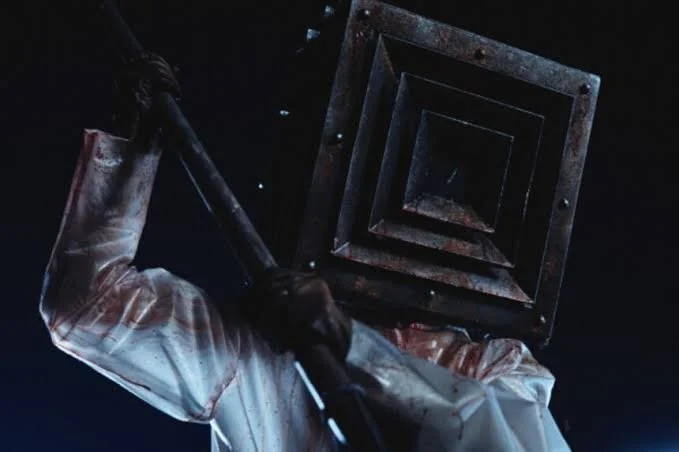
Little Death from ‘Teenage Sex and Death at Camp Miasma’
Along similar lines, “the abject” version of these characters are what live in these artificial settings: the green screens of L.A. backlots, the Camp Tivolis. But when they retreat from reality, these hostile identities remain. Even if Little Death and Betty play disparate roles in their respective stories, they become entrenched in the transition from the impassioned self to the abject other; the person to the actor; the real to the fake.
By the end of the film, Kris has made the complete transition to the abject other. Remember: it is all an illusion. Death is not death here— in a movie, when the director yells “cut,” everything reverts back to equilibrium. Camp Miasma never really leaves equilibrium. If it’s all just mockery, and the characters know they live within movie-land, there is no fatality, no finality. Anyone can do anything.
My experience with Jane Schoenbrun’s fearlessness relates to the early psychoanalytic research I did as a freshman in college. An ingenious English professor of mine at Tufts University, Lee Edelman, introduced me to critical theory via Alienation Effect by Bertolt Brecht and Powers of Horror by Julia Kristeva. These core texts supply the tools of embracing art’s endless interpretive breadth. It powered a line of reasoning that I had yet to discover. Through Professor Edelman, I gained the strength to question what, in cinema, is real and fake. Witnessing Teenage Sex and Death at Camp Miasma was a return to that artfully inquisitive jungle gym. Dissecting art beyond what is “the explicit” provides tangible feeling and connection. At least for myself, Schoenbrun’s work is the perfect meal: it evokes nostalgia for those experiences as both joyful and complex. I can only hope it lives on, in all its charm, long after the cameras cut and the actors go home. Good afternoon, good evening and goodnight.