
‘The Invite’ Invites Us To Explore the Relationships Between Ourselves
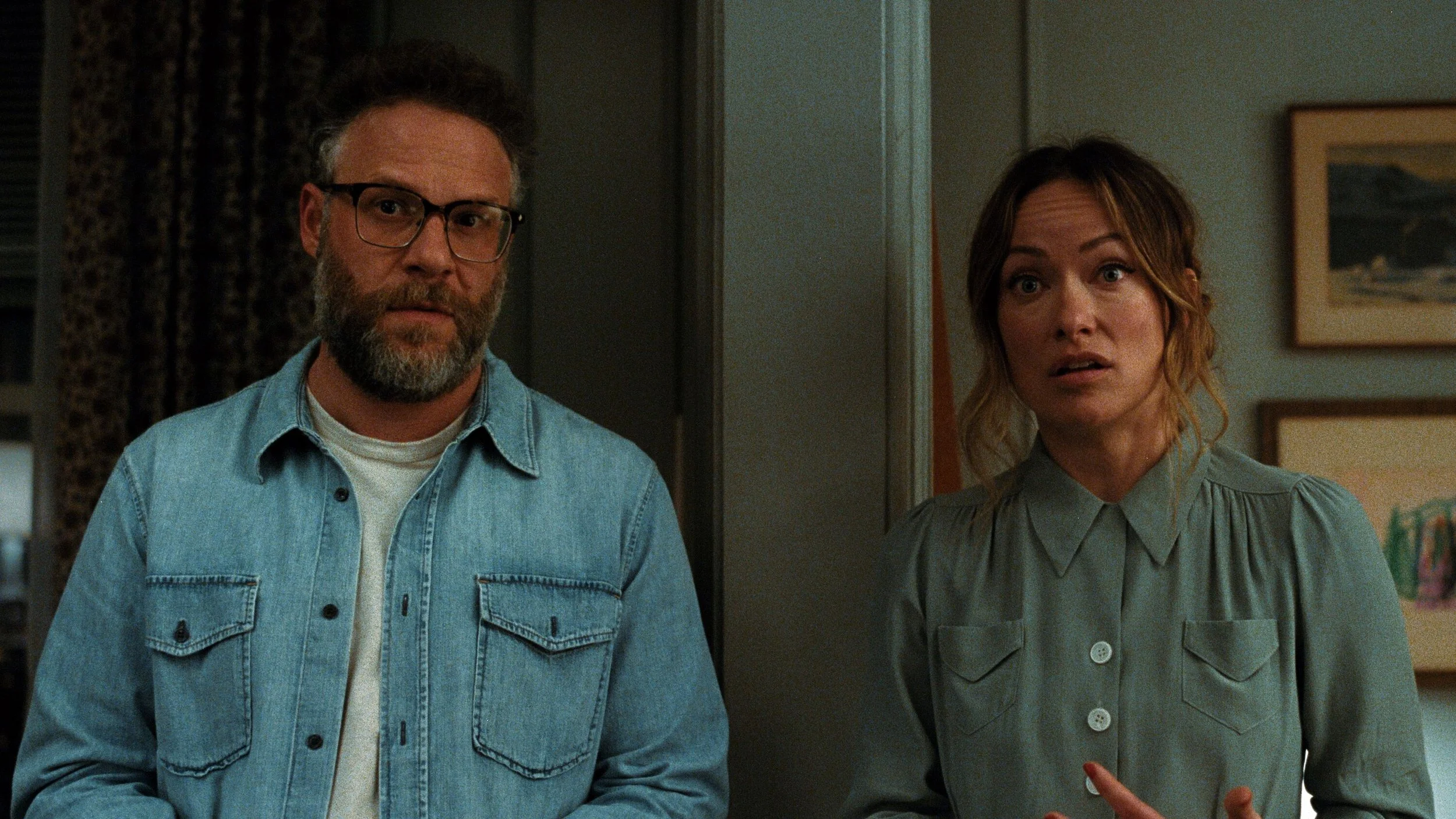
Mirrors are haunting. Their purpose is to provide us with a reflection of ourselves; it's the only way we know what we look like, what we lack, who we are. Much like mirrors, relationships provide us with a reflection of ourselves. They show us who we are and what we like. Marriages lead to a blend of the things that made you an individual. You start using each other's phrases, start picking up idiosyncrasies that you love in a partner. All the good that couples see in each other oozes out. However, just as mirrors can bring out the things we lack, so do relationships. It's not direct. It builds up, little resentments that pile up. They don't pile up because of what the other person did but because nobody knows you better than that one other person. Nobody knows who you are, who you were and who you can be better than your partner. In The Invite, Olivia Wilde dissects a marriage hanging on by a thread. Angela and Joe (played by a stellar Wilde and an equally great Rogen) are presented with what they perceive is a perfect couple in Peena and Hawk (Penelope Cruz and Edward Norton, both electric). We don't fully understand what frustrations our unhappy couple face, but the tension is palpable from the moment you see them share the screen. We've seen our parents, hell even ourselves, engage in this dance of "I don't want to do this" vs. "We are going to do this." Perhaps that's why the audience reaction has felt so visceral. I've seen the film twice, and both times there were audible groans, whispered "cmon's," and hysterical laughter. It's a film that lives within tonal transitions with such ease you'd forget this is only Wilde's third time directing.
In lesser hands than Wilde's the film doesn't land as well, or reads as ultimately too positive. The way that she moves the camera across the screen, slowly, quickly, tracking each character at certain moments, allows us to question what exactly is happening in each of the characters' heads. Wilde's use of mirrors throughout the film, particularly in the first half, is reflective of the film's thesis. If partners are meant to reflect us, what happens when we see something we don't recognize? Both Angela and Joe are often captured through a reflection, allowing us to see the subtle moments of anguish and awkwardness each experiences.
The reflection I see in the mirror makes me recoil. It's an image of someone who didn't quite achieve everything he thought he was going to but isn't sure who to blame, he's lazy but can do a good job if he cares enough. The feeling generated by that image takes over when dealing with interpersonal conflict in my life. I'd be lying if I didn't cringe at certain scenes in the film. It felt like watching my parents, seeing a discussion about the perils of a foldable bike become the catalyst for yelling and pouting. One thing is used to justify the anger the other has and lives with. It's fear that informs a lot of how I deal with interpersonal conflict. I don't shy away from it, but I'm always trying to couch the words so that it never feels like an attack, something along the lines of "Hm, well I think we should think more before making decisions." I still struggle to not feel attacked. It's an almost instinctual deflection that occurs. That lazy, disinterested oaf becomes defensive, attempting to justify his disinterest and laziness. When I take the moment to think about why I'm feeling that way, it's almost always because of an insecurity. When that happens, I have a choice to make: double down in frustration or address the insecurity. I think that's what makes relationships hard in the first place. Relationships require us to constantly reevaluate the small choices we make day in, day out. I will never be the perfect idealized version I have of myself but that's part of the agreement in a relationship. I know my own partner will push me to be the best version of myself and vice versa. It can be frustrating at times, but that's because it's easier to give up and stop trying to be anything other than what's comfortable. She's trying to get me to see the version she sees in the mirror.
It's hard to decouple Wilde's own relationship history from the film; her relationship with Jason Sudeikis feels like the skeleton key to her understanding of her own character and Seth Rogen's too. Where Sudeikis felt like an up-and-coming star in the mid-2010s and now he's solely known for Ted Lasso, Rogen's character had a huge hit in his youth and is now just a music teacher at a great school. It's not a bad life but probably not the one that was imagined. Wilde's career ran on the periphery in a similar way, more visible than his but never appreciated for her talent. Her work in the 2013 film Drinking Buddies comes to mind. There's a certain level of emotional catharsis that's felt through the screen, in the loud and quiet moments. The most obvious is when Peena and Hawk compliment her interior design work and Angela is on the verge of tears because of the appreciation. It's stark. For the entirety of the film prior to this moment, we've seen Joe's dismissiveness over the same topic. It felt like a reminder of where long term relationships often find themselves, a lack of appreciation, and a lack of recognition. Wilde understands that things often get left unsaid, boiling under each person's skin until all that's left is a pressure cooker of a relationship looking for any escape.
It's not just Wilde and Rogen's characters though. Behind the sultry, loving relationship that exists between Peena and Hawk lies tension. Their relationship slowly gets cut through by the toxicity of their hosts. It's a noticeable contrast with Angela and Joe, but nevertheless frustration rises to the top and we get to see how that couple deals with conflict. The contrast is sharp and you understand why this movie is resonating with so many of us.
Hawk has a monologue towards the end of the film. It's both heartbreaking and confusing, and you don't quite understand the point until Joe (rudely) cracks a joke over it. Relationships aren't just about you, there's another person involved with hopes, dreams, and desires. That person needs you as much as you need them. You can't be a better partner, a better parent, a better person, when you don't want to be a better you. It all compounds from there. That's why mirrors are haunting, they don't let us escape what's in front of us, and neither do our loved ones.