
Giving an Ancient Epic a Modern Voice in Christopher Nolan’s ‘The Odyssey’
My father spent much of his childhood at a boarding school in Northern Pakistan, where, for reasons still somewhat unclear, old American Westerns were screened late in the evenings to keep hyperactive students occupied. A dreamer by nature, my young, curly-headed dad watched cowboys riding across expansive, vast landscapes and decided that, one day, he would move to America and become one himself. Just over 60 years later, his life is pretty close: living in Western Canada, on a farm where we are surrounded by vast expanses of agricultural crops. Those films offered him a world larger than the one he knew, and, in doing so, quietly reshaped the course of his life.
This is the feeling that draws me to Christopher Nolan’s The Odyssey. An adaptation of one of the oldest surviving works of Western literature, the film is built around a larger-than-life story that has endured for nearly three thousand years — a swords-and-sandals journey defined by gods, monsters, warfare and the longing for home. Yet Nolan’s greatest challenge is not simply bringing Homer’s epic to the screen, but instead is capturing the sense of greatness and wonder that allowed the poem to survive across generations. And he does it. Well.
Like the Westerns that inspired my father, The Odyssey is a story of vast landscapes and impossible journeys. It is nothing if not grand. In an era when much of cinema has become increasingly intimate and contained, Nolan’s return to epic storytelling reflects a belief in the enduring power of spectacle — the idea that sometimes we need films that remind us how small we are, while also making us feel connected to something timeless. The Odyssey returned me to that feeling of awe. The feeling of sitting in a theatre and being overwhelmed by something larger than yourself. The feeling of being a child again, slack-jawed and wide-eyed, staring at a grand world.
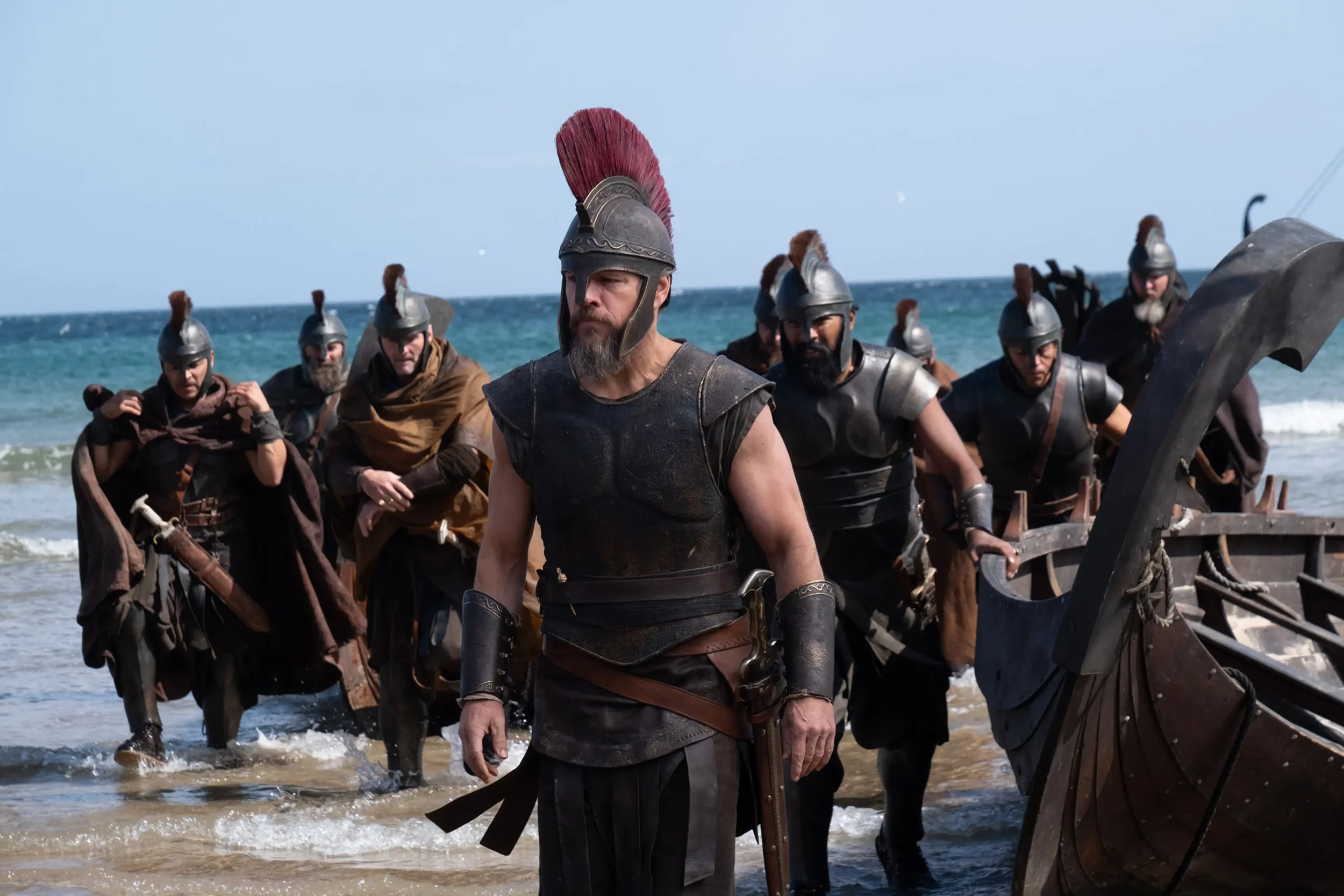
That feeling of awe is also shaped by the physical experience of watching the film. By the size of the image, the architecture of the theatre and the communal silence of an audience drawn into the same spectacle. That raises an obvious question: does the format matter?
Nolan has long been an advocate for large-format filmmaking, arguing that the physical scale of the image is an essential part of the theatrical experience. I wrote this piece after viewing the film three times. Once on opening night in IMAX 70mm. Once in regular 2D format, and then once more in IMAX 70mm. While my usual theatre-going habits may occasionally drift into extravagance, I was able to justify this indulgence in the name of research for this article. Consider this my official defence. I made these three trips to the cinema so that you, the reader, would not have to. In other words, you’re welcome.
Opening night in IMAX 70mm may be my favourite theatre experience I have ever had. The anticipatory hush of the crowd as a not-seen-before preview of Denis Villeneuve’s Dune: Part Three played was incredible. And once The Odyssey started? Not a single peep. No phone scrolling. No loud commentary. No vapes being hit right beside me (please, ask me about my Backrooms theatre experience). Just fully locked-in film watching.
I have spent considerable time thinking about the accessibility of that experience. My perspective is shaped by the privilege of living in a city with a theatre capable of projecting IMAX 70mm, as well as having the disposable income to indulge in such a luxury. The reality is that many audiences will not have access to this particular format, whether because of location, cost or availability. However, I do not believe the solution is to limit filmmakers who want to work at this scale. The responsibility should fall on exhibition companies and IMAX itself to expand access to these experiences, not on filmmakers and artists to shrink their ambitions. Despite the attention given to the 41 IMAX 70mm theatres worldwide, The Odyssey cannot only be seen in those venues. Nolan released the film broadly, and while there is certainly something special about the large-format presentation, I think the film is worth watching in whatever format is available and accessible to you. The experience may vary, but the sense of awe at the heart of the film does not disappear with a smaller screen.
Still, spectacle alone cannot carry a film. Once the initial astonishment settles, what remains are the choices Nolan makes as a storyteller. And, not all of them land with equal force. I found the final parts of Odysseus’ journey home to feel somewhat checklist-like, as though it were racing to ensure every remaining episode of the myth received its moment on screen. I understand the limitations — as much as I would love to sit through a five-hour, extended cut, I recognize I may be in the minority. But, the compression occasionally comes at the expense of emotional weight. Additionally, if I were to be nitpicky, I found myself wishing for more of Odysseus' mischievous side, something translator Emily Wilson also notes in her review “An Uncomplicated Man.” We see flashes of it — most notably in his determination to hear the Sirens' song — but I wanted Nolan to embrace the morally gray trickster more. The Cyclops encounter, in particular, feels like an opportunity to really foreground Odysseus' cunning over his physical heroism. Instead of highlighting Odysseus' wit, to me the scene reads more as an escape from danger than a triumph of deception. Nolan is clearly drawn to the burdened, flawed hero. I only wish he had made more room for the playful deceiver as well.
One of the more interesting aspects of The Odyssey’s casting is the sheer amount of star power Nolan brings together. For the most part, I found the celebrity presence surprisingly unobtrusive. Matt Damon, Anne Hathaway, Tom Holland, and even Travis Scott all bring recognizable personas with them, but these rarely overpower their characters. Damon’s reputation as a leading man works well for Odysseus, allowing the audience to immediately understand the weight carried by a legendary figure. And though heavily critiqued, I found Holland’s youthful energy complementary to Telemachus’ uncertainty and sense of discovery. In fact, I find the familiarity of these performers often works in the film’s favour. When paired with modern dialogue, they give audiences an accessible entry point into a story that is thousands of years old. The challenge with casting recognizable actors in a mythological world is whether viewers see the character or the celebrity — and for most of the film, Nolan successfully maintains that balance.
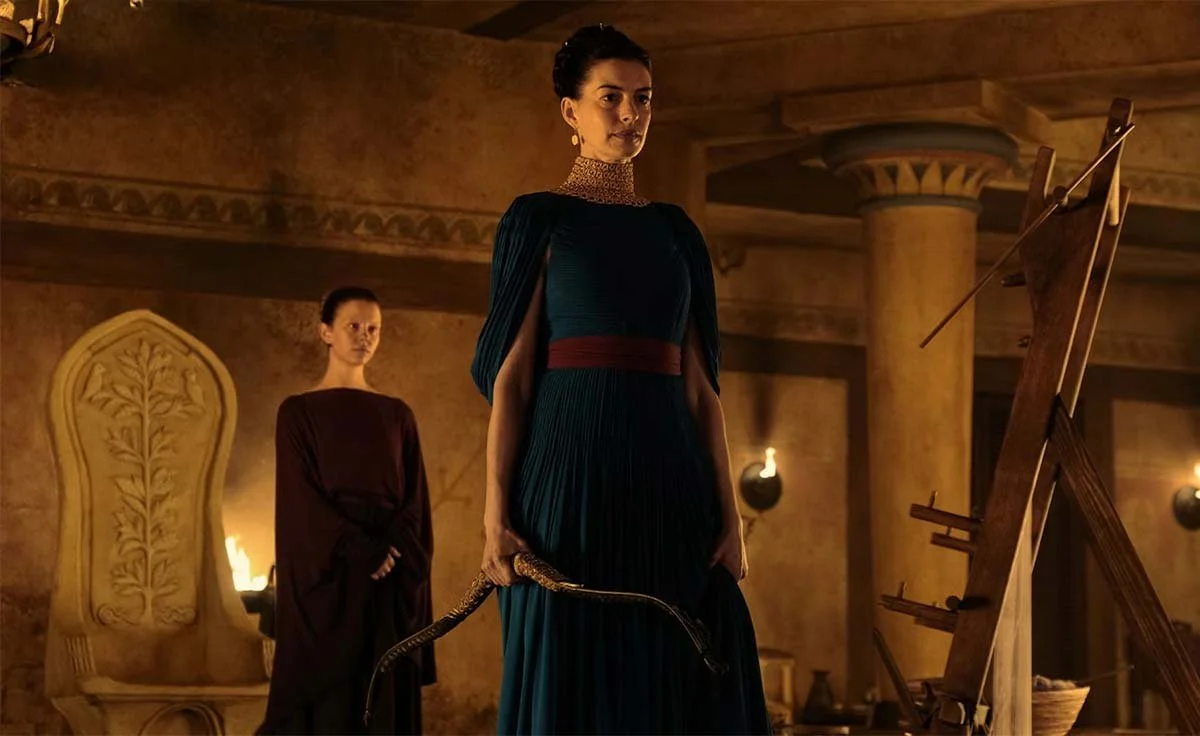
The one exception for me was Charlize Theron, playing Calypso. Her casting never clicked for me. Rather than disappearing into the mythology, she often felt like she had wandered on set from a luxury perfume advertisement, ready to sell me something. The performance is undeniably elegant, but that polished, highly stylized presence occasionally distracted from the ancient world Nolan was attempting to create. However, whatever reservations I had about individual creative choices, they were consistently outweighed by my admiration for how the film was made.
From 60-foot puppets to actors breathing through snorkels while buried beneath the earth in Hades, the making of The Odyssey feels like a love letter to practical filmmaking. Nolan’s commitment to physical sets and real locations reflects a belief in the value of creating something tangible in an increasingly digital world. As someone who loves the process of filmmaking, there is something deeply exciting about seeing a production embrace the idea that movies are made through collaboration and the act of physically bringing an imagined world into existence. The Odyssey reminds me why filmmaking is such a magical process in the first place. The possibility that a group of people can gather together and transform an impossible idea, one of ancient gods and forgotten worlds, into something real is inspiring. It makes me excited about filmmaking.
It is tempting, when examining Nolan’s fascination with the “great man,” to turn the question back toward the filmmaker himself. Nolan has built a career around qualities often associated with his protagonists: technical mastery and an unwavering, ambitious pursuit. His commitment to large-scale filmmaking and practical effects reflects a filmmaker who is interested in preserving a particular vision of what cinema can be.
Yet Nolan’s films don’t present greatness as an uncomplicated achievement. His exceptional figures are often isolated by their ambitions, burdened by the consequences of their choices, and forced to confront the limits of their own abilities. In this sense, Nolan’s interest in greatness seems less like admiration of superiority and more like an examination of its costs. His characters are compelling because they are caught between the desire to accomplish something extraordinary and the human limitations that prevent them from ever fully escaping themselves.
This makes The Odyssey a particularly revealing addition to his filmography. Odysseus’ brilliance and flaws are inseparable. Nolan appears drawn to the idea that greatness is defined by the tension between extraordinary ability and ordinary human weakness. Considering Nolan’s own status as one of the most influential filmmakers working today, it raises an unavoidable question. When he repeatedly returns to stories about exceptional individuals struggling with ambition and sacrifice, is he examining a universal human desire for greatness — or is Nolan, consciously or unconsciously, reflecting on his own place within that tradition?