
Faith and Doubt in the Newest ‘Knives Out’
There’s no right way to believe in a higher power. In Wake Up Dead Man, Rian Johnson explores the many different ways that people find themselves faced with their own personal crisis of faith. As in the previous two entries, there is a large ensemble cast, except this time their faith and loyalty to the Church ties them all together. It makes Benoit Blanc’s inclusion into their lives particularly thorny. Blanc’s relationship with the Church sets us up for a film that is interested in what the Church is and what it should be.
Religion deals with its fair share of fanaticism, luckily Rian Johnson is familiar with the worst qualities fanaticism can offer. His last film project that wasn’t Knives Out was the most reviled Star Wars film since Episode I. The unwarranted blow back following The Last Jedi led Rian Johnson to Knives Out, a series where he’s got full control and leeway to explore themes and genres that most interest him. Despite their success, the previous two Knives Out both feel like a reaction. Not to a moment, but to a type of person, specifically Never Trump Republicans / moderates, Elon Musk, and fellow tech bros who plague and pillage society. It was funny and it worked for a time. But the struggles of Glass Onion are evident when Johnson’s frustrations are fully exposed through Benoit Blanc’s monologues.
Fortunately, Johnson has seemingly recognized how his own personal disdain hurt the character. Johnson still uses Blanc as his proxy, but instead of using him as a conduit for his animosity towards caricatures, he uses Blanc to present to us his views on faith. Johnson’s clearly a doubter, a non-believer. Whether it's doubt in the institution or in the concept of a higher being itself, it doesn’t matter. It’s a universal experience, we’ve all been faced with moments in our life that have tested our faith or changed our faith.
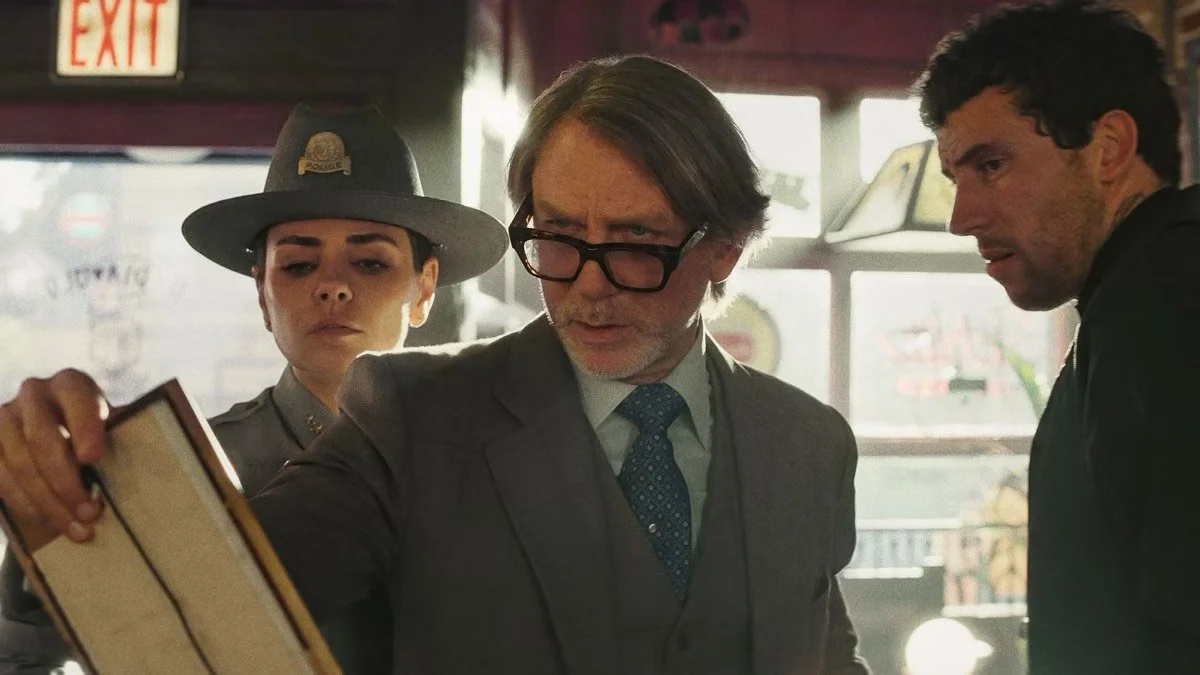
Josh O’Connor’s Reverend Jud Duplenticy represents someone whose faith lacks any cynicism, it lacks any doubt. His faith exists and persists because he’s been saved. The salvation he found through God has given him his new purpose — to help those who need, whenever they may need it. O’Connor approaches that with a level of sincerity that borders on saccharine. In the film’s best scene, Reverend Duplenticy halts the investigation, taking hours to talk to a member of the town who’s not a member of the church. She doesn’t attend mass, but she needs his help. And that’s what the Reverend does. He sits and prays with her in her time of need.
The audience is forced to stop, sit, and digest a moment that doesn’t solve the mystery at the heart of the story. At first it felt like an unnecessary tangent, grinding the story to a halt at such a critical moment. But once I let myself be absorbed by the scene, I recognized myself in it. When things become hard, when we need answers, what do we all do? We go and ask God for help. It might feel odd to only reach out when in need, but there’s no right way to have faith. The entire movie hinges on this scene’s credibility. It serves as an inflection point in the film. Benoit’s resolve and belief in logic as the be all, end all becomes sidelined. He’s a character whose faith has left him and he finds himself in circumstances where his lack of faith is tested as well.
The test of faith often feels like a universal experience. I’ve come across many people in my life who’ve lost it completely, who’ve lost it and regained it, and who’ve stayed true to their faith their whole life. I’ve found myself facing that test my whole life. I didn’t do Sunday school, but I did receive baptism and communion. I loved the church, so much so that I wanted to be a priest. As the years went by, and as life got harder for my family, I would sit and wonder, “Why was this happening to us? What did we do?” I was angry—how could I not be? Every day seemed like God was testing our family’s ability to do anything. The situations didn’t feel fair, we were good people after all. As a kid, that’s enough to push someone away. Years later, in college, I was able to reconnect with my faith. My perspective changed. I saw how my mother, through all of our struggles, never wavered in her faith. I saw my fellow classmates use the church as a way to bring them closer to community. That perspective continued to evolve during my time in graduate school in Natchitoches, Louisiana.
Natchitoches is a small town, but the people of the town made sure that the whole city was closed until after Sunday mass. Everyone knew each other and everyone knew what each wanted from God that day, month or year. There wasn’t any judgment. There was an unspoken rule: faith isn’t questioned. You might find yourself wanting to do so. But even if the reason for their faith may sound ridiculous, you didn’t question it. The base of their faith is built on that reason. It was a learning moment, I can catch myself slipping, just like Blanc.
After Ole Miss won the Egg Bowl a couple weeks ago, Lane Kiffin gave an interview where he was asked if he had decided to leave Ole Miss for LSU as it had been rumored since the LSU job became available. He said, “No, I haven't. I've got a lot of praying to do to figure that out tomorrow." I initially found the statement a bit ridiculous. Kiffin is best known for leaving a program in the middle of the night and for getting fired on a tarmac — why did he need to talk to God? Now, I recognize that while I may think he lacks sincerity, his faith is sincere to him.
Johnson recognizes his own hesitation towards faith and the various motivations behind them. He surrounds Blanc with characters whose faith can be questioned. However, instead of diving in and dissecting these people, instead of revealing them all to be phonies, he pivots. Johnson’s focus on Reverend Duplenticy and Benoit Blanc drives the characters to the side, and creates a much more focused film than the previous Knives Out installment. Johnson’s interest isn’t in the institution of the Church. Frankly, neither is mine. His interest lies in the questions of faith. He dares to ask us: Is our faith stubborn? Do we use faith as a foundation for our grudges, intending to keep us righteous and judge others? Johnson gives us his answer through the final scenes between the Martha (Glenn Close) character and Reverend Duplenticy. The sincerity of her beliefs, and her conviction to those beliefs impact the entire film and in essence provide the answers to the questions posed by Johnson.
Everyone has a story of when they dealt with a crisis of faith. Sometimes, we find our way back, other times we don’t. The reason for those crises can range from the most personal to the most inconsequential. We’re currently living in a moment where people’s faith may be waning. The socio-political climate in the United States over the course of the year has led to increasingly difficult moments for immigrant families. People are afraid to leave their house, afraid to live their lives. What keeps them going? Why aren't they drowning in despair? Because they believe that God will help them through this. Faith is powerful. Faith, like Reverend Duplenticy believes, is the light that helps guide us in the hard, dark moments.